



 Chat with AI
Exam 16: Pricing Strategy

Exam 1: Economics: Foundations and Models234 Questions
Exam 2: Trade-Offs, Comparative Advantage, and the Market System258 Questions
Exam 3: Where Prices Come From: the Interaction of Demand and Supply242 Questions
Exam 4: Economic Efficiency, Government Price Setting, and Taxes208 Questions
Exam 5: Externalities, Environmental Policy, and Public Goods263 Questions
Exam 6: Elasticity: the Responsiveness of Demand and Supply295 Questions
Exam 7: The Economics of Health Care171 Questions
Exam 8: Firms, the Stock Market, and Corporate Governance264 Questions
Exam 9: Comparative Advantage and the Gains From International Trade188 Questions
Exam 10: Consumer Choice and Behavioral Economics300 Questions
Exam 11: Technology, Production, and Costs328 Questions
Exam 12: Firms in Perfectly Competitive Markets296 Questions
Exam 13: Monopolistic Competition: the Competitive Model in a More Realistic Setting274 Questions
Exam 14: Oligopoly: Firms in Less Competitive Markets259 Questions
Exam 15: Monopoly and Antitrust Policy279 Questions
Exam 16: Pricing Strategy261 Questions
Exam 17: The Markets for Labor and Other Factors of Production281 Questions
Exam 18: Public Choice, Taxes, and the Distribution of Income258 Questions
Select questions type


Which of the following will prevent firms from engaging in price discrimination?
(Multiple Choice)
4.9/5  (81)
(81) To successfully price discriminate, a firm must ensure that there are no opportunities for arbitrage.
(True/False)
4.9/5 (88)
(88) Which of the following statements about perfect price discrimination is false?
(Multiple Choice)
4.7/5 (74)
(74) Which of the following antitrust laws forbade firms to engage in price discrimination if the effect would lessen competition or create a monopoly?
(Multiple Choice)
4.9/5 (70)
(70) Which of the following are necessary conditions for successful price discrimination?
A.zero transactions costs
B.a perfectly competitive market structure
C.an imperfectly competitive market structure
D.at least two different markets with different price elasticities of demand
E.at least two different markets with different price elasticities of supply
(Multiple Choice)
4.8/5 (80)
(80) Figure 16-2
 Plato Playhouse, a theatre company in the university town of Wegg, caters to two groups of customers: students and the non-student population.Figure 16-2 shows the demand curves for the two groups of customers.
-Refer to Figure 16-2.Suppose Plato Playhouse charges a single price of Pd for each performance.Which of the following statements is true?
Plato Playhouse, a theatre company in the university town of Wegg, caters to two groups of customers: students and the non-student population.Figure 16-2 shows the demand curves for the two groups of customers.
-Refer to Figure 16-2.Suppose Plato Playhouse charges a single price of Pd for each performance.Which of the following statements is true? (Multiple Choice)
4.9/5 (86)
(86) An optimal two-part tariff pricing schedule maximizes consumer surplus.
(True/False)
4.8/5 (85)
(85) Figure 16-5
 -Refer to Figure 16-5.Suppose the firm represented in the diagram decides to practice perfect price discrimination.What is the profit-maximizing price it will charge?
 (Multiple Choice)
4.9/5 (94)
(94) Many people sell goods through eBay at prices that are higher than the prices they paid for these goods.Economists consider these transactions as
(Multiple Choice)
4.9/5 (84)
(84) Assume that a monopolist practices perfect price discrimination.The firm's marginal revenue curve will
(Multiple Choice)
4.9/5 (77)
(77) Figure 16-7
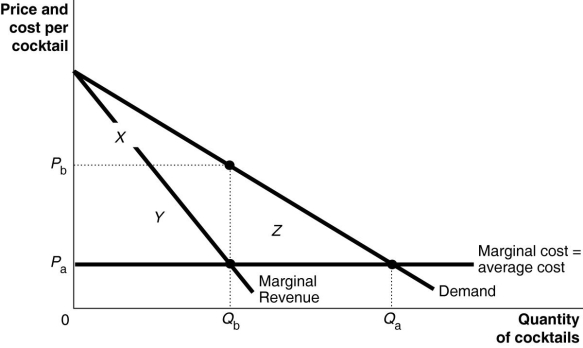 The Lizard Lounge is well known for its exotic cocktails.Figure 16-7 shows its estimated demand curve for cocktails.
-Refer to Figure 16-7.The owners of the Lizard Lounge are considering the following four pricing options:
A.A single price scheme where the price of cocktails equals the monopoly price.
B.A single price scheme where the cocktail price equals the competitive price.
C.A two-part tariff: a monopoly price for cocktails and a cover charge that will generate total revenue equal to the area X.
D.A two-part tariff: a competitive price for cocktails and a cover charge that will generate total revenue equal to the area X + Y + Z.
Which scheme will earn the largest profit?
The Lizard Lounge is well known for its exotic cocktails.Figure 16-7 shows its estimated demand curve for cocktails.
-Refer to Figure 16-7.The owners of the Lizard Lounge are considering the following four pricing options:
A.A single price scheme where the price of cocktails equals the monopoly price.
B.A single price scheme where the cocktail price equals the competitive price.
C.A two-part tariff: a monopoly price for cocktails and a cover charge that will generate total revenue equal to the area X.
D.A two-part tariff: a competitive price for cocktails and a cover charge that will generate total revenue equal to the area X + Y + Z.
Which scheme will earn the largest profit? (Multiple Choice)
4.9/5 (82)
(82) If, at the firm's projected sales level, the marginal cost is $40, the average cost is $50 and the markup is 30 percent, then its selling price is
(Multiple Choice)
4.9/5 (70)
(70) Figure 16-2
Plato Playhouse, a theatre company in the university town of Wegg, caters to two groups of customers: students and the non-student population.Figure 16-2 shows the demand curves for the two groups of customers.
-Refer to Figure 16-2.Suppose Plato Playhouse price discriminates.Which of the following statements is true?
Plato Playhouse, a theatre company in the university town of Wegg, caters to two groups of customers: students and the non-student population.Figure 16-2 shows the demand curves for the two groups of customers.
-Refer to Figure 16-2.Suppose Plato Playhouse price discriminates.Which of the following statements is true? (Multiple Choice)
4.9/5 (69)
(69) Figure 16-3
 Chantal owns a hairdressing salon which caters to two main groups of customers: residents of "The Chateau," a retirement community, and other residents in the neighborhood.Figure 16-3 shows the demand curves for the residents of the retirement community, labeled Market A, and other residents in the neighborhood, labeled Market B.The demand curves are not identical.
-Refer to Figure 16-3.What prices are charged in the two markets?
Chantal owns a hairdressing salon which caters to two main groups of customers: residents of "The Chateau," a retirement community, and other residents in the neighborhood.Figure 16-3 shows the demand curves for the residents of the retirement community, labeled Market A, and other residents in the neighborhood, labeled Market B.The demand curves are not identical.
-Refer to Figure 16-3.What prices are charged in the two markets? (Multiple Choice)
4.8/5 (61)
(61) Cost-plus pricing is a reasonable way to determine the optimal price when
(Multiple Choice)
4.7/5 (80)
(80) 
Filters
- Essay(0)
- Multiple Choice(0)
- Short Answer(0)
- True False(0)
- Matching(0)