



 Chat with AI
Exam 5: The Behavior of Interest Rates

Exam 1: Why Study Money, banking, and Financial Markets109 Questions
Exam 2: An Overview of the Financial System143 Questions
Exam 3: What Is Money99 Questions
Exam 4: The Meaning of Interest Rates107 Questions
Exam 5: The Behavior of Interest Rates165 Questions
Exam 6: The Risk and Term Structure of Interest Rates116 Questions
Exam 7: The Stock Market, the Theory of Rational Expectations, and the Efficient Market Hypothesis101 Questions
Exam 8: An Economic Analysis of Financial Structure96 Questions
Exam 9: Banking and the Management of Financial Institutions148 Questions
Exam 10: Economic Analysis of Financial Regulation100 Questions
Exam 11: Banking Industry: Structure and Competition138 Questions
Exam 12: Financial Crises48 Questions
Exam 13: Central Banks and the Federal Reserve System71 Questions
Exam 14: The Money Supply Process218 Questions
Exam 15: Tools of Monetary Policy123 Questions
Exam 16: The Conduct of Monetary Policy: Strategy and Tactics116 Questions
Exam 17: The Foreign Exchange Market133 Questions
Exam 18: The International Financial System115 Questions
Exam 19: Quantity Theory, inflation and the Demand for Money112 Questions
Exam 20: The Is Curve130 Questions
Exam 21: The Monetary Policy and Aggregate Demand Curves29 Questions
Exam 22: Aggregate Demand and Supply Analysis108 Questions
Exam 23: Monetary Policy Theory58 Questions
Exam 24: The Role of Expectations in Monetary Policy31 Questions
Exam 25: Transmission Mechanisms of Monetary Policy62 Questions
Exam 26: Financial Crises in Emerging Market Economies21 Questions
Exam 27: The ISLM Model99 Questions
Select questions type


Everything else held constant,when households save less,wealth and the demand for bonds ________ and the bond demand curve shifts ________.
(Multiple Choice)
4.8/5  (75)
(75) Of the four effects on interest rates from an increase in the money supply,the one that works in the opposite direction of the other three is the
(Multiple Choice)
5.0/5 (86)
(86) Everything else held constant,when stock prices become ________ volatile,the demand curve for bonds shifts to the ________ and the interest rate ________.
(Multiple Choice)
4.8/5 (87)
(87) Using the liquidity preference framework,what will happen to interest rates if the Fed increases the money supply?
(Essay)
4.9/5 (76)
(76) In recent years in Europe,Japan,and the United States,interest rates have remained low because of a combination of
(Multiple Choice)
4.9/5 (66)
(66) Use the following figure to nswer the question :
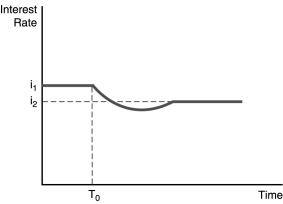 -The figure above illustrates the effect of an increased rate of money supply growth at time period T0. From the figure,one can conclude that the
 (Multiple Choice)
4.9/5 (74)
(74) 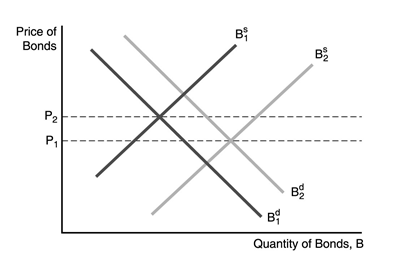 - In the figure above,a factor that could cause the demand for bonds to decrease (shift to the left)is
 (Multiple Choice)
4.8/5 (80)
(80) If the interest rate on a bond is above the equilibrium interest rate,there is an excess ________ for bonds and the bond price will ________.
(Multiple Choice)
4.8/5 (96)
(96) Holding everything else constant in the market for money,as the interest rate rises,the opportunity cost of holding money ________ thus making money less desirable. So the quantity of money demanded falls.
(Multiple Choice)
4.8/5 (74)
(74) Use the following figure to answer the question :
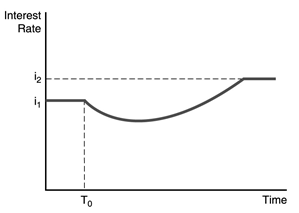 -Interest rates increased continuously during the 1970s. The most likely explanation is
 (Multiple Choice)
5.0/5 (84)
(84) Higher government deficits ________ the supply of bonds and shift the supply curve to the ________,everything else held constant.
(Multiple Choice)
4.9/5 (92)
(92) An increase in an asset's expected return relative to that of an alternative asset,holding everything else constant,________ the quantity demanded of the asset.
(Multiple Choice)
4.8/5 (73)
(73) The bond supply and demand framework is easier to use when analyzing the effects of changes in ________,while the liquidity preference framework provides a simpler analysis of the effects from changes in income,the price level,and the supply of ________.
(Multiple Choice)
4.9/5 (85)
(85) Everything else held constant,if the expected return on U.S. Treasury bonds falls from 8 to 7 percent and the expected return on corporate bonds falls from 10 to 8 percent,then the expected return of corporate bonds ________ relative to U.S. Treasury bonds and the demand for corporate bonds ________.
(Multiple Choice)
4.8/5 (82)
(82) In contrast to the CAPM,the APT assumes that there can be several sources of ________ that cannot be eliminated through diversification.
(Multiple Choice)
4.8/5 (70)
(70) A decrease in the brokerage commissions in the housing market from 6% to 5% of the sales price will shift the ________ curve for bonds to the ________,everything else held constant.
(Multiple Choice)
4.8/5 (68)
(68) The risk of a well-diversified portfolio depends only on the ________ risk of the assets in the portfolio.
(Multiple Choice)
4.7/5 (75)
(75) In the market for money,when the Fed ________ the money stock,the money supply curve shifts to the ________ and the interest rate ________,everything else held constant.
(Multiple Choice)
4.7/5 (87)
(87) 
Filters
- Essay(0)
- Multiple Choice(0)
- Short Answer(0)
- True False(0)
- Matching(0)