



 Chat with AI
Exam 14: Oligopoly: Firms in Less Competitive Markets

Exam 1: Economics: Foundations and Models240 Questions
Exam 2: Trade-Offs, Comparative Advantage, and the Market System258 Questions
Exam 3: Where Prices Come From: the Interaction of Demand and Supply242 Questions
Exam 4: Economic Efficiency, Government Price Setting, and Taxes208 Questions
Exam 5: Externalities, Environmental Policy, and Public Goods262 Questions
Exam 6: Elasticity: the Responsiveness of Demand and Supply293 Questions
Exam 7: The Economics of Health Care171 Questions
Exam 8: Firms, the Stock Market, and Corporate Governance261 Questions
Exam 9: Comparative Advantage and the Gains From International Trade188 Questions
Exam 10: Consumer Choice and Behavioral Economics304 Questions
Exam 11: Technology, Production, and Costs327 Questions
Exam 12: Firms in Perfectly Competitive Markets297 Questions
Exam 13: Monopolistic Competition: the Competitive Model in a272 Questions
Exam 14: Oligopoly: Firms in Less Competitive Markets257 Questions
Exam 15: Monopoly and Antitrust Policy279 Questions
Exam 16: Pricing Strategy258 Questions
Exam 17: The Markets for Labor and Other Factors of Production279 Questions
Exam 18: Public Choice, Taxes, and the Distribution of Income258 Questions
Select questions type


Table 14-8
 Two rival oligopolists in the coffee industry, Wide Awake and Zuma, have to decide on their pricing strategy. Each can choose either a high price or a low price. Table 14-8 shows the payoff matrix with the profits that each firm can expect to earn depending on the pricing strategy it adopts.
-Refer to Table 14-8.If the two firms collude, is there an incentive for either to cheat on the collusion agreement?
Two rival oligopolists in the coffee industry, Wide Awake and Zuma, have to decide on their pricing strategy. Each can choose either a high price or a low price. Table 14-8 shows the payoff matrix with the profits that each firm can expect to earn depending on the pricing strategy it adopts.
-Refer to Table 14-8.If the two firms collude, is there an incentive for either to cheat on the collusion agreement? (Multiple Choice)
4.9/5  (67)
(67) All of the following are examples of oligopolistic markets except
(Multiple Choice)
4.8/5 (69)
(69) Figure 14-2
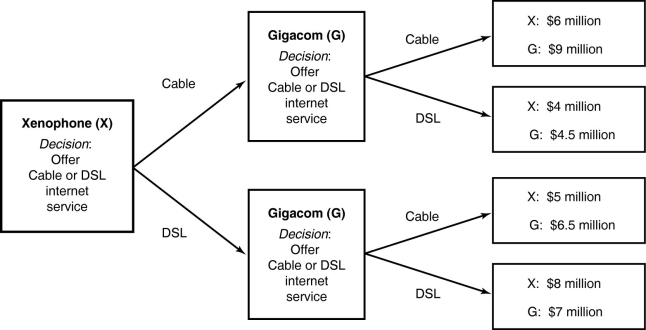 The government of a developing country plans to award two firms, Gigacom and Xenophone, the exclusive rights to share the market for high speed Internet service. Gigacom and Xenophone can both provide the service either via television cable lines or via direct subscriber line (DSL). Suppose the government is considering a proposal to delay one firm's entry into the market on the grounds that it wants to prevent "harmful" competition. Figure 14-2 shows the decision tree for this game.
-Refer to Figure 14-2.Now suppose that the government delays Xenophone's entry and Gigacom moves first, what is the likely outcome in the market?
The government of a developing country plans to award two firms, Gigacom and Xenophone, the exclusive rights to share the market for high speed Internet service. Gigacom and Xenophone can both provide the service either via television cable lines or via direct subscriber line (DSL). Suppose the government is considering a proposal to delay one firm's entry into the market on the grounds that it wants to prevent "harmful" competition. Figure 14-2 shows the decision tree for this game.
-Refer to Figure 14-2.Now suppose that the government delays Xenophone's entry and Gigacom moves first, what is the likely outcome in the market? (Multiple Choice)
4.9/5 (76)
(76) The value of the four-firm concentration ratio that many economists consider indicative of the existence of an oligopoly in a particular industry is
(Multiple Choice)
4.8/5 (75)
(75) The approach economists use to analyze competition among oligopolists is called
(Multiple Choice)
4.8/5 (77)
(77) Hewlett-Packard will not raise the prices of its personal computers without first considering how Dell might respond.This is evidence of
(Multiple Choice)
4.7/5 (84)
(84) According to the textbook, of all barriers to entry, the most important are those that are due to
(Multiple Choice)
4.8/5 (87)
(87) Because of the flaws of the concentration ratio as a measure of the extent of competition in an industry, some economists prefer another measure of competition, the Herfindahl-Hirschman Index.
(True/False)
5.0/5 (84)
(84) We can draw demand curves for firms in perfectly competitive and monopolistically competitive industries, but not for oligopoly firms.The reason for this is
(Multiple Choice)
4.7/5 (82)
(82) Figure 14-8
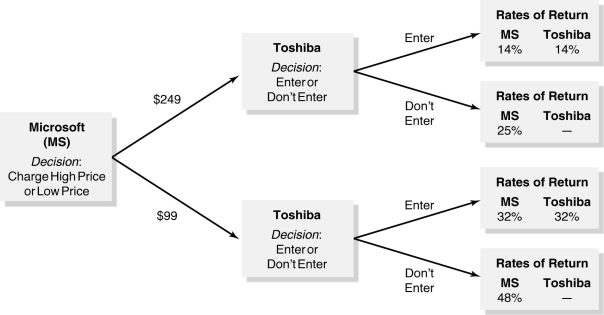 -Refer to Figure 14-8 Use the decision tree to determine whether Microsoft should deter Toshiba from entering the market for ergonomic wireless keyboards.Assume that each firm must earn a 20% return on investment to break even.Explain Microsoft's decision process.
 (Essay)
4.8/5 (76)
(76) Which government agency publishes four-firm concentration ratios?
(Multiple Choice)
4.8/5 (82)
(82) What is a sequential game? How are decision trees used to analyze sequential games?
(Essay)
5.0/5 (85)
(85) Figure 14-2
The government of a developing country plans to award two firms, Gigacom and Xenophone, the exclusive rights to share the market for high speed Internet service. Gigacom and Xenophone can both provide the service either via television cable lines or via direct subscriber line (DSL). Suppose the government is considering a proposal to delay one firm's entry into the market on the grounds that it wants to prevent "harmful" competition. Figure 14-2 shows the decision tree for this game.
-Refer to Figure 14-2.If the government delays Gigacom's entry and Xenophone moves first, is a threat by Gigacom that it will provide DSL service if Xenophone provides cable service a credible threat?
The government of a developing country plans to award two firms, Gigacom and Xenophone, the exclusive rights to share the market for high speed Internet service. Gigacom and Xenophone can both provide the service either via television cable lines or via direct subscriber line (DSL). Suppose the government is considering a proposal to delay one firm's entry into the market on the grounds that it wants to prevent "harmful" competition. Figure 14-2 shows the decision tree for this game.
-Refer to Figure 14-2.If the government delays Gigacom's entry and Xenophone moves first, is a threat by Gigacom that it will provide DSL service if Xenophone provides cable service a credible threat? (Multiple Choice)
4.9/5 (81)
(81) On January 2, 1971, all cigarette advertising was banned on U.S.television and radio stations.Assuming that advertising is a prisoner's dilemma, and that if one company advertises, its competitors will also choose to spend money to advertise, did this ban likely increase or decrease the profits of cigarette companies in 1971? Briefly explain.
(Essay)
4.7/5 (74)
(74) Table 14-3
 Suppose OPEC has only two producers, Saudi Arabia and Ecuador. Saudi Arabia has far more oil reserves and is the lower-cost producer compared to Ecuador. The payoff matrix in Table 14-3 shows the profits earned per day by each country. "Low output" corresponds to producing the OPEC assigned quota and "high output" corresponds to producing the maximum capacity beyond the assigned quota.
-Refer to Table 14-3.What is the Nash equilibrium in this game?
Suppose OPEC has only two producers, Saudi Arabia and Ecuador. Saudi Arabia has far more oil reserves and is the lower-cost producer compared to Ecuador. The payoff matrix in Table 14-3 shows the profits earned per day by each country. "Low output" corresponds to producing the OPEC assigned quota and "high output" corresponds to producing the maximum capacity beyond the assigned quota.
-Refer to Table 14-3.What is the Nash equilibrium in this game? (Multiple Choice)
4.7/5 (83)
(83) The DeBeers Company of South Africa was able to block competition through
(Multiple Choice)
4.7/5 (85)
(85) OPEC periodically meets to agree to restrict the cartel's oil output, and yet almost every member of OPEC produces more than its own output quota.This suggests that OPEC has
(Multiple Choice)
4.8/5 (78)
(78) An entry barrier exists when firms in an industry charge the lowest price possible for their products.
(True/False)
4.8/5 (85)
(85) Who won a Nobel Prize in economics for his work in the development of game theory?
(Multiple Choice)
4.8/5 (76)
(76) 
Filters
- Essay(0)
- Multiple Choice(0)
- Short Answer(0)
- True False(0)
- Matching(0)