



 Chat with AI
Exam 4: Economic Efficiency, Government Price Setting, and Taxes

Exam 1: Economics: Foundations and Models240 Questions
Exam 2: Trade-Offs, Comparative Advantage, and the Market System258 Questions
Exam 3: Where Prices Come From: the Interaction of Demand and Supply242 Questions
Exam 4: Economic Efficiency, Government Price Setting, and Taxes208 Questions
Exam 5: Externalities, Environmental Policy, and Public Goods262 Questions
Exam 6: Elasticity: the Responsiveness of Demand and Supply293 Questions
Exam 7: The Economics of Health Care171 Questions
Exam 8: Firms, the Stock Market, and Corporate Governance261 Questions
Exam 9: Comparative Advantage and the Gains From International Trade188 Questions
Exam 10: Consumer Choice and Behavioral Economics304 Questions
Exam 11: Technology, Production, and Costs327 Questions
Exam 12: Firms in Perfectly Competitive Markets297 Questions
Exam 13: Monopolistic Competition: the Competitive Model in a272 Questions
Exam 14: Oligopoly: Firms in Less Competitive Markets257 Questions
Exam 15: Monopoly and Antitrust Policy279 Questions
Exam 16: Pricing Strategy258 Questions
Exam 17: The Markets for Labor and Other Factors of Production279 Questions
Exam 18: Public Choice, Taxes, and the Distribution of Income258 Questions
Select questions type


Table 4-2
 -Refer to Table 4-2.The table above lists the highest prices five consumers are willing to pay for a theater ticket.If the price of one of the tickets is $18,
 (Multiple Choice)
5.0/5  (74)
(74) Figure 4-3
 Figure 4-3 shows the market for tiger shrimp. The market is initially in equilibrium at a price of $15 and a quantity of 80. Now suppose producers decide to cut output to 40 in order to raise the price to $18.
-Refer to Figure 4-3.At a price of $18 consumers are willing to buy 40 pounds of tiger shrimp.Is this an economically efficient quantity?
Figure 4-3 shows the market for tiger shrimp. The market is initially in equilibrium at a price of $15 and a quantity of 80. Now suppose producers decide to cut output to 40 in order to raise the price to $18.
-Refer to Figure 4-3.At a price of $18 consumers are willing to buy 40 pounds of tiger shrimp.Is this an economically efficient quantity? (Multiple Choice)
4.9/5 (72)
(72) If the price of chewing gum is represented by P in equation P = 25 - 0.5 Qᴰ, then the corresponding quantity of chewing gum demanded is represented by the demand equation
(Multiple Choice)
4.8/5 (72)
(72) Article Summary
Voters in California approved a $2 per pack tax increase on cigarettes, which went into effect on April 1, 2017. Cigarette taxes are now $2.87 per pack in California, the ninth highest cigarette tax in the country. Approximately one-in-nine adults in California are smokers, and the tax increase is estimated to generate almost $1.4 billion in revenue during the first year, with the revenue designated for the state-run health care plan as well as various state-wide anti-smoking campaigns.
Source: Andrew Blake, "Cigarette tax hike takes effect in California, costs surge by $2 per pack," Washington Times, April 1, 2017.
-Refer to the Article Summary.The additional tax of $2 per pack of cigarettes will have which of the following effects on the market for cigarettes in California?
(Multiple Choice)
4.9/5 (92)
(92) Figure 4-7
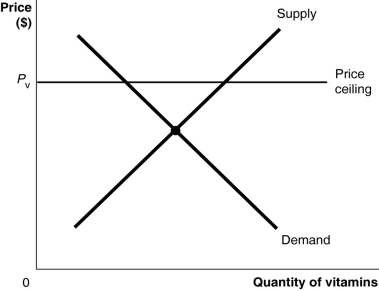 -Refer to Figure 4-7 which shows the market for vitamins.Suppose the government imposes a price ceiling of Pᵥ.How will the price ceiling affect the quantity supplied, quantity demanded, and quantity exchanged?
 (Essay)
5.0/5 (81)
(81) What is the difference between a price ceiling and a price floor? Compared to the competitive equilibrium price, where must price ceilings and price floors be set to have an effect on the market?
(Essay)
4.7/5 (79)
(79) In New York City, government limits on the supply of taxis resulted in a price ________ the competitive market level, which would typically ________ economic efficiency.
(Multiple Choice)
5.0/5 (76)
(76) Figure 4-4
 -Refer to Figure 4-4.The figure above represents the market for pecans.Assume that this is a competitive market.If the price of pecans is $9, what changes in the market would result in an economically efficient output?
 (Multiple Choice)
4.8/5 (80)
(80) Producer surplus is the difference between the lowest price a firm is willing to accept for a product and the price it actually receives for the product.
(True/False)
4.9/5 (62)
(62) Using a supply and demand graph, illustrate the effect of the addition of a $10.00 per-unit unit tax on digital cameras, where the entire tax burden falls on the seller.Assume the equilibrium price before the tax is $125 and the equilibrium quantity is 50,000.What happens to the price and quantity after the tax is implemented?
(Essay)
4.9/5 (80)
(80) Suppose that in Canada the government places a $1,500 tax on the buyers of new snowmobiles.After the purchase of a new snowmobile, a buyer must pay the government $1,500.How would the imposition of the tax on buyers be illustrated in a graph?
(Multiple Choice)
4.7/5 (74)
(74) Figure 4-8
 Figure 4-8 shows the market for beer. The government plans to impose a per-unit tax in this market.
-Refer to Figure 4-8.What is the size of the per-unit tax?
Figure 4-8 shows the market for beer. The government plans to impose a per-unit tax in this market.
-Refer to Figure 4-8.What is the size of the per-unit tax? (Multiple Choice)
4.7/5 (82)
(82) In a city with rent-controlled apartments, all of the following are true except
(Multiple Choice)
4.8/5 (88)
(88) 
Filters
- Essay(0)
- Multiple Choice(0)
- Short Answer(0)
- True False(0)
- Matching(0)