



 Chat with AI
Exam 12: Monetary Policy

Exam 1: Economics: Foundations and Models160 Questions
Exam 2: Choices and Trade Offs in the Market192 Questions
Exam 3: Where Prices Come From: the Interaction of Demand and Supply201 Questions
Exam 4: Gdp: Measuring Total Production, Income and Economic Growth123 Questions
Exam 5: Economic Growth, the Financial System and Business Cycles132 Questions
Exam 6: Long-Run Economic Growth: Sources and Policies118 Questions
Exam 7: Unemployment120 Questions
Exam 8: Inflation110 Questions
Exam 9: Aggregate Expenditure and Output in the Short Run138 Questions
Exam 10: Aggregate Demand and Aggregate Supply Analysis134 Questions
Exam 11: Money, Banks and the Reserve Bank of Australia123 Questions
Exam 12: Monetary Policy116 Questions
Exam 13: Fiscal Policy163 Questions
Exam 14: Macroeconomics in an Open Economy141 Questions
Exam 15: The International Financial System145 Questions
Select questions type


One goal of monetary policy (according to the Reserve Bank Act (1959))is:
(Multiple Choice)
4.8/5  (90)
(90) Explain the consequences of expansionary monetary policy if the economy was close to, or at, potential GDP level.
_____________________________________________________________________________________________
_____________________________________________________________________________________________
(Essay)
4.8/5 (80)
(80) Suppose the following table illustrates the values of real and potential GDP and the price level, if the Reserve Bank of Australia (RBA)does not change their current policy to be more contractionary or expansionary. Suppose that the RBA uses an appropriate policy and is successful in keeping real GDP at its potential level in 2018.
 State whether each of the following will be higher or lower than if the RBA had taken no action:
a.Real GDP.
b.Potential GDP.
c.The price level.
d.The unemployment rate.
_____________________________________________________________________________________________
_____________________________________________________________________________________________
State whether each of the following will be higher or lower than if the RBA had taken no action:
a.Real GDP.
b.Potential GDP.
c.The price level.
d.The unemployment rate.
_____________________________________________________________________________________________
_____________________________________________________________________________________________ (Essay)
4.8/5 (76)
(76) Refer to Figure 12.3 for the following question.
Figure 12.3
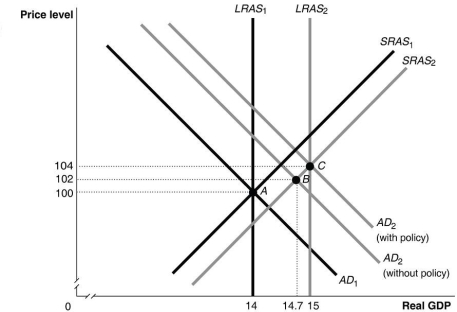 -Refer to Figure 12.3. In this figure, suppose the economy in Year 1 is at point A and expected in Year 2 to be at point B. Which of the following policies could the Reserve Bank of Australia use to move the economy to point C?
 (Multiple Choice)
4.8/5 (82)
(82) What economic objectives are the Reserve Bank of Australia required to pursue in its conduct of monetary policy and what relative importance is placed on these objectives?
_____________________________________________________________________________________________
_____________________________________________________________________________________________
(Essay)
4.8/5 (81)
(81) When the Reserve Bank of Australia raises the cash rate, this normally leads to:
(Multiple Choice)
4.8/5 (78)
(78) Explain how monetary policy affects aggregate demand, the price level and real GDP.
_____________________________________________________________________________________________
_____________________________________________________________________________________________
(Essay)
4.8/5 (71)
(71) An increase in real GDP will __________ the demand for money and ____________the equilibrium interest rate.
(Multiple Choice)
4.9/5 (83)
(83) The Reserve Bank of Australia can use expansionary monetary policy to lower interest rates to stimulate aggregate demand.
(True/False)
4.9/5 (77)
(77) How does 'monetary policy' affect the share market?
_____________________________________________________________________________________________
_____________________________________________________________________________________________
(Essay)
4.9/5 (68)
(68) Rising real GDP will increase the demand for money and short-term interest rates.
(True/False)
4.8/5 (91)
(91) Inflation targeting is when the Reserve Bank of Australia uses monetary policy with the aim of keeping the inflation rate at an annual average of between 2% and 3% in the medium term.
(True/False)
4.8/5 (81)
(81) Explain the effect that a rise in interest rates has on real GDP in the short term.
_____________________________________________________________________________________________
_____________________________________________________________________________________________
(Essay)
4.8/5 (84)
(84) Give an example of a monetary policy target. Explain which monetary policy target the Reserve Bank of Australia (RBA)uses and why the RBA uses a policy target.
_____________________________________________________________________________________________
_____________________________________________________________________________________________
(Essay)
4.8/5 (84)
(84) 'Quantitative easing' refers to the action of the central bank:
(Multiple Choice)
4.9/5 (73)
(73) For over a decade, monetary policy in Australia has been carried out mainly by using repurchase agreements rather than the outright purchase of government securities.
(True/False)
4.9/5 (89)
(89) What are the main reasons for keeping a central bank independent from the government?
_____________________________________________________________________________________________
_____________________________________________________________________________________________
(Essay)
5.0/5 (75)
(75) 
Filters
- Essay(0)
- Multiple Choice(0)
- Short Answer(0)
- True False(0)
- Matching(0)