



 Chat with AI
Exam 7: Unemployment

Exam 1: Economics: Foundations and Models160 Questions
Exam 2: Choices and Trade Offs in the Market192 Questions
Exam 3: Where Prices Come From: the Interaction of Demand and Supply201 Questions
Exam 4: Gdp: Measuring Total Production, Income and Economic Growth123 Questions
Exam 5: Economic Growth, the Financial System and Business Cycles132 Questions
Exam 6: Long-Run Economic Growth: Sources and Policies118 Questions
Exam 7: Unemployment120 Questions
Exam 8: Inflation110 Questions
Exam 9: Aggregate Expenditure and Output in the Short Run138 Questions
Exam 10: Aggregate Demand and Aggregate Supply Analysis134 Questions
Exam 11: Money, Banks and the Reserve Bank of Australia123 Questions
Exam 12: Monetary Policy116 Questions
Exam 13: Fiscal Policy163 Questions
Exam 14: Macroeconomics in an Open Economy141 Questions
Exam 15: The International Financial System145 Questions
Select questions type


Refer to the following table.
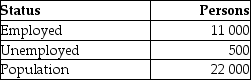 All of the following mathematical calculations are correct. The unemployment rate is approximately:
 (Multiple Choice)
4.9/5  (91)
(91) What effect does the payment of government unemployment benefits have on the unemployment rate?
_____________________________________________________________________________________________
_____________________________________________________________________________________________
(Essay)
4.9/5 (67)
(67) Outline the 'costs of unemployment'.
_____________________________________________________________________________________________
_____________________________________________________________________________________________
(Essay)
5.0/5 (84)
(84) If the number employed is 11 million, the number unemployed is 0.6 million, and the working-age population is 16 million, then the labour force participation rate is:
(Multiple Choice)
4.8/5 (82)
(82) In Australia in early 2016, approximately how many people were not in the labour force but were of working age?
(Multiple Choice)
4.8/5 (82)
(82) Which of the following is an example of a worker experiencing 'frictional unemployment'?
(Multiple Choice)
4.8/5 (84)
(84) In Australia in 2016, the proportion of unemployed people who were 'long-term unemployed' as measured by the Australian Bureau of Statistics (ABS)was approximately:
(Multiple Choice)
4.9/5 (77)
(77) If people who have been looking for work give up actively looking for work, ceteris paribus, the:
(Multiple Choice)
4.8/5 (85)
(85) How has the labour force participation rate changed for men and women over the past 30 years in Australia?
_____________________________________________________________________________________________
_____________________________________________________________________________________________
(Essay)
4.8/5 (85)
(85) Explain the three main types of unemployment and outline the types of policies that can be used to reduce each type.
_____________________________________________________________________________________________
_____________________________________________________________________________________________
(Essay)
4.8/5 (83)
(83) For purposes of unemployment, how is a full-time student who is not working categorised?
(Multiple Choice)
5.0/5 (63)
(63) Explain why 'discouraged workers' are not measured as being 'unemployed'.
_____________________________________________________________________________________________
_____________________________________________________________________________________________
(Essay)
4.7/5 (88)
(88) The demand for new motor vehicles falls when the economy enters a downturn and as a result, motor vehicle manufacturers sack some workers. This would be an example of:
(Multiple Choice)
5.0/5 (69)
(69) Which of the following is not an advantage of labour market deregulation?
(Multiple Choice)
4.9/5 (62)
(62) The natural rate of unemployment consists of frictional unemployment plus cyclical unemployment.
(True/False)
4.8/5 (75)
(75) When is the labour market considered to be at 'full employment'?
(Multiple Choice)
4.9/5 (87)
(87) 
Filters
- Essay(0)
- Multiple Choice(0)
- Short Answer(0)
- True False(0)
- Matching(0)