



 Chat with AI
Exam 10: Risk and Return in Capital Markets

Exam 1: Corporate Finance and the Financial Manager91 Questions
Exam 2: Introduction to Financial Statement Analysis122 Questions
Exam 3: The Valuation Principle: the Foundation of Financial Decision Making120 Questions
Exam 4: The Time Value of Money101 Questions
Exam 5: Interest Rates118 Questions
Exam 6: Bonds122 Questions
Exam 7: Valuing Stocks122 Questions
Exam 8: Investment Decision Rules137 Questions
Exam 9: Fundamentals of Capital Budgeting107 Questions
Exam 10: Risk and Return in Capital Markets101 Questions
Exam 11: Systematic Risk and the Equity Risk Premium102 Questions
Exam 12: Determining the Cost of Capital106 Questions
Exam 13: Risk and the Pricing of Options112 Questions
Exam 14: Raising Equity Capital104 Questions
Exam 15: Debt Financing109 Questions
Exam 16: Capital Structure113 Questions
Exam 17: Payout Policy101 Questions
Exam 18: Financial Modelling and Pro Forma Analysis124 Questions
Exam 19: Working Capital Management122 Questions
Exam 20: Short Term Financial Planning105 Questions
Exam 21: Risk Management108 Questions
Exam 22: International Corporate Finance108 Questions
Exam 23: Leasing86 Questions
Exam 24: Mergers and Acquisitions81 Questions
Exam 25: Corporate Governance52 Questions
Select questions type


Many former employees at Enron,an energy trading and supply company,had a large part of their portfolio invested in Enron stock.These employees were bearing a high degree of ________ risk.
(Multiple Choice)
4.9/5  (80)
(80) Use the table for the question(s) below.
Consider the following realized annual returns:
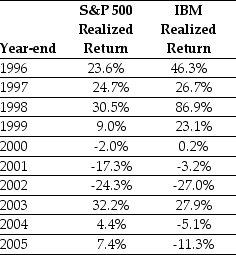 -The average annual return on the S&P 500 from 1996 to 2005 is closest to:
 (Multiple Choice)
4.9/5 (69)
(69) Is volatility a reasonable measure of risk when evaluating large portfolios?
(Essay)
4.9/5 (87)
(87) Historical evidence on the returns of large portfolios of stock and bonds shows that investments with higher volatility have rewarded investors with higher returns.
(True/False)
4.7/5 (74)
(74) If the Bank of Canada were to change from an expansionary to contractionary monetary policy,this would be an example of
(Multiple Choice)
4.8/5 (81)
(81) Is volatility a reasonable measure of risk when evaluating the investment in a single stock?
(Essay)
4.8/5 (71)
(71) You purchase a 30-year,zero-coupon bond for a price of $20.The bond will pay back $100 after 30 years and make no interim payments.The annual compounded return (geometric average return)on this investment is:
(Multiple Choice)
4.9/5 (77)
(77) Suppose you invested $45 in TD Bank one month ago.It paid a dividend of $0.60,and you sold it right after the dividend was paid for $44.90.What was your dividend yield and capital gains yield on the investment?
(Multiple Choice)
4.8/5 (74)
(74) Your investment over one year yielded a capital gains yield of 7% and a dividend yield of 4%.If the sale price was $86 per share,what was the cost of the investment?
(Multiple Choice)
4.8/5 (75)
(75) If a stock pays dividends at the end of each quarter,with realized returns of R₁,R₂,R₃,and R₄ each quarter,then the annual realized return is calculated as:
(Multiple Choice)
4.7/5 (75)
(75) Use the table for the question(s) below.
Consider the following average annual returns:
 -What is the risk premium for the portfolio of small stocks?
 (Multiple Choice)
4.8/5 (76)
(76) Suppose you invested $55 in CIBC stock one month ago.Today,it paid a dividend of $0.35,and then you sold it for $56.25.What was the return on your investment?
(Multiple Choice)
4.9/5 (79)
(79) Independent risks can be diversified by holding a large number of uncorrelated assets with independent risks.
(True/False)
4.8/5 (74)
(74) If asset A's return is exactly two times asset B's return,then following risk return tradeoff,the standard deviation of asset A should be ________ times the standard deviation of asset B.
(Multiple Choice)
4.8/5 (82)
(82) Use the information for the question(s) below.
Big Cure and Little Cure are both pharmaceutical companies. Big Cure presently has a potential "blockbuster" drug before the Food and Drug Administration (FDA) waiting for approval. If approved, Big Cure's blockbuster drug will produce $1 billion in net income for Big Cure. Little Cure has ten separate, less important drugs before the FDA waiting for approval. If approved, each of Little Cure's drugs would produce $100 million in net income for Little Cure. The probability of the FDA approving a drug is 50%.
-What is the expected payoff for Little Cure's ten drugs?
(Multiple Choice)
4.7/5 (78)
(78) Apple computer's stock price jumped when it announced that its revenue had increased because of the successful launch of iPhone and the increased sales of Macintosh computers.This is an example of
(Multiple Choice)
4.8/5 (71)
(71) A stock whose return does not depend on overall economic conditions has a low systematic risk.
(True/False)
4.9/5 (80)
(80) The S&P TSX Composite index delivered annual returns of 17.61%,-8.71%,7.19% and 12.99% from 2010 to 2013.What is the standard deviation of the index returns over these four years?
(Multiple Choice)
5.0/5 (86)
(86) 
Filters
- Essay(0)
- Multiple Choice(0)
- Short Answer(0)
- True False(0)
- Matching(0)