



 Chat with AI
Exam 14: Human Evolution

Exam 1: The Nature of Science66 Questions
Exam 2: Chemistry of Life78 Questions
Exam 3: Life Is Cellular72 Questions
Exam 4: How Cells Work64 Questions
Exam 5: Cell Division62 Questions
Exam 6: Patterns of Inheritance67 Questions
Exam 7: Chromosomes and Human Genetics68 Questions
Exam 8: What Genes Are64 Questions
Exam 9: How Genes Work64 Questions
Exam 10: Evidence for Evolution64 Questions
Exam 11: Mechanisms of Evolution64 Questions
Exam 12: Adaptation and Species64 Questions
Exam 13: The History of Life71 Questions
Exam 14: Human Evolution66 Questions
Exam 15: General Principles of Ecology64 Questions
Exam 16: Growth of Populations65 Questions
Exam 17: Communities of Organisms64 Questions
Exam 18: Ecosystems66 Questions
Exam 19: Applying the Science67 Questions
Select questions type


Examine the following Hominin evolutionary tree.Which of the following genera are most closely related? 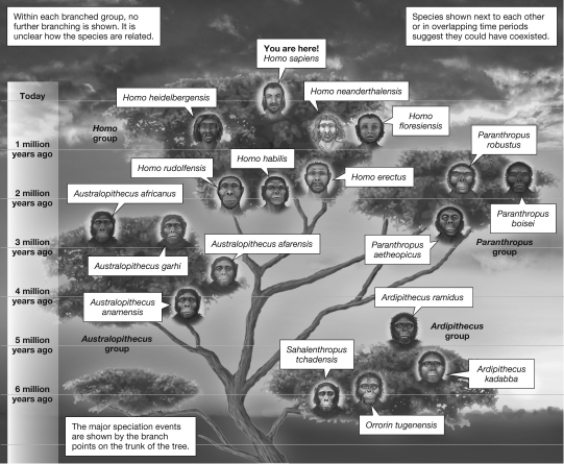
(Multiple Choice)
4.8/5  (77)
(77) Match the following levels of human classification with the appropriate levels of the Linnaean hierarchy.
-Family
(Multiple Choice)
4.9/5 (69)
(69) Match the following levels of human classification with the appropriate levels of the Linnaean hierarchy.
-Kingdom
(Multiple Choice)
4.8/5 (79)
(79) Which of the following categories of the Linnaean hierarchy would include the most closely related organisms?
(Multiple Choice)
4.8/5 (70)
(70) The first vertebrates to evolve lacked jaws and had skeletons made from a strong flexible tissue called cartilage.The lamprey is a modern example of this ancient group of vertebrates known as
(Multiple Choice)
4.9/5 (90)
(90) It is possible that modern humans may have comingled with which of these other ancestors?
(Multiple Choice)
4.9/5 (90)
(90) You are camping in the south central United States when one evening you happen across an animal with several "armored" plates covering its back and shoulders.The plates are bony and separated by thin bands of flexible skin.The belly of this short-legged quadruped is covered with skin and soft fur.You also notice four young ones scurrying along with the adult.This animal most likely belongs to which class?
(Multiple Choice)
4.8/5 (79)
(79) Which of the following traits was likely deleterious for early hominins?
(Multiple Choice)
5.0/5 (78)
(78) The fossil of a male hominin is discovered,and it appears to share traits with both humans and Neanderthals.What could mitochondrial-DNA sequencing and whole-genome DNA sequencing tell you about the fossil's parents?
(Essay)
4.9/5 (82)
(82) What evidence would support the hypothesis that Neanderthals evolved sometime after hominins migrated out of Africa?
(Multiple Choice)
4.8/5 (79)
(79) Match the following levels of human classification with the appropriate levels of the Linnaean hierarchy.
-Species
(Multiple Choice)
4.8/5 (92)
(92) Which of the following adaptations was NOT required to facilitate the evolution of animal life on land?
(Multiple Choice)
4.7/5 (90)
(90) Which of the following is NOT a feature of hominins that distinguishes them from other hominids?
(Multiple Choice)
4.9/5 (85)
(85) The phylum Chordata includes several subgroups of organisms.To which of these subgroups would humans belong?
(Multiple Choice)
4.9/5 (84)
(84) You are on an archaeological dig in Africa when you find a collection of stone tools along with several skeletons in a cave.These bipedal skeletons date to about 3.5 million years ago and show no evidence of a partially opposable toe.Measurements indicate the brains would have been a little less than a third of the volume of modern humans.The teeth found on these skeletons look more like those of an ape than those of a human.Your skeletal discovery is most likely which of the following?
(Multiple Choice)
4.9/5 (82)
(82) 
Filters
- Essay(0)
- Multiple Choice(0)
- Short Answer(0)
- True False(0)
- Matching(0)