



 Chat with AI
Exam 3: Life Is Cellular

Exam 1: The Nature of Science66 Questions
Exam 2: Chemistry of Life78 Questions
Exam 3: Life Is Cellular72 Questions
Exam 4: How Cells Work64 Questions
Exam 5: Cell Division62 Questions
Exam 6: Patterns of Inheritance67 Questions
Exam 7: Chromosomes and Human Genetics68 Questions
Exam 8: What Genes Are64 Questions
Exam 9: How Genes Work64 Questions
Exam 10: Evidence for Evolution64 Questions
Exam 11: Mechanisms of Evolution64 Questions
Exam 12: Adaptation and Species64 Questions
Exam 13: The History of Life71 Questions
Exam 14: Human Evolution66 Questions
Exam 15: General Principles of Ecology64 Questions
Exam 16: Growth of Populations65 Questions
Exam 17: Communities of Organisms64 Questions
Exam 18: Ecosystems66 Questions
Exam 19: Applying the Science67 Questions
Select questions type


Match the following cellular structures with their primary function (you may need to use a function more than once).
-Golgi apparatus
(Multiple Choice)
4.9/5  (86)
(86) An amoeba,a protozoan that moves by pseudopodia,approaches a smaller protozoan and extends its pseudopodia (extensions of cytoplasm in plasma membrane)around the smaller protozoan.Once the amoeba's pseudopodia completely surrounds the other protozoan,the amoeba's plasma membrane pinches off by folding back into the amoeba and creating a vesicle containing the smaller protozoan.This vesicle is now within the amoeba itself and will soon fuse with other vesicles containing digestive enzymes.This is an example of
(Multiple Choice)
4.9/5 (82)
(82) Examine the figure below.If each sugar molecule represents a percentage point of sugar dissolved in the solution,what change would you expect to see in the solution level over time and why? 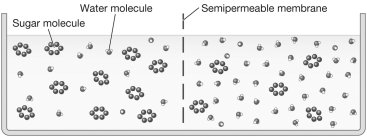
(Multiple Choice)
4.9/5 (90)
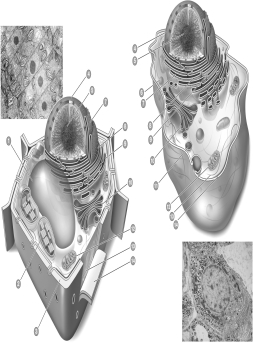
(90) Indicate which cell in this figure is the plant cell and which is the animal cell.Label all cellular structures 1-12 in both cells.Include a very brief description of each organelle's function with its label.Use an asterisk to indicate which structures are unique to plant cells.
(Essay)
4.9/5 (86)
(86) Your muscle cells need large amounts of ATP to function in the movement of your body.Which of the following organelles would you expect to be especially abundant in muscle cells?
(Multiple Choice)
4.9/5 (86)
(86) An experiment mixed together oil (lipids),organophosphate-containing detergent in water,and copper ions to act as a catalyst for a chemical reaction.Membranes budded off of the oil in this mixture.Which of the following is a reasonable and possible explanation of the experimental results?
(Multiple Choice)
4.9/5 (87)
(87) Which of the following would be likely to move through a plasma membrane by simple diffusion?
(Multiple Choice)
4.8/5 (91)
(91) Which of the following can be used to accurately describe viruses?
(Multiple Choice)
4.8/5 (90)
(90) Using the compound light microscope in the lab room,you observe a wet mount slide preparation.You observe layers of cells that have a definite,rigid,rectangular shape;there appears to be a nucleus in all of the cells and there are many oval-shaped green structures that seem to be moving around inside of the cells in an orderly fashion.What general cell type are you most likely observing?
(Multiple Choice)
4.8/5 (84)
(84) Match the following cellular structures with their primary function (you may need to use a function more than once).
-rough endoplasmic reticulum
(Multiple Choice)
4.9/5 (87)
(87) Phospholipids are large organic molecules with a ________,polar phosphate head connected to ________,nonpolar fatty acid tails.How do these molecules arrange themselves to form a mostly impermeable barrier between a liposome and its environment?
(Multiple Choice)
4.8/5 (72)
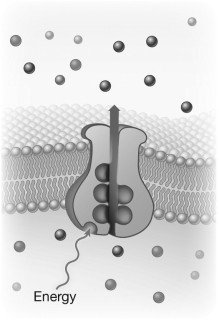
(72) This figure depicts a transport protein in a plasma membrane.The dark blue molecules represent a protein that is being transported out of the cell.Is the transport of the protein active or passive? Support your answer by describing evidence visible in the figure and stating its significance regarding your answer.
(Essay)
4.8/5 (77)
(77) A cell containing a nucleus,mitochondria,Golgi apparatus,both smooth and rough ER,ribosomes,cytoskeleton,a large vacuole,and chloroplasts would be an example of a typical ________ cell.
(Short Answer)
4.9/5 (81)
(81) From what substance do liposomes spontaneously form and why are they important?
(Multiple Choice)
4.9/5 (72)
(72) Adenine (A),thymine (T),guanine (G),and cytosine (C)are the ________ building blocks for DNA;they are organized in different combinations to code for all of the proteins needed to accomplish everything the cell does.
(Multiple Choice)
4.8/5 (85)
(85) Some antibiotics used to treat bacterial infections kill the bacteria by chemically punching holes in the cell wall of the bacteria,by preventing the bacteria from replicating their DNA,or by many other actions that ultimately cause cell death.Why do these antibiotics not work to kill viruses and cure people of viral infections?
(Multiple Choice)
4.8/5 (87)
(87) Which of the following help increase the selective permeability of a phospholipid bilayer membrane?
(Multiple Choice)
4.7/5 (71)
(71) Why would hydrophilic substances such as sodium ions (Na⁺),hydrogen ions (H⁺),sugars,and amino acids be unable to simply diffuse across a plasma membrane?
(Multiple Choice)
4.8/5 (94)
(94) Viruses use their ________ material to take over their host cell's metabolic machinery to produce the components needed for the virus to reproduce.
(Short Answer)
4.9/5 (59)
(59) 
Filters
- Essay(0)
- Multiple Choice(0)
- Short Answer(0)
- True False(0)
- Matching(0)