



 Chat with AI
Exam 8: Analyzing Probabilities and Expected Values

Exam 1: Collecting Data and Drawing Conclusions60 Questions
Exam 2: Summarizing Data55 Questions
Exam 3: Randomness in Data61 Questions
Exam 4: Inference From Data: Principles57 Questions
Exam 5: Inference From Data: Comparisons22 Questions
Exam 6: Inferences With Categorical Data32 Questions
Exam 7: Relationships in Data35 Questions
Exam 8: Analyzing Probabilities and Expected Values34 Questions
Select questions type


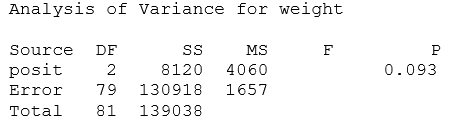
Data were collected on the weights for the entire roster of the 2005 Cal Poly football team. Individuals were classified as playing offense, defense, or special teams. Suppose you want to consider these data as representative of all collegiate football players and want to compare the average weight of the players in these three groups.
-Based on this output, how many players were on the Cal Poly team? Explain (briefly) how you know.

Free
(Short Answer)
4.9/5  (79)
(79) Correct Answer: Verified
There are 82, one more than the total degrees of freedom in the ANOVA table.
Suppose that a defendant faces charges of first-degree murder and of third-degree murder. She has been offered a plea-bargained agreement under which she would serve five years in jail by pleading guilty to the third-degree charge. If she does not plead guilty, however, the case will go to a jury trial, and the jury will reach one of three verdicts: not guilty, guilty of third-degree murder, or guilty of first-degree murder. If the jury finds her not guilty, she will serve no time in jail; if the jury finds her guilty of third-degree murder, she will serve seven years in jail; if the jury finds her guilty of first-degree murder, she will serve forty years in jail. Suppose that her attorney believes that the probability is .3 that a jury would find her innocent and .6 that a jury would find her guilty of third-degree murder.
-Assuming that the defendant wants to minimize her expected jail sentence, should she accept the plea bargain or opt for a jury trial?
Free
(Short Answer)
4.8/5 (83)
(83) Correct Answer:Verified
VerifiedThe plea bargain time ( 5 years) is smaller than the expected jail sentence should she opt for a jury trial.
When betting on a color in roulette, you have an 18/38 probability of winning on any one spin. Suppose that you bet on a color for five spins and count the number of times that you win.
-Calculate the probability that you win exactly three of the five spins.
Free
(Short Answer)
5.0/5 (82)
(82) Correct Answer:Verified
VerifiedWhen betting on a color in roulette, you have an 18/38 probability of winning on any one spin. Suppose that you bet on a color for five spins and count the number of times that you win.
-Calculate the probability that you win at least three of the five spins (and therefore come out ahead).
(Short Answer)
4.8/5 (82)
(82) Suppose that you have a probability of winning a game of solitaire, independently from game to game.
-If you play repeatedly until you win, what is the probability that you must play at least ten games?
(Short Answer)
4.8/5 (78)
(78) Suppose that a defendant faces charges of first-degree murder and of third-degree murder. She has been offered a plea-bargained agreement under which she would serve five years in jail by pleading guilty to the third-degree charge. If she does not plead guilty, however, the case will go to a jury trial, and the jury will reach one of three verdicts: not guilty, guilty of third-degree murder, or guilty of first-degree murder. If the jury finds her not guilty, she will serve no time in jail; if the jury finds her guilty of third-degree murder, she will serve seven years in jail; if the jury finds her guilty of first-degree murder, she will serve forty years in jail. Suppose that her attorney believes that the probability is .3 that a jury would find her innocent and .6 that a jury would find her guilty of third-degree murder.
-Determine the expected loss (in terms of years in jail) of proceeding to a jury trial.
(Short Answer)
4.9/5 (86)
(86) When betting on a color in roulette, you have an 18/38 probability of winning on any one spin. Suppose that you bet on a color for five spins and count the number of times that you win.
-Explain why a binomial distribution is applicable here.
(Essay)
4.8/5 (69)
(69) Suppose you encounter two traffic lights on your commute to school. You estimate that the probability is .5 that the first light will be red when you get to it, .4 that the second light will be red, and .6 that at least one of the lights will be red.
-Calculate and interpret the expected value of the number of red lights that you encounter.
(Short Answer)
4.7/5 (66)
(66) Suppose you encounter two traffic lights on your commute to school. You estimate that the probability is .5 that the first light will be red when you get to it, .4 that the second light will be red, and .6 that at least one of the lights will be red.
-Determine the probability that both lights will be red. (Hint: You might make a probability table or use one of the probability rules from Topic 30.)
(Essay)
4.8/5 (85)
(85) Data were collected on the weights for the entire roster of the 2005 Cal Poly football team. Individuals were classified as playing offense, defense, or special teams. Suppose you want to consider these data as representative of all collegiate football players and want to compare the average weight of the players in these three groups.
-Is this an experiment or an observational study?
(Short Answer)
4.8/5 (71)
(71) In a study reported in the November 2007 issue of Nature, researchers investigated whether infants take into account an individual's actions towards others in evaluating that individual as appealing or aversive, perhaps laying the foundation for social interaction (Hamlin, Wynn, and Bloom, 2007). In one component of the study, 10-month-old infants were shown a "climber" character (a piece of wood with "google" eyes glued onto it) that could not make it up a hill in two tries. Then they were alternately shown two scenarios for the climber's next try, one where the climber was pushed to the top of the hill by another character ("helper") and one where the climber was pushed back down the hill by another character ("hinderer"). The infant was alternately shown these two scenarios several times. Then the child was presented with both pieces of wood (the helper and the hinderer) and asked to pick one to play with. The researchers found that 14 of the 16 infants chose the helper over the hinderer.
-Explain the relevance of this probability calculation to the research question of whether infants have a preference for the helper toy over the hinderer toy. Also summarize the conclusion that you would draw, and explain your reasoning.
(Essay)
4.8/5 (76)
(76) Suppose that 70% of the customers at a particular fast food restaurant order a hamburger, 50% order French fries, and 45% order both. Let H denote the event that a randomly selected customer orders a hamburger, and let F denote the event that he or she orders French fries.
-Determine the conditional probability that a randomly selected customer orders French fries given that he or she orders a hamburger.
(Short Answer)
4.8/5 (79)
(79) When betting on a color in roulette, you have an 18/38 probability of winning on any one spin. Suppose that you bet on a color for five spins and count the number of times that you win.
-Specify the values of and for this binomial distribution.
(Short Answer)
4.8/5 (77)
(77) Suppose that 70% of the customers at a particular fast food restaurant order a hamburger, 50% order French fries, and 45% order both. Let H denote the event that a randomly selected customer orders a hamburger, and let F denote the event that he or she orders French fries.
-Determine the probability that a randomly selected customer orders either a hamburger or French fries.
(Short Answer)
4.9/5 (71)
(71) In a study reported in the November 2007 issue of Nature, researchers investigated whether infants take into account an individual's actions towards others in evaluating that individual as appealing or aversive, perhaps laying the foundation for social interaction (Hamlin, Wynn, and Bloom, 2007). In one component of the study, 10-month-old infants were shown a "climber" character (a piece of wood with "google" eyes glued onto it) that could not make it up a hill in two tries. Then they were alternately shown two scenarios for the climber's next try, one where the climber was pushed to the top of the hill by another character ("helper") and one where the climber was pushed back down the hill by another character ("hinderer"). The infant was alternately shown these two scenarios several times. Then the child was presented with both pieces of wood (the helper and the hinderer) and asked to pick one to play with. The researchers found that 14 of the 16 infants chose the helper over the hinderer.
-Use the binomial distribution to calculate the probability of 14 or more choosing the helper toy if they really had no preference. Show the details of how you calculate this probability by hand.
(Short Answer)
4.8/5 (83)
(83) In a study reported in the November 2007 issue of Nature, researchers investigated whether infants take into account an individual's actions towards others in evaluating that individual as appealing or aversive, perhaps laying the foundation for social interaction (Hamlin, Wynn, and Bloom, 2007). In one component of the study, 10-month-old infants were shown a "climber" character (a piece of wood with "google" eyes glued onto it) that could not make it up a hill in two tries. Then they were alternately shown two scenarios for the climber's next try, one where the climber was pushed to the top of the hill by another character ("helper") and one where the climber was pushed back down the hill by another character ("hinderer"). The infant was alternately shown these two scenarios several times. Then the child was presented with both pieces of wood (the helper and the hinderer) and asked to pick one to play with. The researchers found that 14 of the 16 infants chose the helper over the hinderer.
-If infants actually have no preference between the helper and hinderer, is it possible that 14 out of 16 infants would have chosen the helper toy just by chance? Explain.
(Short Answer)
4.9/5 (74)
(74) Suppose that a defendant faces charges of first-degree murder and of third-degree murder. She has been offered a plea-bargained agreement under which she would serve five years in jail by pleading guilty to the third-degree charge. If she does not plead guilty, however, the case will go to a jury trial, and the jury will reach one of three verdicts: not guilty, guilty of third-degree murder, or guilty of first-degree murder. If the jury finds her not guilty, she will serve no time in jail; if the jury finds her guilty of third-degree murder, she will serve seven years in jail; if the jury finds her guilty of first-degree murder, she will serve forty years in jail. Suppose that her attorney believes that the probability is .3 that a jury would find her innocent and .6 that a jury would find her guilty of third-degree murder.
-By making the decision that you reached in part , does the defendant guarantee she will be better off than if she had made the other decision? Explain.
(Short Answer)
4.9/5 (84)
(84) Data were collected on the weights for the entire roster of the 2005 Cal Poly football team. Individuals were classified as playing offense, defense, or special teams. Suppose you want to consider these data as representative of all collegiate football players and want to compare the average weight of the players in these three groups.
-State the alternative hypothesis in this study.
Consider the following ANOVA table.
(Short Answer)
4.8/5 (77)
(77) A group of students asked participants from their school to see how many sit-ups they could perform in one minute. Subjects were then randomly assigned to drink either Sobe or Rockstar, two energy drinks. Rockstar is marketed primarily as an energy drink, whereas Sobe is advertised more for taste. Exactly 30 minutes later, the number of sit-ups in one minute was again recorded. The students conjectured that the increase in the number of sit-ups performed would be higher for students drinking Rockstar than for Sobe.
-Is this an experiment or an observational study?
(Short Answer)
4.8/5 (75)
(75) Suppose that 70% of the customers at a particular fast food restaurant order a hamburger, 50% order French fries, and 45% order both. Let H denote the event that a randomly selected customer orders a hamburger, and let F denote the event that he or she orders French fries.
-Convert the given percentages into probability statements involving these symbols .
(Short Answer)
4.7/5 (80)
(80) 
Filters
- Essay(0)
- Multiple Choice(0)
- Short Answer(0)
- True False(0)
- Matching(0)