



 Chat with AI
Exam 53: Community Ecology

Exam 1: Biology and the Tree of Life35 Questions
Exam 2: Water and Carbon: the Chemical Basis of Life51 Questions
Exam 3: Protein Structure and Function54 Questions
Exam 4: Nucleic Acids and the Rna World40 Questions
Exam 5: An Introduction to Carbohydrates40 Questions
Exam 6: Lipids, membranes, and the First Cells54 Questions
Exam 7: Inside the Cell38 Questions
Exam 8: Cell-Cell Interactions38 Questions
Exam 9: Cellular Respiration and Fermentation38 Questions
Exam 10: Photosynthesis39 Questions
Exam 11: The Cell Cycle39 Questions
Exam 12: Meiosis39 Questions
Exam 13: Mendel and the Gene42 Questions
Exam 14: Dna and the Gene: Synthesis and Repair39 Questions
Exam 15: How Genes Work39 Questions
Exam 16: Transcription, RNA Processing, and Translation39 Questions
Exam 17: Control of Gene Expression in Bacteria38 Questions
Exam 18: Control of Gene Expression in Eukaryotes39 Questions
Exam 19: Analyzing and Engineering Genes41 Questions
Exam 20: Genomics41 Questions
Exam 21: Principles of Development39 Questions
Exam 22: An Introduction to Animal Development40 Questions
Exam 23: An Introduction to Plant Development37 Questions
Exam 24: Evolution by Natural Selection42 Questions
Exam 25: Evolutionary Processes50 Questions
Exam 26: Speciation41 Questions
Exam 27: Phylogenies and the History of Life43 Questions
Exam 28: Bacteria and Archaea38 Questions
Exam 29: Protists36 Questions
Exam 30: Green Algae and Land Plants54 Questions
Exam 31: Fungi40 Questions
Exam 32: An Introduction to Animals42 Questions
Exam 33: Protostome Animals38 Questions
Exam 34: Deuterostome Animals43 Questions
Exam 35: Viruses35 Questions
Exam 36: Plant Form and Function36 Questions
Exam 37: Water and Sugar Transport in Plants42 Questions
Exam 38: Plant Nutrition37 Questions
Exam 39: Plant Sensory Systems, signals, and Responses65 Questions
Exam 40: Plant Reproduction41 Questions
Exam 41: Animal Form and Function38 Questions
Exam 42: Water and Electrolyte Balance in Animals41 Questions
Exam 43: Animal Nutrition43 Questions
Exam 44: Gas Exchange and Circulation46 Questions
Exam 45: Electrical Signals in Animals40 Questions
Exam 46: Animal Sensory Systems and Movement43 Questions
Exam 47: Chemical Signals in Animals38 Questions
Exam 48: Animal Reproduction39 Questions
Exam 49: The Immune System in Animals38 Questions
Exam 50: An Introduction to Ecology41 Questions
Exam 51: Behavioural Ecology39 Questions
Exam 52: Population Ecology49 Questions
Exam 53: Community Ecology39 Questions
Exam 54: Ecosystems41 Questions
Exam 55: Biodiversity and Conservation Biology38 Questions
Select questions type


Figure 53.7 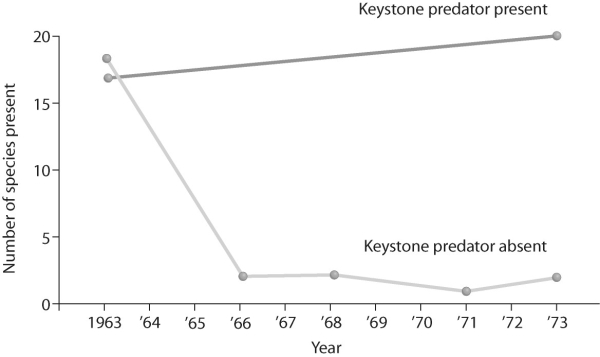 -What does the graph in the figure above tell you about the definition of a keystone species?
 (Multiple Choice)
4.7/5  (87)
(87) What is the main difference between a disturbance and a disturbance regime?
(Multiple Choice)
5.0/5 (96)
(96) Bouchard and Brooks (2004)studied the effect of insect flight on dispersal and speciation in rain-forest insects.They sampled all of the insects in the study area and found that 60 insect species are flightless and 19 are macropterous (able to fly).After analyzing the results of the Bouchard and Brooks study,you conclude that macropterous and flightless insects in the rain forests of northeastern Australia have dispersed and speciated in similar manners.What does this say about flight in these insects?
(Multiple Choice)
4.8/5 (73)
(73) During a one year study,researchers found no difference in treehopper populations in any of their control and experimental groups.What could they measure during the second year to gain information about why this might have occurred?
(Multiple Choice)
4.8/5 (75)
(75) Which one of the following animals would most likely be defined as a keystone species?
(Multiple Choice)
4.9/5 (75)
(75) People with at least one copy of the HLA-B53 gene are better able to beat back malarial infections before the infection progresses.If this is a coevolutionary arms race between Plasmodium and humans,what would the next step in this race be?
(Multiple Choice)
4.9/5 (90)
(90) Figure 53.6 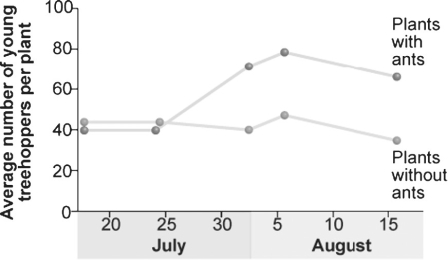 -Treehoppers (a type of insect)produce honeydew,which ants use for food.Treehoppers have a major predator,the jumping spider.Researchers hypothesized that the ants would protect the treehoppers from the spiders.In an experiment,researchers followed study plots with ants removed from the system and compared them to a control plot.In the figure above,what can you conclude?
 (Multiple Choice)
4.7/5 (74)
(74) Clements's view of biological communities is that of a highly predictable and interrelated structure,while Gleason's view of biological communities is that individual species operate independently.If we set up many identical sterilized ponds in the same area and allowed them to be colonized,what should we predict if Gleason's hypothesis is the one we believe is correct?
(Multiple Choice)
4.7/5 (66)
(66) A measure of how much a community is affected by a disturbance is termed
(Multiple Choice)
4.9/5 (70)
(70) Figure 53.11 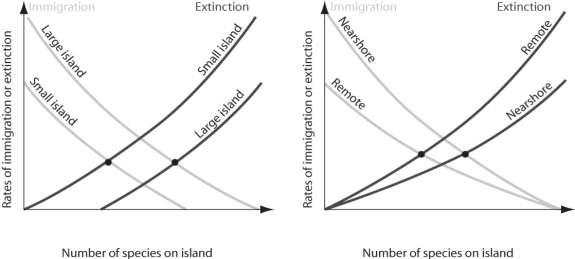 -According to Figure 53.11,a species has the highest chance of extinction when
 (Multiple Choice)
4.9/5 (80)
(80) Figure 53.5  -In the figure above,which of the following statements is true?
 (Multiple Choice)
4.9/5 (87)
(87) Figure 53.1 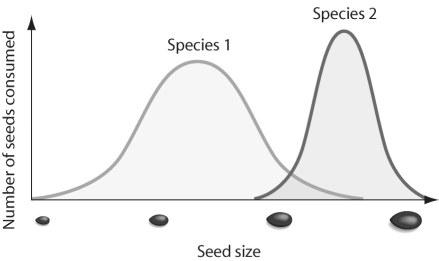 -In looking at the figure above,what conclusions can be drawn?
 (Multiple Choice)
4.9/5 (79)
(79) Figure 53.10 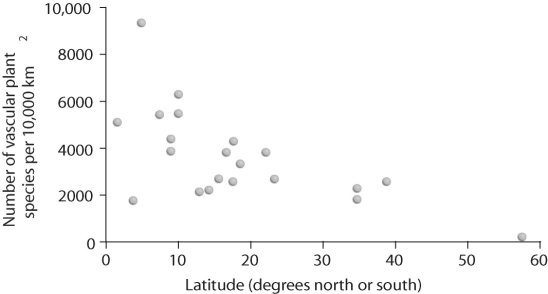 -In figure above,what can be stated about species diversity and latitude?
 (Multiple Choice)
4.8/5 (87)
(87) Some birds follow moving swarms of army ants in the tropics.As the ants march along the forest floor hunting insects and small vertebrates,birds follow and pick off any insects or small vertebrates that fly or jump out of the way of the ants.What is the specific benefit relationship?
(Multiple Choice)
5.0/5 (93)
(93) Figure 53.3 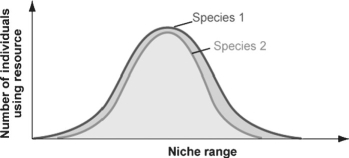 -In the figure above,which species is the stronger competitor?
 (Multiple Choice)
4.9/5 (54)
(54) Figure 53.9 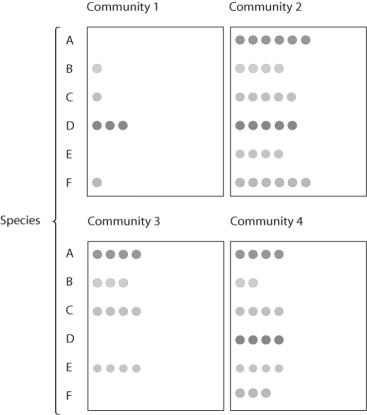 -In the figure above,which community has the highest species richness?
 (Multiple Choice)
4.8/5 (84)
(84) Figure 53.8 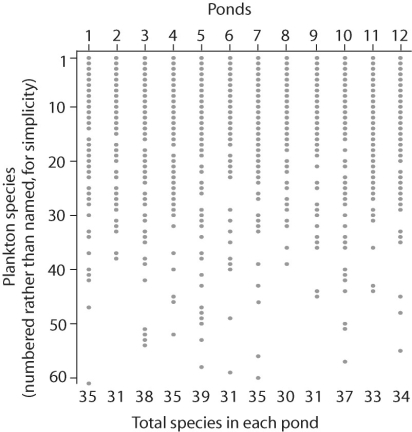 -Clements's view of biological communities is that of a highly predictable and interrelated structure,while Gleason's view of biological communities is that individual species operate independently.Looking at the results in the figure above,which hypothesis (by Clements or Gleason)is supported by the data?
 (Multiple Choice)
4.8/5 (77)
(77) 
Filters
- Essay(0)
- Multiple Choice(0)
- Short Answer(0)
- True False(0)
- Matching(0)