



 Chat with AI
Exam 52: Population Ecology

Exam 1: Biology and the Tree of Life35 Questions
Exam 2: Water and Carbon: the Chemical Basis of Life51 Questions
Exam 3: Protein Structure and Function54 Questions
Exam 4: Nucleic Acids and the Rna World40 Questions
Exam 5: An Introduction to Carbohydrates40 Questions
Exam 6: Lipids, membranes, and the First Cells54 Questions
Exam 7: Inside the Cell38 Questions
Exam 8: Cell-Cell Interactions38 Questions
Exam 9: Cellular Respiration and Fermentation38 Questions
Exam 10: Photosynthesis39 Questions
Exam 11: The Cell Cycle39 Questions
Exam 12: Meiosis39 Questions
Exam 13: Mendel and the Gene42 Questions
Exam 14: Dna and the Gene: Synthesis and Repair39 Questions
Exam 15: How Genes Work39 Questions
Exam 16: Transcription, RNA Processing, and Translation39 Questions
Exam 17: Control of Gene Expression in Bacteria38 Questions
Exam 18: Control of Gene Expression in Eukaryotes39 Questions
Exam 19: Analyzing and Engineering Genes41 Questions
Exam 20: Genomics41 Questions
Exam 21: Principles of Development39 Questions
Exam 22: An Introduction to Animal Development40 Questions
Exam 23: An Introduction to Plant Development37 Questions
Exam 24: Evolution by Natural Selection42 Questions
Exam 25: Evolutionary Processes50 Questions
Exam 26: Speciation41 Questions
Exam 27: Phylogenies and the History of Life43 Questions
Exam 28: Bacteria and Archaea38 Questions
Exam 29: Protists36 Questions
Exam 30: Green Algae and Land Plants54 Questions
Exam 31: Fungi40 Questions
Exam 32: An Introduction to Animals42 Questions
Exam 33: Protostome Animals38 Questions
Exam 34: Deuterostome Animals43 Questions
Exam 35: Viruses35 Questions
Exam 36: Plant Form and Function36 Questions
Exam 37: Water and Sugar Transport in Plants42 Questions
Exam 38: Plant Nutrition37 Questions
Exam 39: Plant Sensory Systems, signals, and Responses65 Questions
Exam 40: Plant Reproduction41 Questions
Exam 41: Animal Form and Function38 Questions
Exam 42: Water and Electrolyte Balance in Animals41 Questions
Exam 43: Animal Nutrition43 Questions
Exam 44: Gas Exchange and Circulation46 Questions
Exam 45: Electrical Signals in Animals40 Questions
Exam 46: Animal Sensory Systems and Movement43 Questions
Exam 47: Chemical Signals in Animals38 Questions
Exam 48: Animal Reproduction39 Questions
Exam 49: The Immune System in Animals38 Questions
Exam 50: An Introduction to Ecology41 Questions
Exam 51: Behavioural Ecology39 Questions
Exam 52: Population Ecology49 Questions
Exam 53: Community Ecology39 Questions
Exam 54: Ecosystems41 Questions
Exam 55: Biodiversity and Conservation Biology38 Questions
Select questions type


One measure for the value of the patch was given by the long-term contribution of a fragment to colonization events in the network.How do the properties of a landscape and the properties of a species affect the value of a patch?
(Multiple Choice)
4.8/5  (94)
(94) If 40 individuals were alive in 1921 and 856 existed in 2007,what is r?
(Multiple Choice)
5.0/5 (82)
(82) Figure 52.1 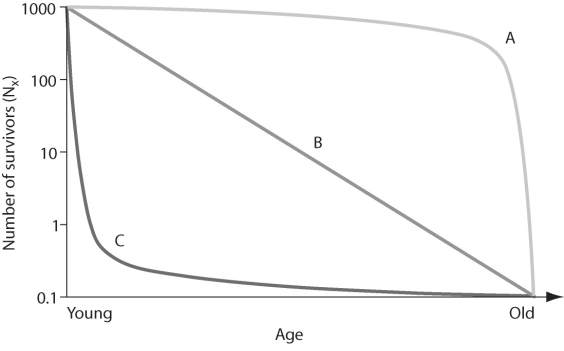 -In the figure above,which of the following survivorship curves implies that an animal may lay thousands of eggs,of which a regular number die each year?
 (Multiple Choice)
4.8/5 (74)
(74) If 60 snow geese were alive in 1926 and 856 existed in 2001,what is r?
(Multiple Choice)
5.0/5 (92)
(92) Figure 52.1
-In the figure above,which of the following survivorship curves implies that an animal may lay thousands of eggs,of which only a few will survive to reproduce?
-In the figure above,which of the following survivorship curves implies that an animal may lay thousands of eggs,of which only a few will survive to reproduce? (Multiple Choice)
4.8/5 (77)
(77) Conservationists will take snow geese off the endangered species list when the population hits 10,000.If populations are sustaining growth at r = 0.088 and the population in 2001 is 3000 individuals,in what year will snow geese be taken off the endangered species list?
(Multiple Choice)
4.9/5 (90)
(90) In 1987,there were only 22 condors (birds)in the wild because of habitat destruction ;all were brought to zoos and breeding centres for captive breeding.In 1991,the first condors were re-introduced into the wild.To determine if the population of wild California condors is increasing,which methods would best be suited to gathering condor population size/density information?
(Multiple Choice)
4.9/5 (81)
(81) Figure 52.6 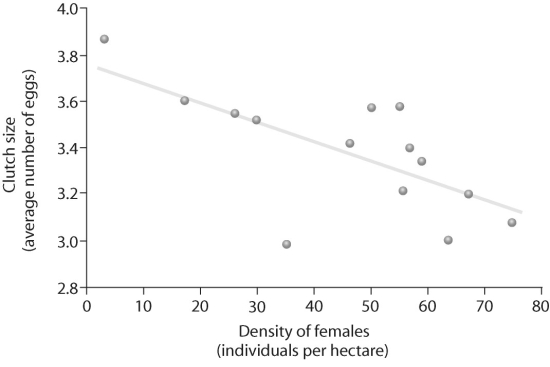 -Based on the figure above,which of the following statements correctly interprets the data?
 (Multiple Choice)
4.9/5 (79)
(79) Suppose researchers marked 800 turtles and later were able to trap a total of 300 individuals in that population,of which 150 were marked.What is the estimate for total population size?
(Multiple Choice)
4.9/5 (80)
(80) Projections for Earth's human population by 2050 that were made in 1992 were much higher than those made in 2002.Which of the following did NOT likely contribute to this change in projection?
(Multiple Choice)
4.9/5 (80)
(80) Figure 52.5 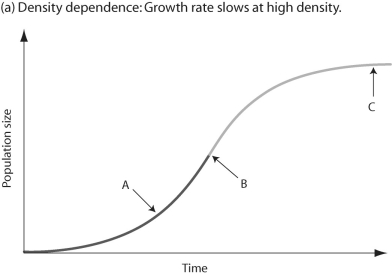 -In the figure above,which of the arrows represents the carrying capacity?
 (Multiple Choice)
4.8/5 (77)
(77) Figure 52.4 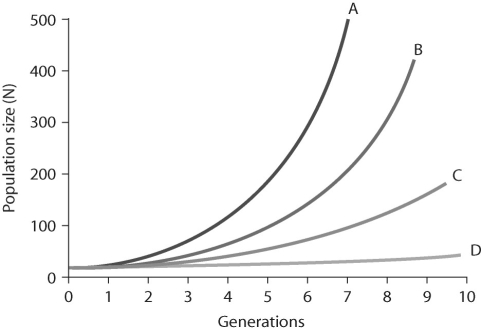 -In the figure above,which of the lines represents exponential growth?
 (Multiple Choice)
4.9/5 (85)
(85) Which of the following statements regarding the future of populations in developing countries is FALSE?
(Multiple Choice)
4.9/5 (94)
(94) Figure 52.13 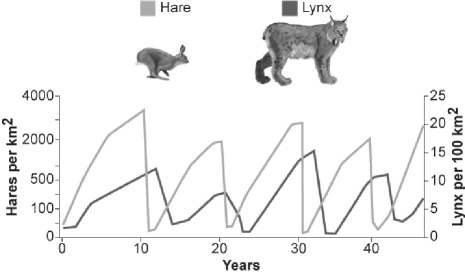 -What conclusion can you draw from the figure above?
 (Multiple Choice)
4.9/5 (82)
(82) Figure 52.8 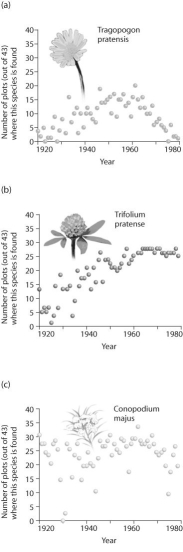 -Park Grass study in Rothamstead,UK is the longest-running biological experiment.A series of plots (~1/3 ha each)with uniform soil and vegetation have been treated either with fertilizer,lime,or left as controls.Annually,researchers record plant species present.Based on the graphs above,which species increased and maintained high population size?
 (Multiple Choice)
4.8/5 (79)
(79) Figure 52.1
-In the figure above,which of the following survivorship curves most applies to humans living in developed countries?
-In the figure above,which of the following survivorship curves most applies to humans living in developed countries? (Multiple Choice)
4.9/5 (89)
(89) What is the primary limiting factor that determines why no female animal can produce a very large number of very large eggs?
(Multiple Choice)
4.8/5 (79)
(79) The white rhinoceros is large [more than 1 000 kg (2 200 lb)],has a herbivorous diet and lives in the open grasslands and savannahs on the African continent.They require a lot of food (~80 kg)and water (80 L)each day to survive.Given this information you would expect (predict)these rhinoceros to exhibit
(Multiple Choice)
4.9/5 (85)
(85) 
Filters
- Essay(0)
- Multiple Choice(0)
- Short Answer(0)
- True False(0)
- Matching(0)