



 Chat with AI
Exam 48: Animal Reproduction

Exam 1: Biology and the Tree of Life35 Questions
Exam 2: Water and Carbon: the Chemical Basis of Life51 Questions
Exam 3: Protein Structure and Function54 Questions
Exam 4: Nucleic Acids and the Rna World40 Questions
Exam 5: An Introduction to Carbohydrates40 Questions
Exam 6: Lipids, membranes, and the First Cells54 Questions
Exam 7: Inside the Cell38 Questions
Exam 8: Cell-Cell Interactions38 Questions
Exam 9: Cellular Respiration and Fermentation38 Questions
Exam 10: Photosynthesis39 Questions
Exam 11: The Cell Cycle39 Questions
Exam 12: Meiosis39 Questions
Exam 13: Mendel and the Gene42 Questions
Exam 14: Dna and the Gene: Synthesis and Repair39 Questions
Exam 15: How Genes Work39 Questions
Exam 16: Transcription, RNA Processing, and Translation39 Questions
Exam 17: Control of Gene Expression in Bacteria38 Questions
Exam 18: Control of Gene Expression in Eukaryotes39 Questions
Exam 19: Analyzing and Engineering Genes41 Questions
Exam 20: Genomics41 Questions
Exam 21: Principles of Development39 Questions
Exam 22: An Introduction to Animal Development40 Questions
Exam 23: An Introduction to Plant Development37 Questions
Exam 24: Evolution by Natural Selection42 Questions
Exam 25: Evolutionary Processes50 Questions
Exam 26: Speciation41 Questions
Exam 27: Phylogenies and the History of Life43 Questions
Exam 28: Bacteria and Archaea38 Questions
Exam 29: Protists36 Questions
Exam 30: Green Algae and Land Plants54 Questions
Exam 31: Fungi40 Questions
Exam 32: An Introduction to Animals42 Questions
Exam 33: Protostome Animals38 Questions
Exam 34: Deuterostome Animals43 Questions
Exam 35: Viruses35 Questions
Exam 36: Plant Form and Function36 Questions
Exam 37: Water and Sugar Transport in Plants42 Questions
Exam 38: Plant Nutrition37 Questions
Exam 39: Plant Sensory Systems, signals, and Responses65 Questions
Exam 40: Plant Reproduction41 Questions
Exam 41: Animal Form and Function38 Questions
Exam 42: Water and Electrolyte Balance in Animals41 Questions
Exam 43: Animal Nutrition43 Questions
Exam 44: Gas Exchange and Circulation46 Questions
Exam 45: Electrical Signals in Animals40 Questions
Exam 46: Animal Sensory Systems and Movement43 Questions
Exam 47: Chemical Signals in Animals38 Questions
Exam 48: Animal Reproduction39 Questions
Exam 49: The Immune System in Animals38 Questions
Exam 50: An Introduction to Ecology41 Questions
Exam 51: Behavioural Ecology39 Questions
Exam 52: Population Ecology49 Questions
Exam 53: Community Ecology39 Questions
Exam 54: Ecosystems41 Questions
Exam 55: Biodiversity and Conservation Biology38 Questions
Select questions type


Asexual reproduction results in offspring that are genetically identical to their parent.What type of cell division occurs to generate this type of offspring?
(Multiple Choice)
4.8/5  (84)
(84) What makes sexually reproduced offspring genetically different from their parents?
(Multiple Choice)
4.9/5 (75)
(75) On a submarine expedition to the ocean bottom,you discover a population of fish that uses a method of reproduction in which female offspring develop from unfertilized eggs.What type of reproduction is this?
(Multiple Choice)
4.8/5 (76)
(76) In an animal that switches between sexual and asexual reproduction,when is sexual reproduction more likely to occur?
(Multiple Choice)
4.9/5 (69)
(69) Why are bird eggs more nutrient rich relative to those found in a human?
(Multiple Choice)
4.8/5 (62)
(62) You are assigned to write the report to the Environment Canada to help them decide what level of 17ß-estradiol to permit in sewage output.You do not want to make the level any lower than necessary,because it requires substantial additional money for the extra treatment of sewage.What level of 17ß-estradiol would you suggest is safe to prevent feminization of fish?
(Multiple Choice)
4.8/5 (79)
(79) If a woman is unable to release an egg,which of the following reproductive technologies would be best to use?
(Multiple Choice)
4.8/5 (61)
(61) Which of the following is NOT a true statement about puberty in humans in the United States?
(Multiple Choice)
4.9/5 (81)
(81) By what mechanism does a second male mating with a female gain an advantage in sperm competition in some insects?
(Multiple Choice)
4.8/5 (72)
(72) You are studying two species of birds,both of which form monogamous pairs (one male and one female).In species 1,you find that the eggs in a pair's nest are in fact almost always the offspring of that pair.In species 2,you are surprised to find that many of the eggs in a nest were actually fathered by males of neighboring pairs.Apparently,mating outside of monogamous pairings is widespread in species 2.Given this information,what would be the logical prediction to make before comparing testis size of males of the two species?
(Multiple Choice)
4.9/5 (87)
(87) Which of the following structures in females is analogous in function to the vas deferens in males?
(Multiple Choice)
4.8/5 (88)
(88) Which of the following hormones are secreted by a developing embryo during pregnancy in humans?
(Multiple Choice)
4.8/5 (87)
(87) Which of the following correctly describes the reproduction of males in Daphnia?
(Multiple Choice)
4.9/5 (79)
(79) Which of the following represents the correct sequence of events for sexual reproduction?
(Multiple Choice)
4.8/5 (81)
(81) Figure 48.1 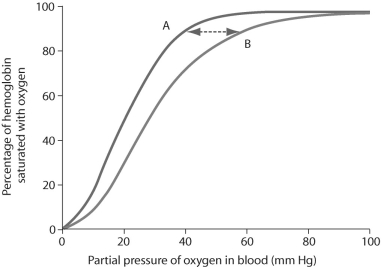 -Based on the figure above,showing fetal and adult oxygen-hemoglobin saturation curves,which of the following conclusions is true?
 (Multiple Choice)
4.7/5 (69)
(69) A physician finds that a 16-year-old male patient,who has a very high-pitched voice and underdeveloped testes,has abnormally low levels of testosterone.What structure(s)might be the reason that this patient is producing such a low level of testosterone? 1. gonads
2) pituitary gland
3) adrenal gland
4) hypothalamus
5) thyroid gland
(Multiple Choice)
4.8/5 (73)
(73) Most clams reproduce by releasing gametes into the water,and two gametes must fuse for successful reproduction.Two populations of a single species of clams were both kept under natural light and temperature conditions.The first population was housed separately,one clam per tank.The second population was kept as a group in a single tank.During the normal mid-summer reproductive period,researchers counted an equal number of individuals releasing gametes in both populations.What hypothesis does this experiment disprove?
(Multiple Choice)
4.8/5 (86)
(86) Which of the following is a challenge to the hypothesis that certain species of animals produce an unusually large number of sperm in order to increase the probability of conception when females engage in multiple matings?
(Multiple Choice)
4.8/5 (84)
(84) Which of the following hormones would you use if you want to induce ovulation right away?
(Multiple Choice)
5.0/5 (71)
(71) 
Filters
- Essay(0)
- Multiple Choice(0)
- Short Answer(0)
- True False(0)
- Matching(0)