



 Chat with AI
Exam 39: Plant Sensory Systems, signals, and Responses

Exam 1: Biology and the Tree of Life35 Questions
Exam 2: Water and Carbon: the Chemical Basis of Life51 Questions
Exam 3: Protein Structure and Function54 Questions
Exam 4: Nucleic Acids and the Rna World40 Questions
Exam 5: An Introduction to Carbohydrates40 Questions
Exam 6: Lipids, membranes, and the First Cells54 Questions
Exam 7: Inside the Cell38 Questions
Exam 8: Cell-Cell Interactions38 Questions
Exam 9: Cellular Respiration and Fermentation38 Questions
Exam 10: Photosynthesis39 Questions
Exam 11: The Cell Cycle39 Questions
Exam 12: Meiosis39 Questions
Exam 13: Mendel and the Gene42 Questions
Exam 14: Dna and the Gene: Synthesis and Repair39 Questions
Exam 15: How Genes Work39 Questions
Exam 16: Transcription, RNA Processing, and Translation39 Questions
Exam 17: Control of Gene Expression in Bacteria38 Questions
Exam 18: Control of Gene Expression in Eukaryotes39 Questions
Exam 19: Analyzing and Engineering Genes41 Questions
Exam 20: Genomics41 Questions
Exam 21: Principles of Development39 Questions
Exam 22: An Introduction to Animal Development40 Questions
Exam 23: An Introduction to Plant Development37 Questions
Exam 24: Evolution by Natural Selection42 Questions
Exam 25: Evolutionary Processes50 Questions
Exam 26: Speciation41 Questions
Exam 27: Phylogenies and the History of Life43 Questions
Exam 28: Bacteria and Archaea38 Questions
Exam 29: Protists36 Questions
Exam 30: Green Algae and Land Plants54 Questions
Exam 31: Fungi40 Questions
Exam 32: An Introduction to Animals42 Questions
Exam 33: Protostome Animals38 Questions
Exam 34: Deuterostome Animals43 Questions
Exam 35: Viruses35 Questions
Exam 36: Plant Form and Function36 Questions
Exam 37: Water and Sugar Transport in Plants42 Questions
Exam 38: Plant Nutrition37 Questions
Exam 39: Plant Sensory Systems, signals, and Responses65 Questions
Exam 40: Plant Reproduction41 Questions
Exam 41: Animal Form and Function38 Questions
Exam 42: Water and Electrolyte Balance in Animals41 Questions
Exam 43: Animal Nutrition43 Questions
Exam 44: Gas Exchange and Circulation46 Questions
Exam 45: Electrical Signals in Animals40 Questions
Exam 46: Animal Sensory Systems and Movement43 Questions
Exam 47: Chemical Signals in Animals38 Questions
Exam 48: Animal Reproduction39 Questions
Exam 49: The Immune System in Animals38 Questions
Exam 50: An Introduction to Ecology41 Questions
Exam 51: Behavioural Ecology39 Questions
Exam 52: Population Ecology49 Questions
Exam 53: Community Ecology39 Questions
Exam 54: Ecosystems41 Questions
Exam 55: Biodiversity and Conservation Biology38 Questions
Select questions type


In the fall,the leaves of some trees change color.This happens because chlorophyll breaks down and the accessory pigments become visible.What hormone is responsible for this?
(Multiple Choice)
4.9/5  (69)
(69) ________ prevents seeds from germinating until conditions are favourable for the growth of the plant.
(Multiple Choice)
4.9/5 (76)
(76) Which of the following is not a characteristic of plant hormones?
(Multiple Choice)
4.9/5 (95)
(95) How does auxin binding to the auxin receptor trigger cell elongation?
(Multiple Choice)
5.0/5 (74)
(74) To find the gene that encodes for the blue-light receptor,researchers inserted the gene for the PHOT1 protein into insect cells growing in culture.When they exposed the transgenic cells to blue light,they found that the PHOT1 protein became phosphorylated.No other plant proteins were present in the insect cells.Which of the following is a reasonable conclusion from this result?
(Multiple Choice)
4.8/5 (72)
(72) To understand how plant phototropic responses are regulated,a researcher performed the following experiment.He exposed oat seedlings to light and then cut off tips of coleoptiles and placed them on agar blocks.Later,the agar blocks were placed on decapitated coleoptiles of other individuals.Some seedlings were kept in darkness,while others were exposed to light.Based on your knowledge of auxin synthesis and mode of action,predict in what cases the decapitated coleoptiles would bend to the right.
(Multiple Choice)
4.9/5 (71)
(71) Antisense gene sequences can be used to block the transcription of specific genes in a cell or group of cells.Suppose you took a cutting from a plant and treated it with an antisense gene that would block the transcription of an enzyme involved in auxin production.What would happen to your cutting?
(Multiple Choice)
4.8/5 (72)
(72) When the researchers inhibited the synthesis of gibberellins in the tobacco plants,neither ethylene nor far-red light could trigger a shade avoidance response.Taken together with the data presented above,these data suggest that gibberellins
(Multiple Choice)
4.9/5 (67)
(67) What hormones are necessary for maintenance of plant tissue culture?
(Multiple Choice)
4.9/5 (83)
(83) Which of the following will occur when sensory hairs in a Venus flytrap are stimulated?
(Multiple Choice)
4.9/5 (82)
(82) Mammalian eyes sense light because they have cells containing molecules called opsins,which change structure when exposed to light.Which of the following plant molecule(s)would be analogous to mammalian opsins in their light-sensing ability?
(Multiple Choice)
4.7/5 (78)
(78) Lettuce seeds need full sunlight to germinate;therefore,germination is inhibited when their phytochrome molecules are in the Pfr conformation.
(Multiple Choice)
4.7/5 (74)
(74) ________ in concentration of auxin in shoot cells and ________ in concentration of auxin in root cells lead to cell elongation.
(Multiple Choice)
4.7/5 (75)
(75) Plant A is diploid and is homozygous for all of the resistance loci.Plant B is tetraploid and is heterozygous for all of the resistance loci.Which is better able to respond to infection?
(Multiple Choice)
4.9/5 (70)
(70) Figure 39.3 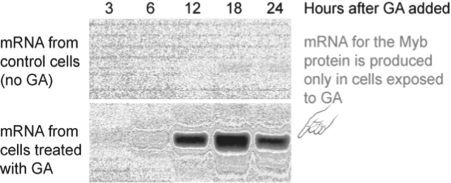 -Figure 39.3 is a Northern blot showing the expression of Myb mRNA in cultured aleurone layer cells that were treated with gibberellin versus control cells that were not treated with gibberellin.Only the gibberellin-treated cells expressed the Myb mRNA,but the Myb mRNA was not detectable until 6-12 hours after gibberellin application.Why did it take so long?
 (Multiple Choice)
5.0/5 (80)
(80) How could you test the hypothesis that caterpillar saliva and a wound are both necessary to attract the parasitoid wasps?
(Multiple Choice)
4.9/5 (75)
(75) Figure 39.1 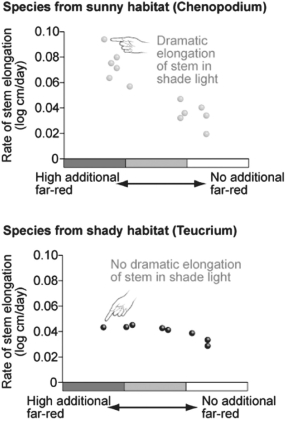 -The data in the figure above were taken from a study on the effects of far-red light on stem elongation.The data indicate that plants from shady habitats do not respond to far-red light by growing taller.Which of the following would be a logical hypothesis for why these plants do not respond to far-red light?
 (Multiple Choice)
5.0/5 (69)
(69) 
Filters
- Essay(0)
- Multiple Choice(0)
- Short Answer(0)
- True False(0)
- Matching(0)