



 Chat with AI
Exam 33: Protostome Animals

Exam 1: Biology and the Tree of Life35 Questions
Exam 2: Water and Carbon: the Chemical Basis of Life51 Questions
Exam 3: Protein Structure and Function54 Questions
Exam 4: Nucleic Acids and the Rna World40 Questions
Exam 5: An Introduction to Carbohydrates40 Questions
Exam 6: Lipids, membranes, and the First Cells54 Questions
Exam 7: Inside the Cell38 Questions
Exam 8: Cell-Cell Interactions38 Questions
Exam 9: Cellular Respiration and Fermentation38 Questions
Exam 10: Photosynthesis39 Questions
Exam 11: The Cell Cycle39 Questions
Exam 12: Meiosis39 Questions
Exam 13: Mendel and the Gene42 Questions
Exam 14: Dna and the Gene: Synthesis and Repair39 Questions
Exam 15: How Genes Work39 Questions
Exam 16: Transcription, RNA Processing, and Translation39 Questions
Exam 17: Control of Gene Expression in Bacteria38 Questions
Exam 18: Control of Gene Expression in Eukaryotes39 Questions
Exam 19: Analyzing and Engineering Genes41 Questions
Exam 20: Genomics41 Questions
Exam 21: Principles of Development39 Questions
Exam 22: An Introduction to Animal Development40 Questions
Exam 23: An Introduction to Plant Development37 Questions
Exam 24: Evolution by Natural Selection42 Questions
Exam 25: Evolutionary Processes50 Questions
Exam 26: Speciation41 Questions
Exam 27: Phylogenies and the History of Life43 Questions
Exam 28: Bacteria and Archaea38 Questions
Exam 29: Protists36 Questions
Exam 30: Green Algae and Land Plants54 Questions
Exam 31: Fungi40 Questions
Exam 32: An Introduction to Animals42 Questions
Exam 33: Protostome Animals38 Questions
Exam 34: Deuterostome Animals43 Questions
Exam 35: Viruses35 Questions
Exam 36: Plant Form and Function36 Questions
Exam 37: Water and Sugar Transport in Plants42 Questions
Exam 38: Plant Nutrition37 Questions
Exam 39: Plant Sensory Systems, signals, and Responses65 Questions
Exam 40: Plant Reproduction41 Questions
Exam 41: Animal Form and Function38 Questions
Exam 42: Water and Electrolyte Balance in Animals41 Questions
Exam 43: Animal Nutrition43 Questions
Exam 44: Gas Exchange and Circulation46 Questions
Exam 45: Electrical Signals in Animals40 Questions
Exam 46: Animal Sensory Systems and Movement43 Questions
Exam 47: Chemical Signals in Animals38 Questions
Exam 48: Animal Reproduction39 Questions
Exam 49: The Immune System in Animals38 Questions
Exam 50: An Introduction to Ecology41 Questions
Exam 51: Behavioural Ecology39 Questions
Exam 52: Population Ecology49 Questions
Exam 53: Community Ecology39 Questions
Exam 54: Ecosystems41 Questions
Exam 55: Biodiversity and Conservation Biology38 Questions
Select questions type


What do all the Lophotrochozoa phyla discussed in the text have in common?
(Multiple Choice)
4.9/5  (73)
(73) Upon close inspection of movement in annelids and nematodes,you would notice an obvious difference.Nematodes tend to wriggle back and forth,while annelids tend to contract along their length as their girth swells and then thins out as they stretch.What anatomical feature explains this type of movement?
(Multiple Choice)
4.8/5 (83)
(83) The presence of a lophophore in a newly discovered species would suggest which of the following?
(Multiple Choice)
4.9/5 (78)
(78) Which one of these mollusc groups can be classified as suspension feeders?
(Multiple Choice)
4.8/5 (81)
(81) What is the only group of Mollusca that does not have a radula?
(Multiple Choice)
4.9/5 (76)
(76) Which of the following do Nematoda and Arthropoda not have in common?
(Multiple Choice)
4.8/5 (83)
(83) Which mollusc group can be described as having several calcium carbonate plates along their dorsal side?
(Multiple Choice)
4.8/5 (93)
(93) Figure 33.1 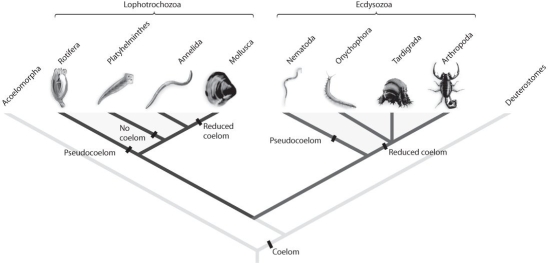 -Refer to Figure 33.1.Suppose new molecular analyses indicated that the phylum Annelida had diverged from the arthropod lineage after Onychophora and Tardigrada.What would this imply about protostome evolution?
 (Multiple Choice)
4.9/5 (86)
(86) What would be the best anatomical feature to look for to distinguish a gastropod from a chiton?
(Multiple Choice)
4.9/5 (59)
(59) Which adaptation is unique to insects among all protostomes?
(Multiple Choice)
4.7/5 (84)
(84) How would a terrestrial centipede most likely benefit from the ability to close its spiracles?
(Multiple Choice)
4.8/5 (78)
(78) Of what advantage is a large surface-area-to-volume ratio to the Platyhelminthes?
(Multiple Choice)
4.9/5 (80)
(80) Whiteflies are common pest insects found on cotton,tomato,poinsettia,and many other plants.Nymphs are translucent and mostly sessile,feeding on their host plants' phloem (sap)from the undersides of leaves.They undergo incomplete metamorphosis into winged adults.Because whitefly nymphs cannot escape predation by moving,you hypothesize that their translucent bodies make them hard to spot by predators.How could you directly test this hypothesis?
(Multiple Choice)
4.8/5 (68)
(68) Here is a statement from the text: "The ability to live in terrestrial environments evolved independently in arthropods (at least twice),molluscs,roundworms,and annelids." What logical conclusion would you make from this statement?
(Multiple Choice)
4.9/5 (71)
(71) If you wanted to identify an unfamiliar protostome with a limbless,wormlike body,which characteristic would not be helpful in differentiating one species from another?
(Multiple Choice)
4.9/5 (85)
(85) 
Filters
- Essay(0)
- Multiple Choice(0)
- Short Answer(0)
- True False(0)
- Matching(0)