



 Chat with AI
Exam 31: Fungi

Exam 1: Biology and the Tree of Life35 Questions
Exam 2: Water and Carbon: the Chemical Basis of Life51 Questions
Exam 3: Protein Structure and Function54 Questions
Exam 4: Nucleic Acids and the Rna World40 Questions
Exam 5: An Introduction to Carbohydrates40 Questions
Exam 6: Lipids, membranes, and the First Cells54 Questions
Exam 7: Inside the Cell38 Questions
Exam 8: Cell-Cell Interactions38 Questions
Exam 9: Cellular Respiration and Fermentation38 Questions
Exam 10: Photosynthesis39 Questions
Exam 11: The Cell Cycle39 Questions
Exam 12: Meiosis39 Questions
Exam 13: Mendel and the Gene42 Questions
Exam 14: Dna and the Gene: Synthesis and Repair39 Questions
Exam 15: How Genes Work39 Questions
Exam 16: Transcription, RNA Processing, and Translation39 Questions
Exam 17: Control of Gene Expression in Bacteria38 Questions
Exam 18: Control of Gene Expression in Eukaryotes39 Questions
Exam 19: Analyzing and Engineering Genes41 Questions
Exam 20: Genomics41 Questions
Exam 21: Principles of Development39 Questions
Exam 22: An Introduction to Animal Development40 Questions
Exam 23: An Introduction to Plant Development37 Questions
Exam 24: Evolution by Natural Selection42 Questions
Exam 25: Evolutionary Processes50 Questions
Exam 26: Speciation41 Questions
Exam 27: Phylogenies and the History of Life43 Questions
Exam 28: Bacteria and Archaea38 Questions
Exam 29: Protists36 Questions
Exam 30: Green Algae and Land Plants54 Questions
Exam 31: Fungi40 Questions
Exam 32: An Introduction to Animals42 Questions
Exam 33: Protostome Animals38 Questions
Exam 34: Deuterostome Animals43 Questions
Exam 35: Viruses35 Questions
Exam 36: Plant Form and Function36 Questions
Exam 37: Water and Sugar Transport in Plants42 Questions
Exam 38: Plant Nutrition37 Questions
Exam 39: Plant Sensory Systems, signals, and Responses65 Questions
Exam 40: Plant Reproduction41 Questions
Exam 41: Animal Form and Function38 Questions
Exam 42: Water and Electrolyte Balance in Animals41 Questions
Exam 43: Animal Nutrition43 Questions
Exam 44: Gas Exchange and Circulation46 Questions
Exam 45: Electrical Signals in Animals40 Questions
Exam 46: Animal Sensory Systems and Movement43 Questions
Exam 47: Chemical Signals in Animals38 Questions
Exam 48: Animal Reproduction39 Questions
Exam 49: The Immune System in Animals38 Questions
Exam 50: An Introduction to Ecology41 Questions
Exam 51: Behavioural Ecology39 Questions
Exam 52: Population Ecology49 Questions
Exam 53: Community Ecology39 Questions
Exam 54: Ecosystems41 Questions
Exam 55: Biodiversity and Conservation Biology38 Questions
Select questions type


You are a forester charged with increasing productivity in a South American forest newly planted with pines from Oregon.You believe that the southern forest lacks the fungal diversity needed by the North American pines,and that this lack of fungi is affecting the pines' productivity,but you have no evidence to support your ideas.To count how many fungal species were present in the Oregon forest,which methodology would you choose,and why?
(Multiple Choice)
4.8/5  (71)
(71) Looking at Figure 31.1,draw a new graph that plots the percentage of plant species in the fossil pollen and spore record,and write a figure legend comparing it to the original figure.
(Short Answer)
4.9/5 (69)
(69) The fungi that we commonly know as mushrooms produce which of the following reproductive structures?
(Multiple Choice)
4.9/5 (87)
(87) Which of the following is an important role for fungi in the carbon cycle?
(Multiple Choice)
4.9/5 (75)
(75) If seedlings in the shade commonly do receive sugars from plants in the sunlight,which of the following areas should be investigated by future research? Explain why you think each area should (or should not)be investigated? Issues to consider: (1)Plausibility-can the research be performed with current technologies? (2)Is it an interesting question that will lead to valuable future knowledge? If so,describe why the information will be helpful.
A.The above-described exchanges were all among seedlings of the same age.Is the rate or degree of carbon transfer from one plant to another more affected by the degree of shading,or by the relative photosynthetic ability (size/age of the tree)?
B.Does the identity of the partners matter for rate or degree of carbon transfer? Is there a greater exchange among trees of the same species compared to trees of different species? Or do different fungal species have different capacities for transfer?
C.How far (linear distance in meters)can carbon be transferred in nature? Do exchanges occur only between adjacent plants,or can sugars be taken up by plants outside the immediate neighbors? Does distance affect the rate/degree of exchange in and of itself? (Can a heavily shaded tree that is farther away receive more carbon than a nearby tree in the sun?)
D.All of these areas should be investigated.
(Essay)
5.0/5 (78)
(78) Some fungal species can kill herbivores while feeding off of sugars from its plant host.What type of relationship does this fungus have with its host?
(Multiple Choice)
4.8/5 (87)
(87) Simard et al.(1997)further hypothesized that if reciprocal transfer did occur,it would be a source-sink relationship driven by photosynthetic rates.That is,if one seedling is in full sun and the other in deep shade,there will be a net movement of carbon from the seedling in full sun to the one in deep shade.If a shade was placed over the birch seedlings and the cedar,and the Douglas fir was left in full sun,what result could Simard and colleagues expect?
(Multiple Choice)
4.8/5 (73)
(73) There is much discussion in the media about protecting biodiversity, but does it really matter? Canadian and Swiss researchers wanted to know if the diversity of arbuscular mycorrhizal fungi (AMF)was important to the productivity of grasslands (M.G.A. van der Heijden, J. N. Klironomos, M. Ursic, P. Moutoglis, R. Streitwolf-Engel, T. Boler, A. Wiemken, and I. R. Sanders. 1998. Mycorrhizal fungal diversity determines plant biodiversity, ecosystem variability and productivity. Nature 396:69-72). Specifically, they wanted to know if it mattered which specific AMF species were present, or just that some type of AMF was present. They grew various plants in combination with one of four AMF species, no AMF, or all four AMF species together; and they measured plant growth under each set of conditions. All plant species were grown in each plot, so they always competed with each other with the only difference being which AMF species were present. Use the graphs in Figure 31.4 to answer the questions that follow. Note that the x-axis labels indicate the number and identity of AMF species (bar 0 = no fungi; bars A-D = individual AMF species; bar A+B+C+D = all AMF species together). The y-axis indicates the amount (grams)of plant biomass for the species shown in italics above each graph.
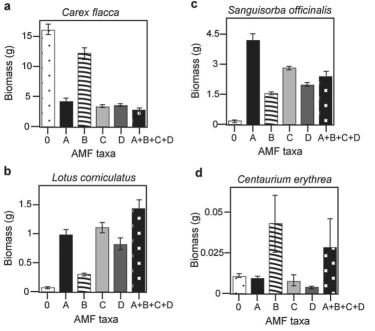 Figure 31.4
-Based on the van der Heijden et al.(1998)graphs in Figure 31.4,which of the following is the best description of the data supporting the idea that a plant species did not form mycorrhizae with a fungus?
Figure 31.4
-Based on the van der Heijden et al.(1998)graphs in Figure 31.4,which of the following is the best description of the data supporting the idea that a plant species did not form mycorrhizae with a fungus? (Multiple Choice)
4.8/5 (77)
(77) Suzanne Simard and colleagues knew that the same mycorrhizal fungal species could colonize multiple types of trees. They wondered if the same fungal individual would colonize different trees, forming an underground network that potentially could transport carbon and nutrients from one tree to another (S. Simard et al. 1997. Net transfer of carbon between mycorrhizal tree species in the field. Nature 388:579-82). Figure 31.2 illustrates the team's experimental setup. Pots containing seedlings of three different tree species were set up and grown under natural conditions for three years; two of the three species formed ectomycorrhizae (Douglas fir, birch)and the other (cedar)formed arbuscular mycorrhizae. For the experiment, the researchers placed airtight bags over the Douglas fir and birch seedlings; into each bag, they injected either carbon dioxide made from carbon-13 or carbon-14 (¹³CO₂ and ¹⁴CO₂, isotopes of carbon). As the seedlings photosynthesized, the radioactive carbon dioxide was converted into radioactively labeled sugars that could be tracked and measured by the researchers.
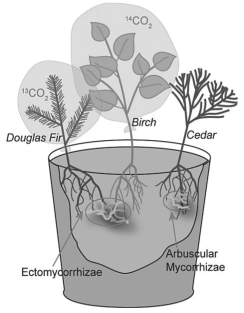 Figure 31.2
-Refer to Figure 31.2.Which of the following results would support Simard et al.'s (1997)hypothesis that fungi can move carbon from one plant to another? Hypothesis: Sugars made by one plant during photosynthesis can travel through a mycorrhizal fungus and be incorporated into the tissues of another plant.
Figure 31.2
-Refer to Figure 31.2.Which of the following results would support Simard et al.'s (1997)hypothesis that fungi can move carbon from one plant to another? Hypothesis: Sugars made by one plant during photosynthesis can travel through a mycorrhizal fungus and be incorporated into the tissues of another plant. (Multiple Choice)
4.9/5 (68)
(68) There is much discussion in the media about protecting biodiversity, but does it really matter? Canadian and Swiss researchers wanted to know if the diversity of arbuscular mycorrhizal fungi (AMF)was important to the productivity of grasslands (M.G.A. van der Heijden, J. N. Klironomos, M. Ursic, P. Moutoglis, R. Streitwolf-Engel, T. Boler, A. Wiemken, and I. R. Sanders. 1998. Mycorrhizal fungal diversity determines plant biodiversity, ecosystem variability and productivity. Nature 396:69-72). Specifically, they wanted to know if it mattered which specific AMF species were present, or just that some type of AMF was present. They grew various plants in combination with one of four AMF species, no AMF, or all four AMF species together; and they measured plant growth under each set of conditions. All plant species were grown in each plot, so they always competed with each other with the only difference being which AMF species were present. Use the graphs in Figure 31.4 to answer the questions that follow. Note that the x-axis labels indicate the number and identity of AMF species (bar 0 = no fungi; bars A-D = individual AMF species; bar A+B+C+D = all AMF species together). The y-axis indicates the amount (grams)of plant biomass for the species shown in italics above each graph.
Figure 31.4
-Which of the following best explains the data given in graph (b)of Figure 31.4 about Lotus corniculatus?
Figure 31.4
-Which of the following best explains the data given in graph (b)of Figure 31.4 about Lotus corniculatus? (Multiple Choice)
4.7/5 (82)
(82) The fungus Saccharomyces cerevisiae is a model eukaryotic cell for genetic studies.Which of the following is an important attribute that makes this organism ideal for this purpose?
(Multiple Choice)
5.0/5 (86)
(86) Fungi have an extremely high surface-area-to-volume ratio.What is the advantage of this to an organism that gets most of its nutrition through absorption?
(Multiple Choice)
4.8/5 (86)
(86) The researchers then wanted to know if plant biodiversity and productivity would increase in a natural system as a result of increasing AMF diversity beyond just four species. Consider Figure 31.6 below (Figure 2 from van der Heijden et al. 1998):
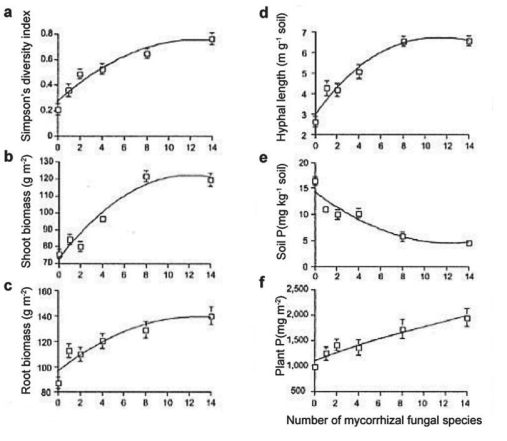 Figure 31.6
-Plant biomass (growth)in Figure 31.6 increases as fungal diversity increases.True or false?
Figure 31.6
-Plant biomass (growth)in Figure 31.6 increases as fungal diversity increases.True or false? (True/False)
5.0/5 (76)
(76) This symbiotic association grows on rocks,where it begins the process of soil formation,and it is a major food source for caribou.
(Multiple Choice)
4.9/5 (76)
(76) After looking at Figure 31.1 above,why do you think the spike in fungal abundance ended so "abruptly"? Why didn't fungal abundance remain high?
(Multiple Choice)
4.9/5 (78)
(78) This group of fungi has the ability to penetrate its host's cell wall,thus increasing the efficiency with which materials are passed from fungus to host.
(Multiple Choice)
4.8/5 (73)
(73) There was a mass extinction of plants and animals at the end of the Permian period 250 million years ago.Which of the following would be a reasonable prediction for the fungal fossil record?
(Multiple Choice)
4.9/5 (83)
(83) Most coal was formed during the Carboniferous period.What is a reasonable hypothesis that explains this observation?
(Multiple Choice)
4.8/5 (67)
(67) The researchers then wanted to know if plant biodiversity and productivity would increase in a natural system as a result of increasing AMF diversity beyond just four species. Consider Figure 31.6 below (Figure 2 from van der Heijden et al. 1998):
Figure 31.6
-The plants in graphs (b),(c),(e),and (f)have mycorrhizal associations.True or false?
Figure 31.6
-The plants in graphs (b),(c),(e),and (f)have mycorrhizal associations.True or false? (True/False)
5.0/5 (80)
(80) 
Filters
- Essay(0)
- Multiple Choice(0)
- Short Answer(0)
- True False(0)
- Matching(0)