



 Chat with AI
Exam 27: Phylogenies and the History of Life

Exam 1: Biology and the Tree of Life35 Questions
Exam 2: Water and Carbon: the Chemical Basis of Life51 Questions
Exam 3: Protein Structure and Function54 Questions
Exam 4: Nucleic Acids and the Rna World40 Questions
Exam 5: An Introduction to Carbohydrates40 Questions
Exam 6: Lipids, membranes, and the First Cells54 Questions
Exam 7: Inside the Cell38 Questions
Exam 8: Cell-Cell Interactions38 Questions
Exam 9: Cellular Respiration and Fermentation38 Questions
Exam 10: Photosynthesis39 Questions
Exam 11: The Cell Cycle39 Questions
Exam 12: Meiosis39 Questions
Exam 13: Mendel and the Gene42 Questions
Exam 14: Dna and the Gene: Synthesis and Repair39 Questions
Exam 15: How Genes Work39 Questions
Exam 16: Transcription, RNA Processing, and Translation39 Questions
Exam 17: Control of Gene Expression in Bacteria38 Questions
Exam 18: Control of Gene Expression in Eukaryotes39 Questions
Exam 19: Analyzing and Engineering Genes41 Questions
Exam 20: Genomics41 Questions
Exam 21: Principles of Development39 Questions
Exam 22: An Introduction to Animal Development40 Questions
Exam 23: An Introduction to Plant Development37 Questions
Exam 24: Evolution by Natural Selection42 Questions
Exam 25: Evolutionary Processes50 Questions
Exam 26: Speciation41 Questions
Exam 27: Phylogenies and the History of Life43 Questions
Exam 28: Bacteria and Archaea38 Questions
Exam 29: Protists36 Questions
Exam 30: Green Algae and Land Plants54 Questions
Exam 31: Fungi40 Questions
Exam 32: An Introduction to Animals42 Questions
Exam 33: Protostome Animals38 Questions
Exam 34: Deuterostome Animals43 Questions
Exam 35: Viruses35 Questions
Exam 36: Plant Form and Function36 Questions
Exam 37: Water and Sugar Transport in Plants42 Questions
Exam 38: Plant Nutrition37 Questions
Exam 39: Plant Sensory Systems, signals, and Responses65 Questions
Exam 40: Plant Reproduction41 Questions
Exam 41: Animal Form and Function38 Questions
Exam 42: Water and Electrolyte Balance in Animals41 Questions
Exam 43: Animal Nutrition43 Questions
Exam 44: Gas Exchange and Circulation46 Questions
Exam 45: Electrical Signals in Animals40 Questions
Exam 46: Animal Sensory Systems and Movement43 Questions
Exam 47: Chemical Signals in Animals38 Questions
Exam 48: Animal Reproduction39 Questions
Exam 49: The Immune System in Animals38 Questions
Exam 50: An Introduction to Ecology41 Questions
Exam 51: Behavioural Ecology39 Questions
Exam 52: Population Ecology49 Questions
Exam 53: Community Ecology39 Questions
Exam 54: Ecosystems41 Questions
Exam 55: Biodiversity and Conservation Biology38 Questions
Select questions type


Some beetles and flies have antler-like structures on their heads,much like male deer do.The existence of antlers in beetle,fly,and deer species with strong male-male competition is an example of
(Multiple Choice)
4.9/5  (56)
(56) You have obtained the following data on genetic similarity among five species.The higher the number,the closer the relationship between the two species (so a species is related to itself 100%).What approach can you take to construct a phylogeny using these data? 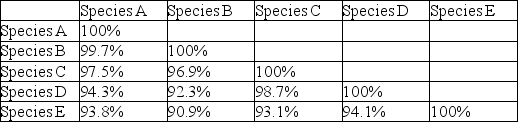
(Multiple Choice)
4.8/5 (76)
(76) Figure 27.8 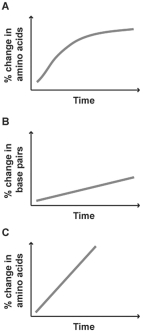 -The graphs above show percentage of change in three different molecular sequences plotted against time.Which of these molecular sequences would make a good candidate for a molecular clock?
 (Multiple Choice)
4.9/5 (77)
(77) You know that a particular stretch of DNA changes at the rate of 1 base per 10 million years.You sequence this length of DNA in two species and find that they differ by 4 bases: AATGCGATCG and AATGTTATGC.Based on these data,how long has it been since these two species diverged? (Hint: Ancestral sequence is AATGCTATGG.)
(Multiple Choice)
4.7/5 (76)
(76) Which listing of geological periods is in the correct order,from oldest to most recent?
(Multiple Choice)
4.7/5 (73)
(73) Figure 27.9 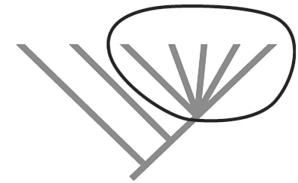 -What does the circled part of the phylogenetic tree above indicate?
 (Multiple Choice)
4.9/5 (79)
(79) Which of the following are typically responsible for island extinctions?
(Multiple Choice)
4.8/5 (74)
(74) To use a genetic sequence as a molecular clock,the changes in nucleotides in the sequence must have accumulated at a steady pace over time.Drawing on what you know about codons and redundancy in the genetic code,which type of change would most likely be the type that is useful for a molecular clock?
(Multiple Choice)
4.7/5 (75)
(75) Why would gene duplication events,such as those seen in the Hox gene complex,set the stage for adaptive radiation?
(Multiple Choice)
4.8/5 (71)
(71) Figure 27.7 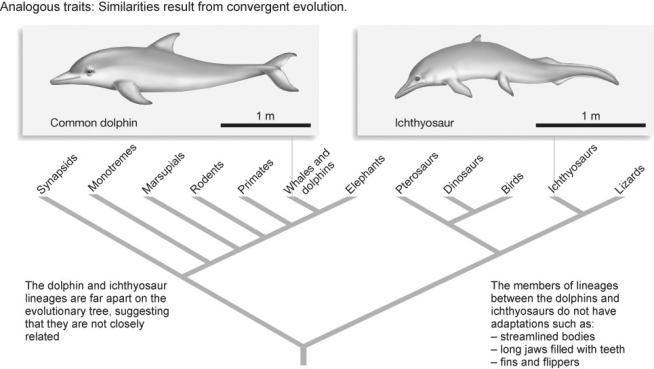 -For the streamlined bodies shown in Figure 27.7 above to be homologous instead of homoplasious,which of the following groups would also have to have streamlined bodies?
 (Multiple Choice)
4.9/5 (78)
(78) How do mass extinctions differ from background extinctions?
(Multiple Choice)
4.8/5 (78)
(78) What is thought to be the significance of the duplication of homeotic genes?
(Multiple Choice)
4.8/5 (75)
(75) You are using a molecular clock to investigate how long ago two taxa diverged.In the sequence of mitochondrial DNA you are using,in one location an arginine mutated to a thymine;thousands of years later,it mutated from thymine back to arginine.What effect will this reversion to arginine have on your estimate of the time of divergence?
(Multiple Choice)
4.8/5 (73)
(73) Which of the following would be least likely in the fossil record?
(Multiple Choice)
4.8/5 (71)
(71) Which of the following statements best describes the rationale for applying the principle of parsimony in constructing phylogenetic trees?
(Multiple Choice)
4.9/5 (66)
(66) Islands are well known for having many endemic species-species that are unique to that location.What is a likely explanation for this pattern?
(Multiple Choice)
4.9/5 (89)
(89) The theory of plate tectonics describes movement of plates of the Earth's crust through time.Which of the following can you deduce from what you learned in this chapter about plate tectonics?
(Multiple Choice)
4.8/5 (86)
(86) Which of the following traits is useful in generating a phylogeny of species W,X,Y,and Z? 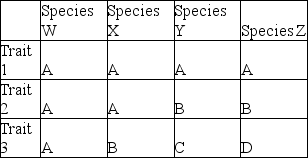
(Multiple Choice)
4.9/5 (77)
(77) Dicynodonts were pig-sized reptiles that lived during the Permian geologic period.An increase in dicynodont species diversity occurred soon after the Permian extinction.Given what you know of this period,this increase in dicynodont species diversity represents ________,most likely due to ________.
(Multiple Choice)
4.8/5 (80)
(80) 
Filters
- Essay(0)
- Multiple Choice(0)
- Short Answer(0)
- True False(0)
- Matching(0)