



 Chat with AI
Exam 26: Speciation

Exam 1: Biology and the Tree of Life35 Questions
Exam 2: Water and Carbon: the Chemical Basis of Life51 Questions
Exam 3: Protein Structure and Function54 Questions
Exam 4: Nucleic Acids and the Rna World40 Questions
Exam 5: An Introduction to Carbohydrates40 Questions
Exam 6: Lipids, membranes, and the First Cells54 Questions
Exam 7: Inside the Cell38 Questions
Exam 8: Cell-Cell Interactions38 Questions
Exam 9: Cellular Respiration and Fermentation38 Questions
Exam 10: Photosynthesis39 Questions
Exam 11: The Cell Cycle39 Questions
Exam 12: Meiosis39 Questions
Exam 13: Mendel and the Gene42 Questions
Exam 14: Dna and the Gene: Synthesis and Repair39 Questions
Exam 15: How Genes Work39 Questions
Exam 16: Transcription, RNA Processing, and Translation39 Questions
Exam 17: Control of Gene Expression in Bacteria38 Questions
Exam 18: Control of Gene Expression in Eukaryotes39 Questions
Exam 19: Analyzing and Engineering Genes41 Questions
Exam 20: Genomics41 Questions
Exam 21: Principles of Development39 Questions
Exam 22: An Introduction to Animal Development40 Questions
Exam 23: An Introduction to Plant Development37 Questions
Exam 24: Evolution by Natural Selection42 Questions
Exam 25: Evolutionary Processes50 Questions
Exam 26: Speciation41 Questions
Exam 27: Phylogenies and the History of Life43 Questions
Exam 28: Bacteria and Archaea38 Questions
Exam 29: Protists36 Questions
Exam 30: Green Algae and Land Plants54 Questions
Exam 31: Fungi40 Questions
Exam 32: An Introduction to Animals42 Questions
Exam 33: Protostome Animals38 Questions
Exam 34: Deuterostome Animals43 Questions
Exam 35: Viruses35 Questions
Exam 36: Plant Form and Function36 Questions
Exam 37: Water and Sugar Transport in Plants42 Questions
Exam 38: Plant Nutrition37 Questions
Exam 39: Plant Sensory Systems, signals, and Responses65 Questions
Exam 40: Plant Reproduction41 Questions
Exam 41: Animal Form and Function38 Questions
Exam 42: Water and Electrolyte Balance in Animals41 Questions
Exam 43: Animal Nutrition43 Questions
Exam 44: Gas Exchange and Circulation46 Questions
Exam 45: Electrical Signals in Animals40 Questions
Exam 46: Animal Sensory Systems and Movement43 Questions
Exam 47: Chemical Signals in Animals38 Questions
Exam 48: Animal Reproduction39 Questions
Exam 49: The Immune System in Animals38 Questions
Exam 50: An Introduction to Ecology41 Questions
Exam 51: Behavioural Ecology39 Questions
Exam 52: Population Ecology49 Questions
Exam 53: Community Ecology39 Questions
Exam 54: Ecosystems41 Questions
Exam 55: Biodiversity and Conservation Biology38 Questions
Select questions type


Imagine two North American ground cricket species that contact each other as the southern species moves northward during a period of global warming.These two species do not mate much,due to differences in their courtship songs.The northern cricket does not seem to tolerate the warmer temperatures well,but is limited in its ability to move north because it does not normally disperse much.Based on this information,which is the most likely outcome?
(Multiple Choice)
4.8/5  (84)
(84) You are studying two populations of spiders of the Dolomedes genus,characterized by a light stripe down each side of the body.One population lives in a pond,while another nearby population lives in the trees.Which of the following species concept would you be using if you determined that these were two different species?
(Multiple Choice)
4.9/5 (86)
(86) Natural selection for traits that keep distinct populations from reproducing with each other is called reinforcement.When is reinforcement beneficial?
(Multiple Choice)
4.8/5 (89)
(89) Which of the following reproductive barriers would prevent a hybrid zygote from developing into a viable,fertile adult?
(Multiple Choice)
4.9/5 (75)
(75) If the isthmus formed gradually rather than suddenly,what pattern of genetic divergence would you expect to find in these species pairs?
(Multiple Choice)
4.9/5 (81)
(81) Many songbirds breed in North America in the spring and summer and then migrate to Central and South America in the fall.They spend the winter in these warmer areas,where they feed and prepare for the spring migration north and another breeding season.Two hypothetical species of sparrow,A and B,overwinter together in mixed flocks in Costa Rica.In spring,species A goes to the east coast of North America,and species B goes to the west coast.What can you say about the isolating mechanisms of these two species?
(Multiple Choice)
4.8/5 (84)
(84) Two researchers experimentally formed tetraploid frogs by fertilizing diploid eggs from Rana porosa brevipoda with diploid sperm from Rana nigromaculata.When they mated these tetraploid frogs with each other,most of the offspring that survived to maturity were tetraploid,with chromosome sets of both diploid parent species.Based on these results,if this type of tetraploid formed in the wild,what would be the result? (Y.Kondo and A.Kashiwagi.2004.Experimentally induced autotetraploidy and allotetraploidy in two Japanese pond frogs.Journal of Herpetology 38(3):381-92.)
(Multiple Choice)
4.8/5 (77)
(77) The common edible frog of Europe is a hybrid between two species,Rana lessonae and Rana ridibunda.The hybrids were first described in 1758 and have a wide distribution,from France across central Europe to Russia.Both male and female hybrids exist,but when they mate among themselves,they are rarely successful in producing offspring.What can you infer from this information?
(Multiple Choice)
4.9/5 (76)
(76) The snake family Typhlopidae consists of small,burrowing species with vestigial eyes.They are found in Australia,sub-Saharan Africa,India and some adjacent areas,and South America.What is the most likely explanation for this distribution?
(Multiple Choice)
4.8/5 (67)
(67) Male frogs give calls that attract female frogs to approach and mate.Researchers examined mating calls of closely related tree frogs in South America.What outcomes can occur where the ranges of two species overlap?
(Multiple Choice)
4.9/5 (86)
(86) Most causes of speciation are relatively slow,in that they may take many generations of organism to see changes,except
(Multiple Choice)
4.8/5 (91)
(91) Which of the following is a disadvantage of the morphological species concept?
(Multiple Choice)
4.9/5 (63)
(63) Male frogs give calls that attract female frogs to approach and mate.Researchers examined mating calls of closely related tree frogs in South America.If reinforcement of prezygotic isolation is occurring,what would you expect if you compare the calls of the two species in zones of sympatry versus zones of allopatry?
(Multiple Choice)
4.8/5 (75)
(75) The sister populations on opposite sides of the isthmus are true species under which species concept?
(Multiple Choice)
5.0/5 (73)
(73) How are two different species most likely to evolve from one ancestral species?
(Multiple Choice)
4.9/5 (87)
(87) When the Isthmus of Panama formed,a land bridge resulted between North and South America.What opportunities for colonization did this land bridge offer?
(Multiple Choice)
4.8/5 (83)
(83) Three populations of crickets look very similar,but the males have courtship songs that sound different.What function would this difference in song likely serve if the populations came in contact?
(Multiple Choice)
4.9/5 (78)
(78) Figure 26.1 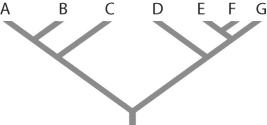 -Refer to Figure 26.1.Which of the following forms a monophyletic group?
 (Multiple Choice)
4.8/5 (89)
(89) 
Filters
- Essay(0)
- Multiple Choice(0)
- Short Answer(0)
- True False(0)
- Matching(0)