



 Chat with AI
Exam 16: Transcription, RNA Processing, and Translation

Exam 1: Biology and the Tree of Life35 Questions
Exam 2: Water and Carbon: the Chemical Basis of Life51 Questions
Exam 3: Protein Structure and Function54 Questions
Exam 4: Nucleic Acids and the Rna World40 Questions
Exam 5: An Introduction to Carbohydrates40 Questions
Exam 6: Lipids, membranes, and the First Cells54 Questions
Exam 7: Inside the Cell38 Questions
Exam 8: Cell-Cell Interactions38 Questions
Exam 9: Cellular Respiration and Fermentation38 Questions
Exam 10: Photosynthesis39 Questions
Exam 11: The Cell Cycle39 Questions
Exam 12: Meiosis39 Questions
Exam 13: Mendel and the Gene42 Questions
Exam 14: Dna and the Gene: Synthesis and Repair39 Questions
Exam 15: How Genes Work39 Questions
Exam 16: Transcription, RNA Processing, and Translation39 Questions
Exam 17: Control of Gene Expression in Bacteria38 Questions
Exam 18: Control of Gene Expression in Eukaryotes39 Questions
Exam 19: Analyzing and Engineering Genes41 Questions
Exam 20: Genomics41 Questions
Exam 21: Principles of Development39 Questions
Exam 22: An Introduction to Animal Development40 Questions
Exam 23: An Introduction to Plant Development37 Questions
Exam 24: Evolution by Natural Selection42 Questions
Exam 25: Evolutionary Processes50 Questions
Exam 26: Speciation41 Questions
Exam 27: Phylogenies and the History of Life43 Questions
Exam 28: Bacteria and Archaea38 Questions
Exam 29: Protists36 Questions
Exam 30: Green Algae and Land Plants54 Questions
Exam 31: Fungi40 Questions
Exam 32: An Introduction to Animals42 Questions
Exam 33: Protostome Animals38 Questions
Exam 34: Deuterostome Animals43 Questions
Exam 35: Viruses35 Questions
Exam 36: Plant Form and Function36 Questions
Exam 37: Water and Sugar Transport in Plants42 Questions
Exam 38: Plant Nutrition37 Questions
Exam 39: Plant Sensory Systems, signals, and Responses65 Questions
Exam 40: Plant Reproduction41 Questions
Exam 41: Animal Form and Function38 Questions
Exam 42: Water and Electrolyte Balance in Animals41 Questions
Exam 43: Animal Nutrition43 Questions
Exam 44: Gas Exchange and Circulation46 Questions
Exam 45: Electrical Signals in Animals40 Questions
Exam 46: Animal Sensory Systems and Movement43 Questions
Exam 47: Chemical Signals in Animals38 Questions
Exam 48: Animal Reproduction39 Questions
Exam 49: The Immune System in Animals38 Questions
Exam 50: An Introduction to Ecology41 Questions
Exam 51: Behavioural Ecology39 Questions
Exam 52: Population Ecology49 Questions
Exam 53: Community Ecology39 Questions
Exam 54: Ecosystems41 Questions
Exam 55: Biodiversity and Conservation Biology38 Questions
Select questions type


Which of the following occurs in prokaryotes,but not eukaryotes?
(Multiple Choice)
4.9/5  (70)
(70) Death cap mushrooms produce a substance called -amanitin.α-amanitin efficiently blocks synthesis of mRNA,but not of tRNA or rRNA in eukaryotic organisms.How is that possible?
(Multiple Choice)
4.7/5 (78)
(78) Which of the following processes is central to the initiation of transcription?
(Multiple Choice)
4.9/5 (76)
(76) Which of the following does not play a role in the process of translation?
(Multiple Choice)
4.8/5 (88)
(88) Figure 16.4 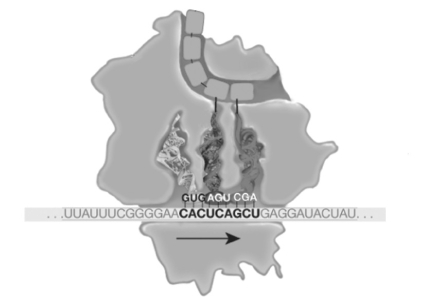 -Refer to Figure 16.4.During elongation,which site in the ribosome represents the location where a codon is being read?
 (Multiple Choice)
4.9/5 (79)
(79) RNA polymerase needs a subunit to initiate transcription that is not needed for transcript elongation.What is the subunit?
(Multiple Choice)
5.0/5 (67)
(67) Which of the following is/are post-transcriptional modifications occurring in eukaryotic mRNAs?
(Multiple Choice)
4.7/5 (82)
(82) There should be a strong positive correlation between the rate of protein synthesis and
(Multiple Choice)
4.9/5 (75)
(75) What is the function of the group of amino acids on the RNA polymerase called the rudder?
(Multiple Choice)
4.9/5 (75)
(75) Put the following events of elongation in prokaryotic translation in chronological order. 1. Binding of mRNA with small ribosomal subunit.
2) Recognition of initiation codon
3) Complementary base pairing between initiator codon and anticodon of initiator tRNA
4) Base pairing of the mRNA codon following the initiator codon with its complementary tRNA
5) Attachment of the large subunit
(Multiple Choice)
4.7/5 (78)
(78) Once a peptide has been formed between the amino acid attached to the tRNA in the P site and the amino acid associated with the tRNA in the A site,which process on the list occurs next?
(Multiple Choice)
4.8/5 (81)
(81) David Pribnow studied the base sequences of promoters in bacteria and bacterial viruses.He found two conserved regions in these promoters (the -10 box and the -35 box).What is the function of these two regions of the promoter?
(Multiple Choice)
4.8/5 (80)
(80) As scientists were unraveling the mysteries associated with transcription and translation,they discovered there was not a one-to-one correspondence between nucleotide sequence of a gene and base sequence of the mRNA it codes for.They proposed the genes-in-pieces hypothesis.How can the genes-in-pieces hypothesis be explained?
(Multiple Choice)
4.9/5 (84)
(84) What molecule is responsible for the catalytic activity in the spliceosomes that are involved in removal of introns?
(Multiple Choice)
4.8/5 (62)
(62) The segments of DNA where transcription begins have a binding site for RNA polymerase.These segments are known as
(Multiple Choice)
4.9/5 (73)
(73) Codons are three-base sequences that specify the addition of a single amino acid.How do eukaryotic codons and prokaryotic codons compare?
(Multiple Choice)
4.7/5 (86)
(86) Figure 16.5 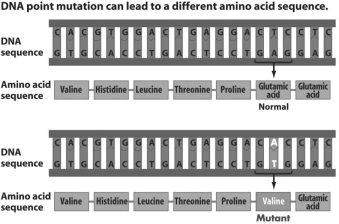 -Refer to Figure 16.5.The mutation resulting in sickle cell anemia is an example of a
 (Multiple Choice)
4.9/5 (71)
(71) Put the following events of transcription in chronological order. 1. Sigma binds to the promoter region.
2) The double helix of DNA is unwound,breaking hydrogen bonds between complementary strands.
3) Sigma binds to RNA polymerase.
4) Sigma is released.
5) Transcription begins.
(Multiple Choice)
4.7/5 (85)
(85) 
Filters
- Essay(0)
- Multiple Choice(0)
- Short Answer(0)
- True False(0)
- Matching(0)