



 Chat with AI
Exam 15: How Genes Work

Exam 1: Biology and the Tree of Life35 Questions
Exam 2: Water and Carbon: the Chemical Basis of Life51 Questions
Exam 3: Protein Structure and Function54 Questions
Exam 4: Nucleic Acids and the Rna World40 Questions
Exam 5: An Introduction to Carbohydrates40 Questions
Exam 6: Lipids, membranes, and the First Cells54 Questions
Exam 7: Inside the Cell38 Questions
Exam 8: Cell-Cell Interactions38 Questions
Exam 9: Cellular Respiration and Fermentation38 Questions
Exam 10: Photosynthesis39 Questions
Exam 11: The Cell Cycle39 Questions
Exam 12: Meiosis39 Questions
Exam 13: Mendel and the Gene42 Questions
Exam 14: Dna and the Gene: Synthesis and Repair39 Questions
Exam 15: How Genes Work39 Questions
Exam 16: Transcription, RNA Processing, and Translation39 Questions
Exam 17: Control of Gene Expression in Bacteria38 Questions
Exam 18: Control of Gene Expression in Eukaryotes39 Questions
Exam 19: Analyzing and Engineering Genes41 Questions
Exam 20: Genomics41 Questions
Exam 21: Principles of Development39 Questions
Exam 22: An Introduction to Animal Development40 Questions
Exam 23: An Introduction to Plant Development37 Questions
Exam 24: Evolution by Natural Selection42 Questions
Exam 25: Evolutionary Processes50 Questions
Exam 26: Speciation41 Questions
Exam 27: Phylogenies and the History of Life43 Questions
Exam 28: Bacteria and Archaea38 Questions
Exam 29: Protists36 Questions
Exam 30: Green Algae and Land Plants54 Questions
Exam 31: Fungi40 Questions
Exam 32: An Introduction to Animals42 Questions
Exam 33: Protostome Animals38 Questions
Exam 34: Deuterostome Animals43 Questions
Exam 35: Viruses35 Questions
Exam 36: Plant Form and Function36 Questions
Exam 37: Water and Sugar Transport in Plants42 Questions
Exam 38: Plant Nutrition37 Questions
Exam 39: Plant Sensory Systems, signals, and Responses65 Questions
Exam 40: Plant Reproduction41 Questions
Exam 41: Animal Form and Function38 Questions
Exam 42: Water and Electrolyte Balance in Animals41 Questions
Exam 43: Animal Nutrition43 Questions
Exam 44: Gas Exchange and Circulation46 Questions
Exam 45: Electrical Signals in Animals40 Questions
Exam 46: Animal Sensory Systems and Movement43 Questions
Exam 47: Chemical Signals in Animals38 Questions
Exam 48: Animal Reproduction39 Questions
Exam 49: The Immune System in Animals38 Questions
Exam 50: An Introduction to Ecology41 Questions
Exam 51: Behavioural Ecology39 Questions
Exam 52: Population Ecology49 Questions
Exam 53: Community Ecology39 Questions
Exam 54: Ecosystems41 Questions
Exam 55: Biodiversity and Conservation Biology38 Questions
Select questions type


Which of the following findings violated the central dogma?
(Multiple Choice)
4.8/5  (87)
(87) For a hypothetical gene,how do the terms dominance and recessive relate to gene expression and how genes work?
(Multiple Choice)
4.9/5 (83)
(83) How might a single base substitution in the sequence of a gene affect the amino acid sequence of a protein encoded by the gene,and why?
(Multiple Choice)
4.7/5 (86)
(86) What molecule serves as a link between the information-containing macromolecule,DNA,and protein synthesis?
(Multiple Choice)
4.9/5 (69)
(69) Codons,the three base sequences that code for specific amino acids,are part of
(Multiple Choice)
4.8/5 (61)
(61) Figure 15.2 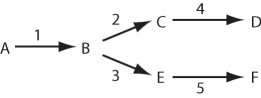 -Refer to Figure 15.2.In the branched metabolic pathway,if enzyme 3 is defective,you might expect to see an increase in the amount of which intermediate/product?
 (Multiple Choice)
5.0/5 (82)
(82) The central dogma has been challenged on several levels (e.g.,the discovery of RNA viruses,which use their RNA to directly synthesize proteins,and the discovery of reverse transcriptase,which makes DNA from RNA).Which of the following is another example of an exception to the central dogma?
(Multiple Choice)
4.9/5 (59)
(59) In the Morse code,a series of dots and dashes code for letters of the alphabet.How is this analogous to the genetic code?
(Multiple Choice)
4.9/5 (82)
(82) The original DNA has the base sequence AGCGTTACCGT;a mutation in the DNA strand results in the base sequence AGGCGTTACCGT.What does this tell you about the mutation?
(Multiple Choice)
4.8/5 (74)
(74) Which molecule carries the message from the DNA in the nucleus to the cytoplasm where the code is translated?
(Multiple Choice)
4.8/5 (83)
(83) The synthesis of RNA through complementary base pairing is known as
(Multiple Choice)
4.7/5 (70)
(70) Beadle discovered that metabolic pathways are studied most effectively using which of the following techniques?
(Multiple Choice)
4.9/5 (83)
(83) When is a single base substitution mutation least likely to be deleterious?
(Multiple Choice)
4.9/5 (93)
(93) Figure 15.6 Use the figure to answer the following question(s).
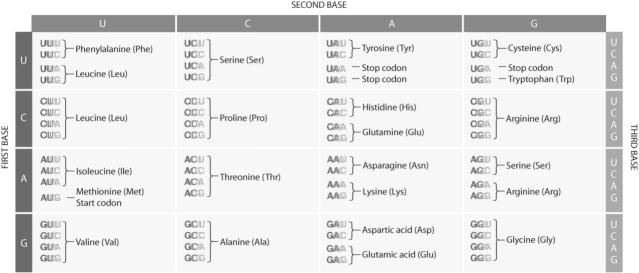 -Refer to Figure 15.5.If you had an mRNA for which the codons were read beginning from the start codon,which amino acids would be added (in order)? UCUGAUGGGCUUU…
 (Multiple Choice)
4.9/5 (76)
(76) The term "point" in point mutation is in reference to which of the following?
(Multiple Choice)
4.8/5 (88)
(88) There are three stop codons (nonsense codons);all remaining codons specify addition of an amino acid (sense codons).How many sense codons are there?
(Multiple Choice)
4.9/5 (89)
(89) 
Filters
- Essay(0)
- Multiple Choice(0)
- Short Answer(0)
- True False(0)
- Matching(0)