



 Chat with AI
Exam 9: Cellular Respiration and Fermentation

Exam 1: Biology and the Tree of Life35 Questions
Exam 2: Water and Carbon: the Chemical Basis of Life51 Questions
Exam 3: Protein Structure and Function54 Questions
Exam 4: Nucleic Acids and the Rna World40 Questions
Exam 5: An Introduction to Carbohydrates40 Questions
Exam 6: Lipids, membranes, and the First Cells54 Questions
Exam 7: Inside the Cell38 Questions
Exam 8: Cell-Cell Interactions38 Questions
Exam 9: Cellular Respiration and Fermentation38 Questions
Exam 10: Photosynthesis39 Questions
Exam 11: The Cell Cycle39 Questions
Exam 12: Meiosis39 Questions
Exam 13: Mendel and the Gene42 Questions
Exam 14: Dna and the Gene: Synthesis and Repair39 Questions
Exam 15: How Genes Work39 Questions
Exam 16: Transcription, RNA Processing, and Translation39 Questions
Exam 17: Control of Gene Expression in Bacteria38 Questions
Exam 18: Control of Gene Expression in Eukaryotes39 Questions
Exam 19: Analyzing and Engineering Genes41 Questions
Exam 20: Genomics41 Questions
Exam 21: Principles of Development39 Questions
Exam 22: An Introduction to Animal Development40 Questions
Exam 23: An Introduction to Plant Development37 Questions
Exam 24: Evolution by Natural Selection42 Questions
Exam 25: Evolutionary Processes50 Questions
Exam 26: Speciation41 Questions
Exam 27: Phylogenies and the History of Life43 Questions
Exam 28: Bacteria and Archaea38 Questions
Exam 29: Protists36 Questions
Exam 30: Green Algae and Land Plants54 Questions
Exam 31: Fungi40 Questions
Exam 32: An Introduction to Animals42 Questions
Exam 33: Protostome Animals38 Questions
Exam 34: Deuterostome Animals43 Questions
Exam 35: Viruses35 Questions
Exam 36: Plant Form and Function36 Questions
Exam 37: Water and Sugar Transport in Plants42 Questions
Exam 38: Plant Nutrition37 Questions
Exam 39: Plant Sensory Systems, signals, and Responses65 Questions
Exam 40: Plant Reproduction41 Questions
Exam 41: Animal Form and Function38 Questions
Exam 42: Water and Electrolyte Balance in Animals41 Questions
Exam 43: Animal Nutrition43 Questions
Exam 44: Gas Exchange and Circulation46 Questions
Exam 45: Electrical Signals in Animals40 Questions
Exam 46: Animal Sensory Systems and Movement43 Questions
Exam 47: Chemical Signals in Animals38 Questions
Exam 48: Animal Reproduction39 Questions
Exam 49: The Immune System in Animals38 Questions
Exam 50: An Introduction to Ecology41 Questions
Exam 51: Behavioural Ecology39 Questions
Exam 52: Population Ecology49 Questions
Exam 53: Community Ecology39 Questions
Exam 54: Ecosystems41 Questions
Exam 55: Biodiversity and Conservation Biology38 Questions
Select questions type


Which of the following is true of oxidation-reduction (redox)reactions?
(Multiple Choice)
4.8/5  (80)
(80) In cellular respiration,electrons are moved along a series of membrane proteins during the electron transport chain.If there was a mutation in the DNA coding for each of the proton pumps of the electron transport chain such that these proteins became non-functional,what would you predict to occur?
(Multiple Choice)
4.9/5 (85)
(85) The chemiosmotic hypothesis is an important key to understanding general metabolism because
(Multiple Choice)
4.9/5 (74)
(74) Which of the following events takes place in the electron transport chain?
(Multiple Choice)
4.8/5 (89)
(89) Which of the following statements describes the pathway shown above?
(Multiple Choice)
4.8/5 (84)
(84) The energy of electron transport serves to move (translocate)protons to the outer mitochondrial compartment.How does this help the mitochondrion to produce energy?
(Multiple Choice)
4.8/5 (83)
(83) Why might adding inorganic phosphate to a reaction mixture where glycolysis was rapidly proceeding help sustain the metabolic pathway?
(Multiple Choice)
4.8/5 (76)
(76) The glucose molecule has a great deal of energy in its ________.
(Multiple Choice)
4.8/5 (88)
(88) Which of the following statements concerning cellular metabolism is false?
(Multiple Choice)
4.9/5 (85)
(85) Substrate level phosphorylation occurs in the citric acid cycle when Succinyl CoA is converted to Succinate.Which of the following statements about this event is true?
(Multiple Choice)
4.9/5 (84)
(84) Substrate-level phosphorylation occurs within a metabolic pathway where sufficient energy is released by a given chemical reaction to drive the synthesis of ATP from ADP and phosphate.Substrate-level phosphorylation is seen in which metabolic pathway(s)?
(Multiple Choice)
4.9/5 (90)
(90) Figure 9.1 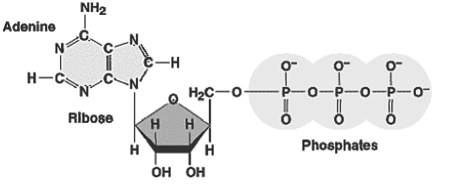 -Refer to Figure 9.1.What characteristic of this molecule (ATP)is responsible for its high energy level compared to AMP?
 (Multiple Choice)
4.7/5 (73)
(73) A cell has enough available ATP to meet its needs for about 30 seconds.What is likely to happen when an athlete exhausts his or her ATP supply?
(Multiple Choice)
4.9/5 (86)
(86) 
Filters
- Essay(0)
- Multiple Choice(0)
- Short Answer(0)
- True False(0)
- Matching(0)