



 Chat with AI
Exam 22: Amazing Ice: Glaciers and Ice Ages

Exam 1: Cosmology and the Birth of Earth50 Questions
Exam 2: Journey to the Center of the Earth52 Questions
Exam 3: Drifting Continents and Spreading Seas50 Questions
Exam 4: The Way the Earth Works: Plate Tectonics57 Questions
Exam 5: Patterns in Nature: Minerals50 Questions
Exam 6: Up From the Inferno: Magma and Igneous Rocks59 Questions
Exam 7: Pages of Earths Past: Sedimentary Rocks52 Questions
Exam 8: Metamorphism: a Process of Change50 Questions
Exam 9: The Wrath of Vulcan: Volcanic Eruptions50 Questions
Exam 10: A Violent Pulse: Earthquakes50 Questions
Exam 11: Crags,cracks,and Crumples: Crustal Deformation and Mountain Building50 Questions
Exam 12: Deep Time: How Old Is Old51 Questions
Exam 13: A Biography of Earth54 Questions
Exam 14: Squeezing Power From a Stone: Energy Resources50 Questions
Exam 15: Riches in Rock: Mineral Resources52 Questions
Exam 16: Unsafe Ground: Landslides and Other Mass Movements50 Questions
Exam 17: Streams and Floods: the Geology of Running Water51 Questions
Exam 18: Restless Realm: Oceans and Coasts50 Questions
Exam 19: A Hidden Reserve: Groundwater50 Questions
Exam 20: An Envelope of Gas: Earths Atmosphere and Climate50 Questions
Exam 21: Dry Regions: the Geology of Deserts50 Questions
Exam 22: Amazing Ice: Glaciers and Ice Ages51 Questions
Exam 23: Global Change in the Earth System50 Questions
Exam 24: Introducing Rocks25 Questions
Exam 25: a Surface Veneer: Sediments and Soils24 Questions
Exam 26: the Rock Cycle in the Earth System25 Questions
Exam 27: the Earths Interior, revisited: Seismic Layering, gravity, and the Magnetic Field25 Questions
Exam 28: Memories of Past Life: Fossils and Evolution25 Questions
Exam 29: Ever-Changing Landscapes and the Hydrologic Cycle25 Questions
Select questions type


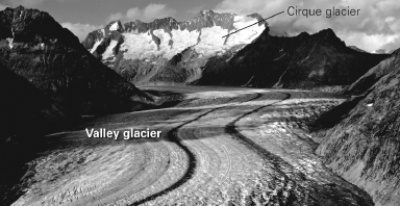

Moraines are composed of jumbled piles of very poorly sorted rock fragments ranging in size from boulder to clay that fall out near the edges of glaciers.Why are the larger particles (boulders,etc.)not broken down during transport in the glacier?
(Multiple Choice)
4.8/5  (74)
(74) A glacier will always advance from its source area if the rate of accumulation is greater than the rate of ________.
(Multiple Choice)
4.9/5 (73)
(73) Glacial ice cores can be used to determine the atmospheric concentration of CO₂ during Earth's history.How do scientists come up with these data?
(Multiple Choice)
4.8/5 (82)
(82) Identify the area where layered sediments have been deposited in the figure below. 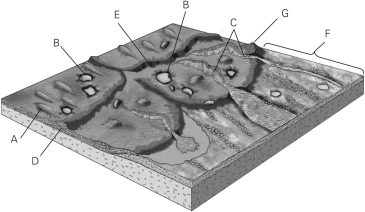
(Multiple Choice)
4.8/5 (70)
(70) A(n)________ in eustatic sea level is ultimately the result of a ________ event.
(Multiple Choice)
4.7/5 (73)
(73) By increasing the albedo of Earth,global ice sheets produce conditions that are ________ to their further advance,thus providing an example of ________ feedback.
(Multiple Choice)
4.9/5 (74)
(74) The Milankovitch cycles describe the change in ________ because of changes in the ________ of Earth relative to the Sun.
(Multiple Choice)
4.7/5 (76)
(76) Which of the following figures is of glacial lake-bed deposits? 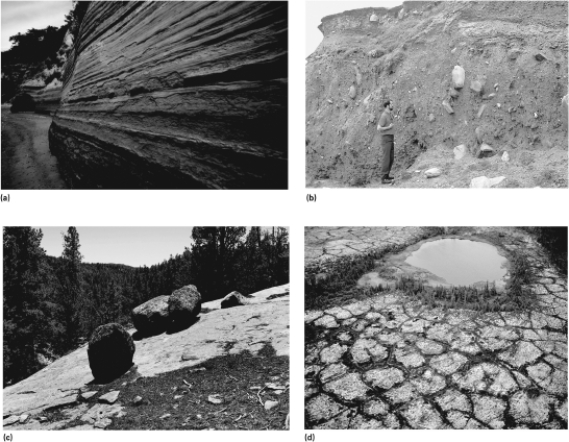
(Multiple Choice)
4.8/5 (71)
(71) Using the figure below,identify which way the glacier advanced. 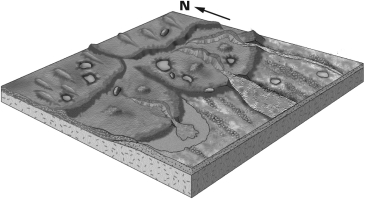
(Multiple Choice)
4.8/5 (79)
(79) 
Filters
- Essay(0)
- Multiple Choice(0)
- Short Answer(0)
- True False(0)
- Matching(0)