



 Chat with AI
Exam 1: Statistics Success Stories and Cautionary Tales

Exam 1: Statistics Success Stories and Cautionary Tales79 Questions
Exam 2: Turning Data Into Information94 Questions
Exam 3: Relationships Between Quantitative Variables99 Questions
Exam 4: Relationships Between Categorical Variables100 Questions
Exam 5: Sampling: Surveys and How to Ask Questions109 Questions
Exam 6: Gathering Useful Data for Examining Relationships90 Questions
Exam 7: Probability112 Questions
Exam 8: Random Variables115 Questions
Exam 9: Understanding Sampling Distributions: Statistics As Random Variables231 Questions
Exam 10: Estimating Proportions With Confidence104 Questions
Exam 11: Estimating Means With Confidence103 Questions
Exam 12: Testing Hypotheses About Proportions139 Questions
Exam 13: Testing Hypotheses About Means166 Questions
Exam 14: Inference About Simple Regression115 Questions
Exam 15: More About Inference for Categorical Variables111 Questions
Exam 16: Analysis of Variance111 Questions
Exam 17: Turning Information Into Wisdom70 Questions
Select questions type


Use the following information for questions:
According to a CNN poll released in January of 2010, 56 percent of the public opposed the stimulus bill, with 42 percent supportive of the plan. The CNN/Opinion Research Corporation poll was conducted January 8-10, with 1,021 adult Americans questioned by telephone. The survey's sampling error was reported as plus or minus 3 percentage points.
-What is the approximate margin of error for this survey? Did the story report the correct margin of error?
(Short Answer)
4.9/5  (85)
(85) A random sample of 1,002 adults aged at least 18 years and living in the 48 contiguous states (i.e. any state in the United States excluding Alaska and Hawaii) was conducted by the Gallup Organization. The interviews were done over the telephone. The population represented by this sample was
(Multiple Choice)
4.8/5 (78)
(78) Use the following information for questions:
In a study of patients who had a heart attack, 3630 patients were randomly assigned to receive one of three treatments: aspirin alone, warfarin alone, or aspirin plus warfarin. The results showed that 20.0% of the aspirin group had another heart attack, stroke, or died, compared with 16.7% of the warfarin group and 15.0% of the aspirin plus warfarin group. The difference between the aspirin and warfarin groups was statistically significant, while the difference between the warfarin and aspirin plus warfarin group was not statistically significant.
-The non-statistically significant difference between the warfarin alone group (16.7%) and the aspirin plus warfarin group (15.0%) means that
(Multiple Choice)
4.9/5 (71)
(71) Suppose that a survey of 20,000 high school students (10,000 girls and 10,000 boys) was done. Students were asked if they had used cocaine during the last 30 days. 4.9% of the boys and 4.2% of the girls reported using cocaine. The difference between the two percentages is statistically significant. Explain why this difference may not be practically significant.
(Essay)
4.8/5 (79)
(79) Use the following information for questions:
Suppose you were to read about a study showing that people who sleep less than five hours a night have twice as much risk of a premature death as people who sleep seven or eight hours a night.
-The "baseline risk"in this context is
(Multiple Choice)
4.9/5 (76)
(76) Use the following information for questions:
A five number summary for hours studied in a week were 5, 12, 14, 18, and 20.
-What is the value such that 75% or more of the students studied longer than that value?
(Multiple Choice)
4.8/5 (78)
(78) A survey of people applying for a mortgage showed that among white people with a bad credit rating, 90% were approved for mortgages, whereas among black people with a bad credit rating, 81% were approved. What confounding variable could also explain the apparent racial difference in the percentage of approved mortgages?
(Short Answer)
4.8/5 (91)
(91) Use the following information for questions:
In a 1994 Census Bureau report, the total number of households and the number of households with a married couple and their own children were reported for the years 1990 and for 1994. The results are given below:
 One newspaper reported these results with the following headline: "Number of Two-Parent Families Up." Another newspaper, based on the percentages, reported on the same results with the headline: "Traditional Families Less Common".
-In 1990, what percentage of households consisted of a married couple with children?
One newspaper reported these results with the following headline: "Number of Two-Parent Families Up." Another newspaper, based on the percentages, reported on the same results with the headline: "Traditional Families Less Common".
-In 1990, what percentage of households consisted of a married couple with children? (Short Answer)
4.9/5 (79)
(79) An Islamic survey conducted by the Gallup organization consisted of a random sample of 10,004 people living in 9 predominantly Islamic countries. Calculate the approximate margin of error for the survey.
(Short Answer)
4.7/5 (78)
(78) Use the following information for questions:
Suppose you were to read about a study showing that people who sleep less than five hours a night have twice as much risk of a premature death as people who sleep seven or eight hours a night.
-Which of the following is not an example of a possible "confounding variable"in this study?
(Multiple Choice)
4.8/5 (67)
(67) One of the common elements of the eight case studies in Chapter 1 is
(Multiple Choice)
4.9/5 (74)
(74) Use the following information for questions:
First-year college students' self-ratings of their emotional health dropped to record low levels in 2010, according to the CIRP Freshman Survey, UCLA's annual survey of the nation's entering students at four-year colleges and universities. The rate of students who reported that their emotional health was in the "highest 10 percent" or "above average" was 519 per 1000 student. This was a drop of 34 per 1000 students from 2009 and a significant decline from the rate of students who placed themselves in those categories when self-ratings of emotional health were first measured in 1985.
-Consider the rate in 1985 as the baseline rate. This rate was 636 per 1000 students. What was the decrease in the rate of students who reported that their emotional health was in the "highest 10 percent" or "above average" as compared to this baseline rate?
(Short Answer)
4.7/5 (79)
(79) Use the following information for questions:
The next three questions are based on a study (part of the Women's Health Initiative) of healthy women volunteers. A total of 16,608 women were randomly assigned to take either placebo or a popular hormone replacement therapy (HRT) for eight years. The study was stopped after 5 years in part because the women on HRT had a higher rate of heart attacks than the placebo group.
-The rate of invasive breast cancer was 30 per 10,000 women in the placebo group and 38 per 10,000 women in the HRT group. What was the increase in the rate of breast cancers in the HRT group compared to the rate in the placebo group?
(Short Answer)
4.8/5 (82)
(82) If a difference seen in sample results is "statistically significant"it means that
(Multiple Choice)
4.9/5 (58)
(58) A randomized experiment was done by randomly assigning each participant either to walk for half an hour three times a week or to sit quietly reading a book for half an hour three times a week. At the end of a year the change in participants' blood pressure over the year was measured, and the change was compared for the two groups.
-This is a randomized experiment rather than an observational study because
(Multiple Choice)
4.8/5 (83)
(83) Drawn below are two dotplots displaying the number of minutes spent exercising during a typical week for 36 female and 39 male students at Penn State University. Also given are the five number summaries. Describe any differences or similarities between the two sets of data. 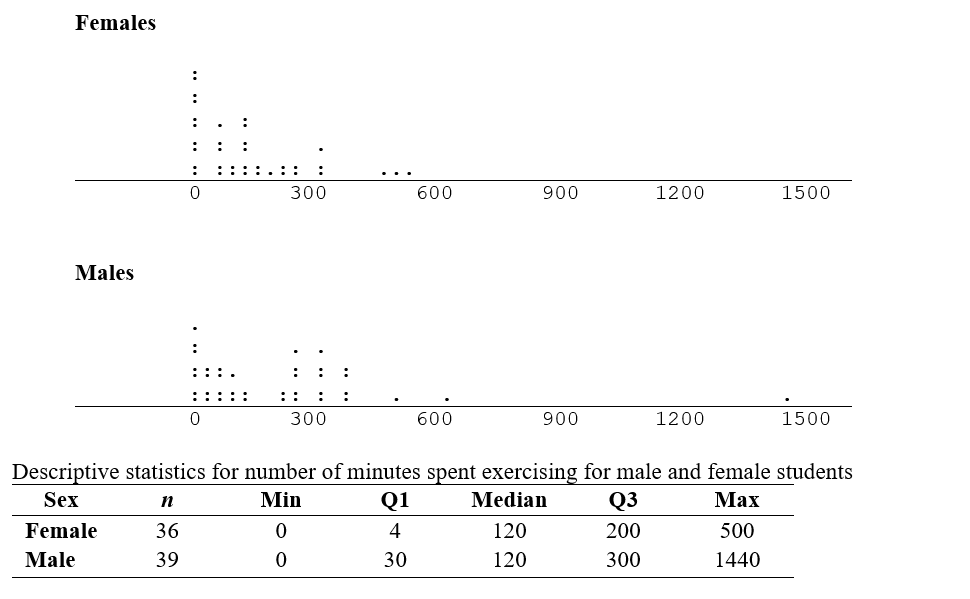
(Essay)
4.9/5 (58)
(58) Which of the following is true about a dotplot and a five-number summary?
(Multiple Choice)
4.9/5 (78)
(78) Use the following information for questions:
According to a CNN poll released in January of 2010, 56 percent of the public opposed the stimulus bill, with 42 percent supportive of the plan. The CNN/Opinion Research Corporation poll was conducted January 8-10, with 1,021 adult Americans questioned by telephone. The survey's sampling error was reported as plus or minus 3 percentage points.
-In March of 2009, just weeks after the stimulus was signed into law by President Obama, a CNN survey indicated that 54 percent supported the program, with 44 percent opposed. If we wish to compare the supporting rates between 2010 and 2009, what would be the base rate?
(Short Answer)
4.8/5 (80)
(80) A newspaper reported that 41% of students who had taken calculus in high school had a first year college GPA (grade point average) of 3.2 or higher. Explain why it would also have been useful to know what the baseline rate was (i.e. the proportion of students without calculus who had a GPA of 3.2 or higher).
(Essay)
4.8/5 (88)
(88) 
Filters
- Essay(0)
- Multiple Choice(0)
- Short Answer(0)
- True False(0)
- Matching(0)