



 Chat with AI
Exam 15: Government Spending and Its Financing

Exam 1: Introduction to Macroeconomics73 Questions
Exam 2: The Measurement and Structure of the National Economy110 Questions
Exam 3: Productivity, output, and Employment111 Questions
Exam 4: Consumption, saving, and Investment109 Questions
Exam 5: Saving and Investment in the Open Economy118 Questions
Exam 6: Long-Run Economic Growth91 Questions
Exam 7: The Asset Market, money, and Prices110 Questions
Exam 8: Business Cycles107 Questions
Exam 9: The Is-Lmad-As Model109 Questions
Exam 10: Classical Business Cycle Analysis106 Questions
Exam 11: Keynesianism: the Macroeconomics of Wage and Price Rigidity98 Questions
Exam 12: Unemployment and Inflation101 Questions
Exam 13: Exchange Rates, business Cycles, and Macroeconomic Policy in the Open Economy106 Questions
Exam 14: Monetary Policy and the Federal Reserve System121 Questions
Exam 15: Government Spending and Its Financing96 Questions
Select questions type


Assume that in an all-currency economy the real interest rate is 4%,the expected rate of inflation is 8%,and the nominal interest rate is 12%.The monetary base equals $50 billion.The real seignorage revenue collected by the government would equal

Free
(Multiple Choice)
4.8/5  (79)
(79) Correct Answer: Verified
A
From the 1950s to the 2010s,transfer payments' share of GDP
Free
(Multiple Choice)
4.9/5 (80)
(80) Correct Answer:Verified
VerifiedA
Suppose that real GDP is 10,000 and remains constant,nominal GDP is initially 30,000,inflation is 3%,and the debt-GDP ratio is 0.7.Find the largest nominal deficit that the government can run without raising the debt-GDP ratio.
Free
(Essay)
4.7/5 (75)
(75) Correct Answer:Verified
Verifiedchange in debt/GDP = deficit/GDP - (debt/GDP × growth rate)
0 = deficit/30,000 - (0.7 × .03)
.021 = deficit/30,000
deficit = .021 × 30,000 = 630.
Compared with other countries in the OECD,U.S.government spending relative to GDP is
(Multiple Choice)
4.9/5 (76)
(76) The amount the government budget deficit would be if the economy were at full employment is known as the
(Multiple Choice)
4.9/5 (87)
(87) Which of the following policies would not prevent the Social Security trust fund from running out of assets?
(Multiple Choice)
4.9/5 (70)
(70) A Social Security system in which payroll taxes that workers and their employers pay in go directly to retirees and other beneficiaries is known as
(Multiple Choice)
4.9/5 (62)
(62) When the United States engaged in quantitative easing from 2008 to 2014,why didn't the money supply rise sharply?
(Multiple Choice)
4.8/5 (80)
(80) Recent proposals to allow the Social Security trust fund to invest in the stock market (instead of buying government bonds)are based on the premise that
(Multiple Choice)
4.8/5 (69)
(69) Consider an economy that has the following monetary data. 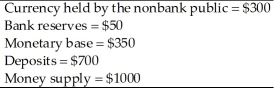 The monetary base and the money supply are expected to grow at a constant rate of 20% per year.Inflation and expected inflation are 20% per year.Suppose that bank reserves and currency pay no interest,all currency is held by the public,and bank deposits pay no interest.What is the cost to the public of the inflation tax?
 (Multiple Choice)
4.8/5 (65)
(65) The graph plotting the tax rate on the horizontal axis and tax revenues on the vertical axis,which was used by supply-side economists to suggest that tax rates were too high,in known as the
(Multiple Choice)
4.8/5 (76)
(76) At the beginning of year one,there is no government debt outstanding.The government runs a $100 billion deficit in year one.Interest at a nominal rate of 10% must be paid starting in year two.Assume nominal GDP in year one is $2000 billion and the nominal growth rate of GDP is 4%.Assume the government balances its primary budget in the future and the interest rate and growth rate do not change.
(a)What will be the government deficit in years two,three,four,and five?
(b)What will be the value of government bonds outstanding at the end of the fifth year?
(c)What will be the debt-GDP ratio at the end of year five?
(Essay)
4.9/5 (79)
(79) From the late 1960s to the late 1990s,the share of GDP devoted to government purchases
(Multiple Choice)
4.9/5 (95)
(95) Who bears the burden of the government debt? Explain why.Under what circumstances is there no burden to be borne?
(Essay)
4.8/5 (67)
(67) 
Filters
- Essay(0)
- Multiple Choice(0)
- Short Answer(0)
- True False(0)
- Matching(0)