



 Chat with AI
Exam 16: Monopoly

Exam 1: Getting Started337 Questions
Exam 2: The Usand Global Economies201 Questions
Exam 3: The Economic Problem273 Questions
Exam 4: Demand and Supply322 Questions
Exam 5: Elasticities of Demand and Supply335 Questions
Exam 6: Efficiency and Fairness of Markets352 Questions
Exam 7: Government Actions in Markets239 Questions
Exam 8: Taxes267 Questions
Exam 9: Global Markets in Action276 Questions
Exam 10: Externalities300 Questions
Exam 11: Public Goods and Common Resources177 Questions
Exam 12: Markets With Private Information101 Questions
Exam 13: Consumer Choice and Demand287 Questions
Exam 14: Production and Cost266 Questions
Exam 15: Perfect Competition275 Questions
Exam 16: Monopoly377 Questions
Exam 17: Monopolistic Competition213 Questions
Exam 18: Oligopoly222 Questions
Exam 19: Markets for Factors of Production178 Questions
Exam 20: Economic Inequality155 Questions
Select questions type


Which of the following is an example of a two-part tariff?
(Multiple Choice)
5.0/5  (76)
(76) 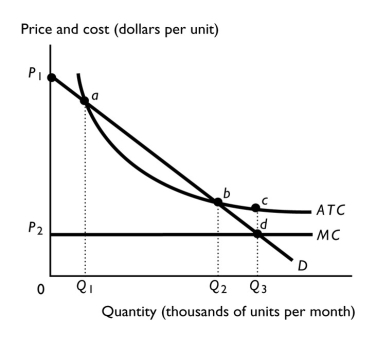 -The above figure represents the cost and demand curves for a natural monopoly that is regulated using a marginal cost pricing rule.
a.What is the quantity?
b.What price is charged?
c.What area represents the consumer surplus when the firm is regulated using a marginal cost pricing rule?
d.What distance represents the firm's loss per unit when the firm is regulated using a marginal cost pricing rule?
-The above figure represents the cost and demand curves for a natural monopoly that is regulated using a marginal cost pricing rule.
a.What is the quantity?
b.What price is charged?
c.What area represents the consumer surplus when the firm is regulated using a marginal cost pricing rule?
d.What distance represents the firm's loss per unit when the firm is regulated using a marginal cost pricing rule? (Essay)
4.8/5 (92)
(92) To encourage invention and innovation,the government provides
(Multiple Choice)
4.9/5 (77)
(77) Under which of the following does a monopoly's demand curve become its marginal revenue curve?
(Multiple Choice)
4.9/5 (69)
(69)  -The figure above shows the demand,marginal revenue,and marginal cost curves for Paul's Parrot Pillows,a single-price monopoly producer of pillows stuffed with parrot feathers.When Paul maximizes his profit,he produces ________ pillows per hour.
 (Multiple Choice)
4.9/5 (71)
(71)  -In the above figure,a perfectly competitive market will have a price of ________ and a single-price monopoly will have a price of ________.
 (Multiple Choice)
4.9/5 (94)
(94) When compared to a perfectly competitive market,a single-price monopoly with the same costs produces ________ output and charges ________ price.
(Multiple Choice)
4.8/5 (72)
(72)  The figure above shows a monopoly's total revenue and total cost curves.
-Using the figure above,which of the following statements are correct?
i.MR = MC when 3 haircuts are produced.
ii.If the firm charges each customer the same price for a haircut,the price of a haircut is $42.
iii.The firm's MC equals $30.
The figure above shows a monopoly's total revenue and total cost curves.
-Using the figure above,which of the following statements are correct?
i.MR = MC when 3 haircuts are produced.
ii.If the firm charges each customer the same price for a haircut,the price of a haircut is $42.
iii.The firm's MC equals $30. (Multiple Choice)
4.8/5 (77)
(77) "Price discrimination allows a monopoly to increase its economic profit by capturing part of the consumer surplus and turning it into economic profit." Is the previous statement correct or incorrect? If the statement is correct,why is it important in understanding firms' behaviors? If it is incorrect,why is it incorrect?
(Essay)
4.9/5 (91)
(91) 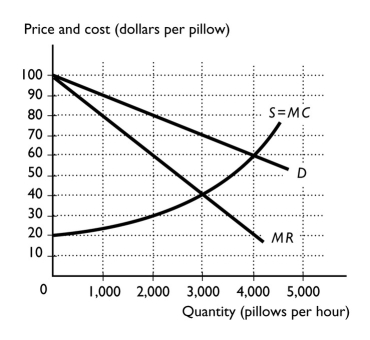 -The figure above shows the demand,marginal revenue,and marginal cost curves for Paul's Parrot pillows,a monopoly producer of pillows stuffed with parrot feathers.When the pillow market is a monopoly,the price of a pillow is ________ and if the pillow market is perfectly competitive,the price of a pillow is ________.
 (Multiple Choice)
4.9/5 (86)
(86) If a monopoly is able to perfectly price discriminate,then consumer surplus is
(Multiple Choice)
4.8/5 (79)
(79) The maximum profit for a single-price monopoly is found when the firm produces the level of output so that
(Multiple Choice)
4.9/5 (81)
(81) For a natural monopoly to cover its total cost,its price must equal its
(Multiple Choice)
4.8/5 (74)
(74) 
Filters
- Essay(0)
- Multiple Choice(0)
- Short Answer(0)
- True False(0)
- Matching(0)