



 Chat with AI
Exam 17: Auctions and Bargaining

Exam 1: The Principles and Practice of Economics103 Questions
Exam 2: Economic Methods and Economic Questions94 Questions
Exam 3: Optimization: Doing the Best You Can94 Questions
Exam 4: Demand, supply, and Equilibrium185 Questions
Exam 5: Consumers and Incentives187 Questions
Exam 6: Sellers and Incentives261 Questions
Exam 7: Perfect Competition and the Invisible Hand251 Questions
Exam 8: Trade264 Questions
Exam 9: Externalities and Public Goods223 Questions
Exam 10: The Government in the Economy: Taxation and Regulation244 Questions
Exam 11: Markets for Factors of Production237 Questions
Exam 12: Monopoly295 Questions
Exam 13: Game Theory and Strategic Play199 Questions
Exam 14: Oligopoly and Monopolistic Competition264 Questions
Exam 15: Trade-Offs Involving Time and Risk147 Questions
Exam 16: The Economics of Information119 Questions
Exam 17: Auctions and Bargaining123 Questions
Exam 18: Social Economics111 Questions
Select questions type


Scenario: Tom, Pat, Arthur, and Julie are participating in a second-price auction for a good. Tom values the good at $150, Pat values it at $180, Arthur values it at $250, and Julie values it at $200.
-Refer to the scenario above.If each bidder uses his or her dominant strategy,who will get the good being auctioned?
(Multiple Choice)
4.8/5  (87)
(87) Scenario: Four friends-Tom, Bill, Jeff, and Roger-are participating in an English auction. Tom values the good being auctioned at $500, Bill values it at $210, Jeff values it at $350, and Roger values it at $625.
-Refer to the scenario above.If they are the only bidders in the auction and each bidder uses his optimal strategy,the maximum price the winner is likely to pay is ________.
(Multiple Choice)
4.9/5 (84)
(84) Scenario: Tom, Pat, Arthur, and Julie are participating in a second-price auction for a good. Tom values the good at $150, Pat values it at $180, Arthur values it at $250, and Julie values it at $200.
-Refer to the scenario above.Arthur should place a bid of ________.
(Multiple Choice)
4.9/5 (99)
(99) Which of the following is true in an ultimatum game if more money is considered to be better than less?
(Multiple Choice)
4.9/5 (74)
(74) Scenario: Tom, Pat, Arthur, and Julie are participating in a second-price auction for a good. Tom values the good at $150, Pat values it at $180, Arthur values it at $250, and Julie values it at $200.
-Refer to the scenario above.Pat should submit a bid of ________.
(Multiple Choice)
4.7/5 (81)
(81) A ________ model of the household assumes that a family maximizes its happiness under a budget constraint that pools all of its income,wealth,and time.
(Multiple Choice)
4.7/5 (83)
(83) Scenario: An ancient painting is being auctioned off in an English auction. The following table shows the maximum willingness to pay of each bidder.
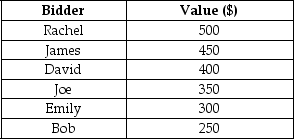 -Refer to the scenario above.Which of the following is true if David's maximum willingness to pay falls to $380?
 (Multiple Choice)
4.8/5 (63)
(63) Scenario: John, Jacob, Alex, and Maria participate in a first-price auction for an iPod. John values the iPod at $400, Jacob values it at $300, Alex values it at $250, and Maria values it at $200.
-Refer to the scenario above.If each bidder uses his or her dominant strategy,who will win the auction?
(Multiple Choice)
4.9/5 (90)
(90) In a Dutch auction,the higher the bid,the ________ the surplus and the ________ the chance of winning.
(Multiple Choice)
4.9/5 (65)
(65) Scenario: Tom, Pat, Arthur, and Julie are participating in a second-price auction for a good. Tom values the good at $150, Pat values it at $180, Arthur values it at $250, and Julie values it at $200.
-Refer to the scenario above.Tom should submit a bid of ________.
(Multiple Choice)
4.8/5 (79)
(79) The consumer surplus enjoyed by the winner of a first-price auction is equal to the difference between ________.
(Multiple Choice)
4.7/5 (81)
(81) The higher the bid in a first-price auction,the ________ will be the chances of winning and the ________ the surplus earned.
(Multiple Choice)
4.8/5 (74)
(74) Scenario: Four friends-Tom, Bill, Jeff, and Roger-are participating in an English auction. Tom values the good being auctioned at $500, Bill values it at $210, Jeff values it at $350, and Roger values it at $625.
-Refer to the scenario above.If these four friends are the only bidders and each bidder uses his optimal strategy,the owner of the good will earn an expected revenue of ________.
(Multiple Choice)
4.8/5 (77)
(77) In a goods market,sellers have a higher bargaining power if ________.
(Multiple Choice)
4.8/5 (74)
(74) Which of the following is a similarity between an English auction and a Dutch auction?
(Multiple Choice)
4.9/5 (76)
(76) 
Filters
- Essay(0)
- Multiple Choice(0)
- Short Answer(0)
- True False(0)
- Matching(0)