



 Chat with AI
Exam 9: Externalities and Public Goods

Exam 1: The Principles and Practice of Economics103 Questions
Exam 2: Economic Methods and Economic Questions94 Questions
Exam 3: Optimization: Doing the Best You Can94 Questions
Exam 4: Demand, supply, and Equilibrium185 Questions
Exam 5: Consumers and Incentives187 Questions
Exam 6: Sellers and Incentives261 Questions
Exam 7: Perfect Competition and the Invisible Hand251 Questions
Exam 8: Trade264 Questions
Exam 9: Externalities and Public Goods223 Questions
Exam 10: The Government in the Economy: Taxation and Regulation244 Questions
Exam 11: Markets for Factors of Production237 Questions
Exam 12: Monopoly295 Questions
Exam 13: Game Theory and Strategic Play199 Questions
Exam 14: Oligopoly and Monopolistic Competition264 Questions
Exam 15: Trade-Offs Involving Time and Risk147 Questions
Exam 16: The Economics of Information119 Questions
Exam 17: Auctions and Bargaining123 Questions
Exam 18: Social Economics111 Questions
Select questions type


Scenario: Vacant houses, foreclosed or abandoned, are typically boarded up with plywood that many people consider unsightly and likely to invite vandalism. An alternative is clear plastic (polycarbonate) panels. The figure below shows the demand and the supply of polycarbonate panels used for boarding up houses in a hypothetical town. Suppose that there are 140 houses that are vacant and the town council makes it illegal to use plywood to board them up, leaving only polycarbonate panels as an alternative. To answer some of the questions below, it will be useful to find the equations of the three lines in the figure.
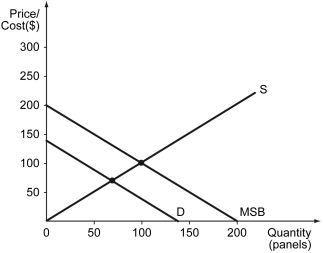 -Refer to the scenario above.The council's action is an example of ________.
 (Multiple Choice)
4.9/5  (83)
(83) Scenario: The following figure shows the private cost and social cost of producing Good X. Firm A is the producer of Good X. The production plant and Bob's house are located next to a river. However, the plant is upstream, and Bob's house is downstream. Since production pollutes the river, Bob suffers from a negative externality.
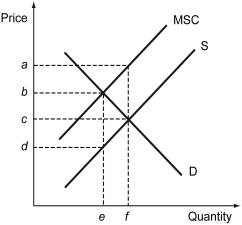 -Refer to the scenario above.If the property rights to the river belong to the firm,what is the minimum transfer between the two party necessary to make the firm produce the socially optimal quantity?
 (Multiple Choice)
4.8/5 (72)
(72) The solution to the "tragedy of the commons" in street traffic congestions in London was ________.
(Multiple Choice)
4.9/5 (80)
(80) A retired athlete built a gym near her house that could be used for free by all the residents in the neighborhood.However,the overuse of the facilities soon led to irreparable damages.This is an example of the ________.
(Multiple Choice)
5.0/5 (79)
(79) The following figure shows the market supply and demand of a good whose consumption entails a $2 positive external benefit per unit.
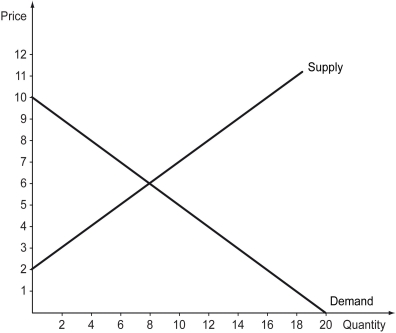 -Refer to the figure above.The socially optimal price for this good should be ________.
 (Multiple Choice)
4.9/5 (66)
(66) Scenario: Vacant houses, foreclosed or abandoned, are typically boarded up with plywood that many people consider unsightly and likely to invite vandalism. An alternative is clear plastic (polycarbonate) panels. The figure below shows the demand and the supply of polycarbonate panels used for boarding up houses in a hypothetical town. Suppose that there are 140 houses that are vacant and the town council makes it illegal to use plywood to board them up, leaving only polycarbonate panels as an alternative. To answer some of the questions below, it will be useful to find the equations of the three lines in the figure.
-Refer to the scenario above.What is the deadweight loss associated with the council's action relative to the socially efficient outcome?
-Refer to the scenario above.What is the deadweight loss associated with the council's action relative to the socially efficient outcome? (Multiple Choice)
4.9/5 (98)
(98) Suppose you live in a housing co-op with eleven other college students.The kitchen is constantly a mess; virtually nobody in the house cleans up,and the sink is overflowing with dirty dishes.This is an example of ________.
(Multiple Choice)
4.9/5 (80)
(80) Pay-As-You-Throw programs that charge people a small price for each bag of trash they throw out are likely to ________.
(Multiple Choice)
4.9/5 (92)
(92) Five players are given $10 each and asked to contribute a portion of it to the sports development fund.They are told that the total collection will be doubled and distributed equally among each of them.In this case,the players are likely to contribute ________.
(Multiple Choice)
4.7/5 (72)
(72) The Trump administration proposes to de-fund the Energy Star program.If the program is discontinued,we would expect ________.
(Multiple Choice)
4.9/5 (88)
(88) Scenario: Currently, major corn-growing states, such as Iowa, use large amounts of nitrogen-based fertilizers. Many of Iowa's corn-growing regions are characterized by karst topography (water erodes the limestone bedrock and forms sinkholes, caves, and underground streams). In karst landscapes, runoff from corn fields contains high levels of nitrogen in the form of nitrates, which can pollute private and municipal water wells. Suppose the demand and supply for corn are:
Corn Demand: Qᴰ = 70 - 5p,
Corn Supply: Qˢ = 10p - 5,
where quantity is millions of bushels of corn and price is dollars per bushel. The marginal private benefit of corn and the marginal private cost of corn production can be derived by rewriting demand and supply with price as a function of quantity:
Inverse Demand: p = 14 - 0.2Q
Marginal Private Benefit: MPB = 14 - 0.2Q
Inverse Supply: p = 0.1Q + 0.5
Marginal Private Cost: MPC = 0.1Q + 0.5
Suppose the marginal external cost (MEC) of nitrogen fertilizer use in corn growing is a constant $1.50 per bushel, so MEC = 1.5. The marginal social cost (MSC) is:
MSC = MPC + MEC = 0.1Q + 0.5 + 1.5
MSC = 0.1Q + 2
The figure below shows these marginal benefits and marginal costs.
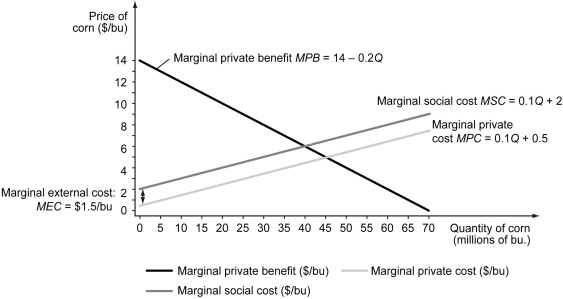 -Refer to the scenario above.The optimal corrective ________ is ________ per bushel.Explain your answer.
 (Multiple Choice)
4.9/5 (68)
(68) The local community in a town has arranged for a fireworks show in a park located in the center of town.The cost of the ticket to watch the show is $5.However,only 40 percent of the tickets are sold,as spectators can watch the show without entering the park.This is an example of ________.
(Multiple Choice)
4.9/5 (86)
(86) Scenario: The following figure shows the private cost and social cost of producing Good X. Firm A is the producer of Good X. The production plant and Bob's house are located next to a river. However, the plant is upstream, and Bob's house is downstream. Since production pollutes the river, Bob suffers from a negative externality.
-Refer to the scenario above.What is the value of the negative externality imposed on Bob when the firm produces to maximize its private net benefits?
-Refer to the scenario above.What is the value of the negative externality imposed on Bob when the firm produces to maximize its private net benefits? (Multiple Choice)
4.8/5 (68)
(68) In 1973,economist Steven N.S.Cheung wrote an article demonstrating that private bargaining between beekeepers and agricultural producers achieved the efficient outcome in the market for pollination services in Washington state ("The Fable of the Bees: An Economic Investigation." Journal of Law and Economics 16,no.1 (1973): 11-33).Strong colonies of honeybees are necessary for pollinating some crops,and they also increase yields.Colonies that are co-located with good pollen sources produce more honey.Suppose the following facts describe the market for pollination services for seed alfalfa in Washington state: seed alfalfa growers harvest an additional $4,000 worth of alfalfa seed when honeybees are co-located with their crop; beekeepers realize an additional $1,500 worth of honey when their bee colonies are co-located with alfalfa; and the cost of moving to another alfalfa grower's field is $500.What amount of payment from the alfalfa grower to the beekeeper will result in a market for pollination services that achieves the efficient outcome? Explain your answer.
(Multiple Choice)
4.8/5 (66)
(66) The presence of a positive externality in a market leads to a(n)________.
(Multiple Choice)
4.8/5 (74)
(74) Which of the following correctly completes the following table?

(Multiple Choice)
4.9/5 (66)
(66) Scenario: In Brazil, more than 60 percent of sugar cane grown is harvested by hand. In São Paulo state, nearly 300,000 workers are employed in sugar cane harvesting. Manual harvesting requires burning the cane fields prior to harvest to remove the cane's sharp leaves and drive snakes from the fields. Burning the cane fields, however, gives off large quantities of ammonia and nitrogen oxide, which lead to ozone creation. In São Paulo state, a layer of ash covers cars, and nitrogen oxide levels double during the harvest period. The nitrogen oxide produced from burning the cane fields can lead to acid rain and changes in water quality.
-Refer to the scenario above.In the graph below,the socially optimal level of production occurs at which point?
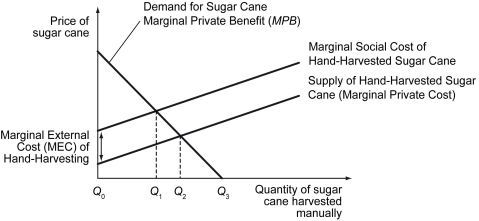
(Multiple Choice)
4.9/5 (75)
(75) Scenario: The following excerpt is from Michael A. McPherson and Michael L. Nieswiadomy, "African Elephants: The Effects of Property Rights and Political Stability," Contemporary Economic Policy 18, no. 1 (2007).
African elephant populations have declined by more than 50% over the past 20 years. International outrage over the slaughter led to a worldwide ban on ivory sales beginning in 1989, despite the objections of many economists and scientists, and of several southern African countries that have established systems of property rights over elephants. Far from declining, elephant populations in many of these countries have increased to levels at or above the carrying capacity of the ecosystem. This article estimates the determinants of changes in elephant populations in 35 African countries over several time periods. The authors find that, controlling for other factors, countries with property rights systems or community wildlife programs have more rapid elephant population growth rates than do those countries that do not. Political instability and the absence of representative governments significantly lower elephant growth rates.
-Refer to the scenario above.Which of the following is consistent with a solution to the elephant population decline described in the quote?
(Multiple Choice)
4.9/5 (86)
(86) 
Filters
- Essay(0)
- Multiple Choice(0)
- Short Answer(0)
- True False(0)
- Matching(0)