



 Chat with AI
Exam 3: Digenea

Exam 1: Introduction and Nematoda34 Questions
Exam 2: Cestoda11 Questions
Exam 3: Digenea12 Questions
Exam 4: Protozoa: Amoeba12 Questions
Exam 5: Protozoa: The Hemoflagellates Trypanosoma SPP , Leishmania SPP, Flagellates and Ciliates10 Questions
Exam 6: Protozoa: Sporozoa16 Questions
Exam 7: Arthropoda14 Questions
Exam 8: Clinical Laboratory Procedures30 Questions
Exam 9: Control and Treatment of Parasitic Disease6 Questions
Select questions type


Two trematode eggs that resemble each other are:

Free
(Multiple Choice)
4.9/5  (78)
(78) Correct Answer: Verified
A
Name the parasite shown in the following image: 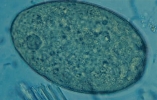
Free
(Multiple Choice)
4.8/5 (74)
(74) Correct Answer:Verified
VerifiedC
An Asian patient with intestinal obstruction, mucoid diarrhea, and eosinophilia was tested for fecal parasites. The fecal sediment revealed a large (180 µm x 90 µm) oval egg with a small operculum. This parasite probably is:
Free
(Multiple Choice)
4.9/5 (69)
(69) Correct Answer:Verified
VerifiedB
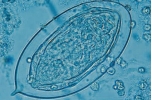
A large egg (180 µm x 80 µm) with a pointed lateral spine was recovered in feces from an immigrant of the West Indies. A likely parasitic infection would be:
(Multiple Choice)
4.8/5 (72)
(72) 
All of the following Digenea infections are acquired by ingesting dormant larval forms EXCEPT:
(Multiple Choice)
4.8/5 (79)
(79) For which of the following is sputum useful in the diagnosis of parasitic infection?
(Multiple Choice)
4.9/5 (71)
(71) If a U.S. citizen never leaves the United States, which of the following is the only disease that he or she could acquire?
(Multiple Choice)
4.8/5 (77)
(77) The egg of one trematode species can be recovered in urine. This parasite is:
(Multiple Choice)
4.7/5 (78)
(78) The infective form in the Fasciola hepatica life cycle is the:
(Multiple Choice)
4.9/5 (81)
(81) The immature schistosome found in human tissue is called the:
(Multiple Choice)
4.7/5 (72)
(72) 
Filters
- Essay(0)
- Multiple Choice(0)
- Short Answer(0)
- True False(0)
- Matching(0)