



 Chat with AI
Exam 39: Digestion and Nutrition

Exam 1: Invitation to Biology79 Questions
Exam 2: Lifes Chemical Basis67 Questions
Exam 3: Molecules of Life87 Questions
Exam 4: Cell Structure and Function106 Questions
Exam 5: Ground Rules of Metabolism69 Questions
Exam 6: Where It Starts - Photosynthesis69 Questions
Exam 7: How Cells Release Chemical Energy75 Questions
Exam 8: Dna Structure and Function61 Questions
Exam 9: From Dna to Protein64 Questions
Exam 10: Gene Control63 Questions
Exam 11: How Cells Reproduce77 Questions
Exam 12: Meiosis and Sexual Reproduction59 Questions
Exam 13: Observing Patterns in Inherited Traits85 Questions
Exam 14: Chromosomes and Human Inheritance76 Questions
Exam 15: Studying and Manipulating Genomes58 Questions
Exam 16: Evidence of Evolution55 Questions
Exam 17: Processes of Evolution74 Questions
Exam 18: Organizating Information About Species46 Questions
Exam 19: Lifes Origin and Early Evolution60 Questions
Exam 20: Viruses - Bacteria - and Archaea56 Questions
Exam 21: Protists - the Simplest Eukaryotes61 Questions
Exam 22: The Land Plants66 Questions
Exam 23: Fungi52 Questions
Exam 24: Animal Evolution - the Invertibrates74 Questions
Exam 25: Animal Evolution - the Chordates71 Questions
Exam 26: Human Evolution51 Questions
Exam 27: Plant Tissues96 Questions
Exam 28: Plant Nutrition and Transport69 Questions
Exam 29: Life Cycles of Flowering Plants89 Questions
Exam 30: Communication Strategies in Plants73 Questions
Exam 31: Animal Tissues78 Questions
Exam 32: Neural Control96 Questions
Exam 33: Sensory Perception72 Questions
Exam 34: Endocrine Control90 Questions
Exam 35: Structural Support and Movement72 Questions
Exam 36: Circulation58 Questions
Exam 37: Immunity73 Questions
Exam 38: Respiration78 Questions
Exam 39: Digestion and Nutrition98 Questions
Exam 40: Maintaining the Internal Environment73 Questions
Exam 41: Animal Reproductive Systems105 Questions
Exam 42: Animal Development72 Questions
Exam 43: Animal Behavior74 Questions
Select questions type


Most digestion occurs and most nutrients and water are absorbed in the __________.
(Short Answer)
4.9/5  (80)
(80) Respond to the following statements with reference to the five vitamins listed below.
-This vitamin functions in carbohydrate metabolism.
(Multiple Choice)
4.9/5 (89)
(89) 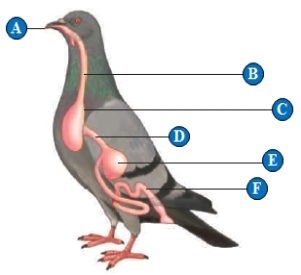 -The storage organ indicated by the letter "C" is called the ____.
 (Multiple Choice)
4.7/5 (80)
(80) 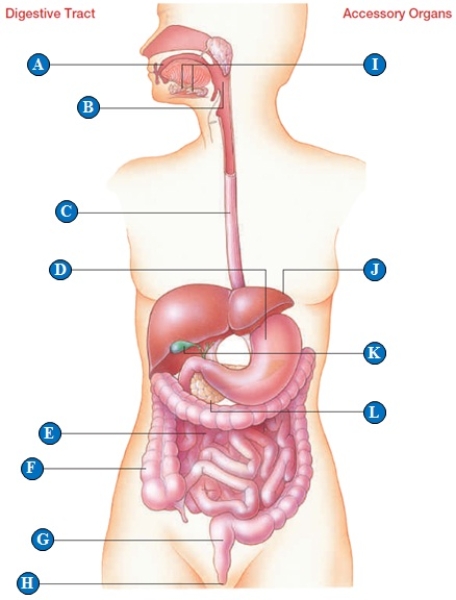 -salivary glands
Choose the one most appropriate statement for each.
-ruminants
(Multiple Choice)
4.7/5 (79)
(79) Respond to the following statements with reference to the five vitamins listed below.
-This vitamin is a coenzyme involved in amino acid metabolism and is obtained from meats and starchy vegetables.
(Multiple Choice)
4.9/5 (72)
(72) Choose the one most appropriate statement for each.
-gastrin
(Multiple Choice)
4.7/5 (66)
(66) Respond to the following statements with reference to the four glands or structures of the mammalian gastrointestinal tract listed below.
-The fat-digesting enzyme, lipase, is formed there.
(Multiple Choice)
4.8/5 (75)
(75) Respond to the following statements with reference to the five components of the gastrointestinal tract listed below.
-Short tubular projection of the large intestine.
(Multiple Choice)
5.0/5 (81)
(81) Choose the one most appropriate statement for each.
-peristalsis
(Multiple Choice)
4.7/5 (76)
(76) Organic molecules found in plant foods that reduce the risk of certain disorders are known as ____.
(Multiple Choice)
4.9/5 (75)
(75) __________ moves food down the esophagus and through a(n) __________ (a ring of muscle that can close off an opening) into the stomach.
(Short Answer)
5.0/5 (72)
(72) Choose the one most appropriate statement for each.
-sphincter
(Multiple Choice)
4.7/5 (71)
(71) 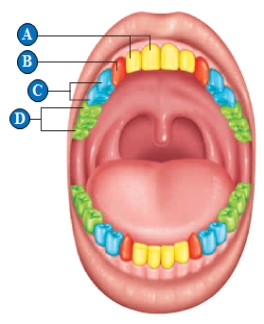 Use the figure above to answer the following question.
-The teeth designated by the letter "D" in the above figure are called ____.
Use the figure above to answer the following question.
-The teeth designated by the letter "D" in the above figure are called ____. (Multiple Choice)
4.8/5 (83)
(83) 
Filters
- Essay(0)
- Multiple Choice(0)
- Short Answer(0)
- True False(0)
- Matching(0)