



 Chat with AI
Exam 31: Animal Tissues

Exam 1: Invitation to Biology79 Questions
Exam 2: Lifes Chemical Basis67 Questions
Exam 3: Molecules of Life87 Questions
Exam 4: Cell Structure and Function106 Questions
Exam 5: Ground Rules of Metabolism69 Questions
Exam 6: Where It Starts - Photosynthesis69 Questions
Exam 7: How Cells Release Chemical Energy75 Questions
Exam 8: Dna Structure and Function61 Questions
Exam 9: From Dna to Protein64 Questions
Exam 10: Gene Control63 Questions
Exam 11: How Cells Reproduce77 Questions
Exam 12: Meiosis and Sexual Reproduction59 Questions
Exam 13: Observing Patterns in Inherited Traits85 Questions
Exam 14: Chromosomes and Human Inheritance76 Questions
Exam 15: Studying and Manipulating Genomes58 Questions
Exam 16: Evidence of Evolution55 Questions
Exam 17: Processes of Evolution74 Questions
Exam 18: Organizating Information About Species46 Questions
Exam 19: Lifes Origin and Early Evolution60 Questions
Exam 20: Viruses - Bacteria - and Archaea56 Questions
Exam 21: Protists - the Simplest Eukaryotes61 Questions
Exam 22: The Land Plants66 Questions
Exam 23: Fungi52 Questions
Exam 24: Animal Evolution - the Invertibrates74 Questions
Exam 25: Animal Evolution - the Chordates71 Questions
Exam 26: Human Evolution51 Questions
Exam 27: Plant Tissues96 Questions
Exam 28: Plant Nutrition and Transport69 Questions
Exam 29: Life Cycles of Flowering Plants89 Questions
Exam 30: Communication Strategies in Plants73 Questions
Exam 31: Animal Tissues78 Questions
Exam 32: Neural Control96 Questions
Exam 33: Sensory Perception72 Questions
Exam 34: Endocrine Control90 Questions
Exam 35: Structural Support and Movement72 Questions
Exam 36: Circulation58 Questions
Exam 37: Immunity73 Questions
Exam 38: Respiration78 Questions
Exam 39: Digestion and Nutrition98 Questions
Exam 40: Maintaining the Internal Environment73 Questions
Exam 41: Animal Reproductive Systems105 Questions
Exam 42: Animal Development72 Questions
Exam 43: Animal Behavior74 Questions
Select questions type


Which part of a neuron allows it to receive and send electrochemical signals?
(Multiple Choice)
4.9/5  (83)
(83) Respond to the following statement with reference to the organ systems listed below.
-the first line of defense against infectious bacteria found in food
(Multiple Choice)
4.8/5 (74)
(74)  -dermis
If you sweat, are you losing extracellular fluid or intracellular fluid?
(Essay)
4.8/5 (87)
(87) Respond to the following statement with reference to the types of connective tissue listed below.
-Tendons are composed of this.
(Multiple Choice)
5.0/5 (84)
(84) Specialized epithelial cells called ____________________ secrete substances that function outside the cell.
(Short Answer)
4.8/5 (68)
(68) Figure 31.6
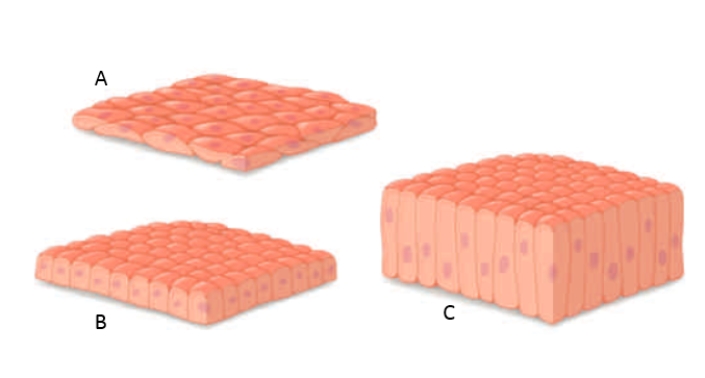 Answer the following question with reference to the above figure of epithelial tissues.
-Which tissue lines the gut?
Answer the following question with reference to the above figure of epithelial tissues.
-Which tissue lines the gut? (Multiple Choice)
4.9/5 (69)
(69) Respond to the following statement with reference to the types of connective tissue listed below.
-The elasticity of skin is due to the presence of this kind of tissue.
(Multiple Choice)
4.7/5 (91)
(91) Respond to the following statement with reference to the types of connective tissue listed below.
-This substance is derived from stem cells in bone.
(Multiple Choice)
4.9/5 (76)
(76) Which body process most often involves in a negative feedback system?
(Multiple Choice)
5.0/5 (77)
(77) A negative feedback system has four steps. Please choose the answer that lists the steps in the correct order.
(Multiple Choice)
4.9/5 (77)
(77) Respond to the following statement with reference to the organ systems listed below.
-distributes antibodies throughout the body
(Multiple Choice)
4.9/5 (78)
(78) What is the term for similar cells that are organized together with a common function?
(Multiple Choice)
4.7/5 (70)
(70) 
Filters
- Essay(0)
- Multiple Choice(0)
- Short Answer(0)
- True False(0)
- Matching(0)