



 Chat with AI
Exam 30: Communication Strategies in Plants

Exam 1: Invitation to Biology79 Questions
Exam 2: Lifes Chemical Basis67 Questions
Exam 3: Molecules of Life87 Questions
Exam 4: Cell Structure and Function106 Questions
Exam 5: Ground Rules of Metabolism69 Questions
Exam 6: Where It Starts - Photosynthesis69 Questions
Exam 7: How Cells Release Chemical Energy75 Questions
Exam 8: Dna Structure and Function61 Questions
Exam 9: From Dna to Protein64 Questions
Exam 10: Gene Control63 Questions
Exam 11: How Cells Reproduce77 Questions
Exam 12: Meiosis and Sexual Reproduction59 Questions
Exam 13: Observing Patterns in Inherited Traits85 Questions
Exam 14: Chromosomes and Human Inheritance76 Questions
Exam 15: Studying and Manipulating Genomes58 Questions
Exam 16: Evidence of Evolution55 Questions
Exam 17: Processes of Evolution74 Questions
Exam 18: Organizating Information About Species46 Questions
Exam 19: Lifes Origin and Early Evolution60 Questions
Exam 20: Viruses - Bacteria - and Archaea56 Questions
Exam 21: Protists - the Simplest Eukaryotes61 Questions
Exam 22: The Land Plants66 Questions
Exam 23: Fungi52 Questions
Exam 24: Animal Evolution - the Invertibrates74 Questions
Exam 25: Animal Evolution - the Chordates71 Questions
Exam 26: Human Evolution51 Questions
Exam 27: Plant Tissues96 Questions
Exam 28: Plant Nutrition and Transport69 Questions
Exam 29: Life Cycles of Flowering Plants89 Questions
Exam 30: Communication Strategies in Plants73 Questions
Exam 31: Animal Tissues78 Questions
Exam 32: Neural Control96 Questions
Exam 33: Sensory Perception72 Questions
Exam 34: Endocrine Control90 Questions
Exam 35: Structural Support and Movement72 Questions
Exam 36: Circulation58 Questions
Exam 37: Immunity73 Questions
Exam 38: Respiration78 Questions
Exam 39: Digestion and Nutrition98 Questions
Exam 40: Maintaining the Internal Environment73 Questions
Exam 41: Animal Reproductive Systems105 Questions
Exam 42: Animal Development72 Questions
Exam 43: Animal Behavior74 Questions
Select questions type


Figure 30.19C
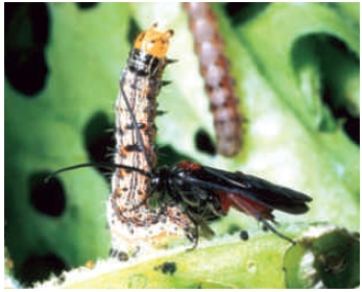 -Which plant hormone listed below is responsible for the symbiotic relationship shown in the accompanying figure?
 (Multiple Choice)
5.0/5  (83)
(83) Auxin is made mainly in ____ and in young leaves, and transported elsewhere.
(Multiple Choice)
4.7/5 (67)
(67) Choose the one most appropriate answer for each. Each letter will be used once.
-phototropism
(Multiple Choice)
4.8/5 (75)
(75) Cycles of biological activity that are repeated every 24 hours are called ____.
(Multiple Choice)
4.7/5 (78)
(78) The flavonoid called epicatechin, found in cocoa, is probably responsible for the absence of __________ among the Kuna tribe.
(Short Answer)
4.7/5 (86)
(86) The mechanism that causes a vine's tendrils to grow around an object, such as a wire fenceline, is called ____.
(Multiple Choice)
4.9/5 (72)
(72) Downward bending of a seedling root can be blocked by ____.
(Multiple Choice)
5.0/5 (69)
(69) In trees, such as the horse chestnut, the abscission of leaves and fruits in the fall is mediated by ____.
(Multiple Choice)
4.9/5 (87)
(87) Choose the one most appropriate answer for each. Each letter will be used once.
-phytochrome
(Multiple Choice)
4.9/5 (83)
(83) Deciduous trees in North America are dormant during winter months because ____.
(Multiple Choice)
5.0/5 (71)
(71) Plants make ____, which are similar to female sex hormones in mammals but have nothing to do with sexual reproduction in plants.
(Multiple Choice)
4.8/5 (71)
(71) Phytochrome is converted from the inactive to the active form by being exposed to light of what color?
(Multiple Choice)
4.8/5 (69)
(69) Respond to the following statements in reference to the five plant hormones listed below.
-This hormone promotes bud and seed dormancy.
(Multiple Choice)
4.7/5 (74)
(74) Abscisic acid promotes bud and seed __________, and it limits water loss by promoting stomatal closure.
(Short Answer)
4.9/5 (87)
(87) Gravity-sensing mechanisms of many organisms are based on ____.
(Multiple Choice)
4.9/5 (77)
(77) The flowers of plants pollinated by night-flying bats open, secrete nectar, and release fragrance only at night. The mechanism that controls this is called ____.
(Multiple Choice)
5.0/5 (84)
(84) Choose the one most appropriate answer for each. Each letter will be used once.
-auxin
(Multiple Choice)
4.9/5 (84)
(84) Choose the one most appropriate answer for each. Each letter will be used once.
-abscisic acid
(Multiple Choice)
4.8/5 (94)
(94) 
Filters
- Essay(0)
- Multiple Choice(0)
- Short Answer(0)
- True False(0)
- Matching(0)