



 Chat with AI
Exam 27: Plant Tissues

Exam 1: Invitation to Biology79 Questions
Exam 2: Lifes Chemical Basis67 Questions
Exam 3: Molecules of Life87 Questions
Exam 4: Cell Structure and Function106 Questions
Exam 5: Ground Rules of Metabolism69 Questions
Exam 6: Where It Starts - Photosynthesis69 Questions
Exam 7: How Cells Release Chemical Energy75 Questions
Exam 8: Dna Structure and Function61 Questions
Exam 9: From Dna to Protein64 Questions
Exam 10: Gene Control63 Questions
Exam 11: How Cells Reproduce77 Questions
Exam 12: Meiosis and Sexual Reproduction59 Questions
Exam 13: Observing Patterns in Inherited Traits85 Questions
Exam 14: Chromosomes and Human Inheritance76 Questions
Exam 15: Studying and Manipulating Genomes58 Questions
Exam 16: Evidence of Evolution55 Questions
Exam 17: Processes of Evolution74 Questions
Exam 18: Organizating Information About Species46 Questions
Exam 19: Lifes Origin and Early Evolution60 Questions
Exam 20: Viruses - Bacteria - and Archaea56 Questions
Exam 21: Protists - the Simplest Eukaryotes61 Questions
Exam 22: The Land Plants66 Questions
Exam 23: Fungi52 Questions
Exam 24: Animal Evolution - the Invertibrates74 Questions
Exam 25: Animal Evolution - the Chordates71 Questions
Exam 26: Human Evolution51 Questions
Exam 27: Plant Tissues96 Questions
Exam 28: Plant Nutrition and Transport69 Questions
Exam 29: Life Cycles of Flowering Plants89 Questions
Exam 30: Communication Strategies in Plants73 Questions
Exam 31: Animal Tissues78 Questions
Exam 32: Neural Control96 Questions
Exam 33: Sensory Perception72 Questions
Exam 34: Endocrine Control90 Questions
Exam 35: Structural Support and Movement72 Questions
Exam 36: Circulation58 Questions
Exam 37: Immunity73 Questions
Exam 38: Respiration78 Questions
Exam 39: Digestion and Nutrition98 Questions
Exam 40: Maintaining the Internal Environment73 Questions
Exam 41: Animal Reproductive Systems105 Questions
Exam 42: Animal Development72 Questions
Exam 43: Animal Behavior74 Questions
Select questions type


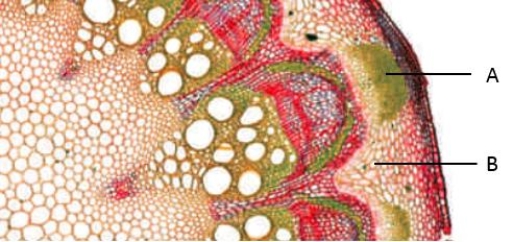 Use the figure above to answer the following two questions.
-The letter "B" in the accompanying figure represents ____.
Use the figure above to answer the following two questions.
-The letter "B" in the accompanying figure represents ____. (Multiple Choice)
4.8/5  (65)
(65) Regions of a stem that give rise to new shoots or roots are called ____.
(Multiple Choice)
4.9/5 (70)
(70) Labeling. The following statements refer to the figure below showing the general body plan of a plant. Figure 27.2
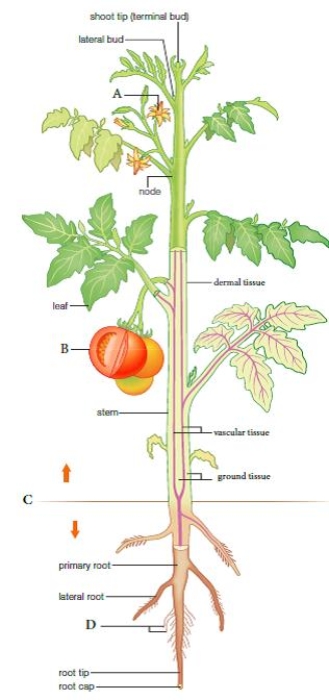 -The sexual organs of the plant are contained in the structure labeled __________.
(Short Answer)
4.9/5 (83)
(83) Figure 27.10A
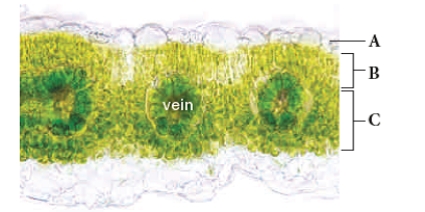 Labeling. The following statements refer to the accompanying figure showing the fine structure of a leaf
-The spongy mesophyll is labeled ____.
Labeling. The following statements refer to the accompanying figure showing the fine structure of a leaf
-The spongy mesophyll is labeled ____.
(Short Answer)
4.9/5 (82)
(82) In most eudicots, the primary root that emerges from a seed thickens and grows longer to become a(n) ____.
(Multiple Choice)
4.8/5 (71)
(71) Answer the following question in reference to the five plant tissues listed below.
-vascular tissue that conducts and distributes food to plant cells
(Multiple Choice)
4.8/5 (82)
(82) Match all applicable letters with the most appropriate term.
-collenchyma
(Multiple Choice)
4.9/5 (78)
(78) Respond to the following statement in reference to the five plant tissues listed below.
-This tissue gives rise to the xylem and phloem of an older tree.
(Multiple Choice)
4.9/5 (82)
(82) Respond to the following statement in reference to the four source tissues of plant roots listed below.
-This tissue gives rise to ground meristem.
(Multiple Choice)
4.9/5 (79)
(79) Do trees really sequester carbon permanently or does this take place simply while they are alive?
(Essay)
4.8/5 (78)
(78) Choose the one most appropriate answer for each.
-sclereids
(Multiple Choice)
4.8/5 (87)
(87) Match all applicable letters with the most appropriate term.
-parenchyma
(Multiple Choice)
4.7/5 (87)
(87) Which component distributes water and nutrients throughout the plant body?
(Multiple Choice)
4.9/5 (66)
(66) Match all applicable letters with the most appropriate term.
-mesophyll
(Multiple Choice)
4.8/5 (81)
(81) Respond to the following statement in reference to the four source tissues of plant roots listed below.
-This tissue gives rise to lateral roots.
(Multiple Choice)
4.9/5 (86)
(86) The vascular tissue that conducts water and mineral ions is called ____.
(Multiple Choice)
4.8/5 (68)
(68) Choose the one most appropriate answer for each.
-companion cells
(Multiple Choice)
4.8/5 (82)
(82) Primary growth (lengthening) arises from ____________________.
(Short Answer)
4.9/5 (79)
(79) Figure 27.8A
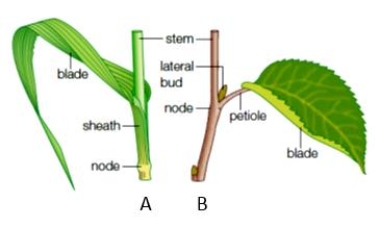 -Figure "A" in the accompanying figure is a ____.
 (Multiple Choice)
4.9/5 (76)
(76) 
Filters
- Essay(0)
- Multiple Choice(0)
- Short Answer(0)
- True False(0)
- Matching(0)