



 Chat with AI
Exam 13: Observing Patterns in Inherited Traits

Exam 1: Invitation to Biology79 Questions
Exam 2: Lifes Chemical Basis67 Questions
Exam 3: Molecules of Life87 Questions
Exam 4: Cell Structure and Function106 Questions
Exam 5: Ground Rules of Metabolism69 Questions
Exam 6: Where It Starts - Photosynthesis69 Questions
Exam 7: How Cells Release Chemical Energy75 Questions
Exam 8: Dna Structure and Function61 Questions
Exam 9: From Dna to Protein64 Questions
Exam 10: Gene Control63 Questions
Exam 11: How Cells Reproduce77 Questions
Exam 12: Meiosis and Sexual Reproduction59 Questions
Exam 13: Observing Patterns in Inherited Traits85 Questions
Exam 14: Chromosomes and Human Inheritance76 Questions
Exam 15: Studying and Manipulating Genomes58 Questions
Exam 16: Evidence of Evolution55 Questions
Exam 17: Processes of Evolution74 Questions
Exam 18: Organizating Information About Species46 Questions
Exam 19: Lifes Origin and Early Evolution60 Questions
Exam 20: Viruses - Bacteria - and Archaea56 Questions
Exam 21: Protists - the Simplest Eukaryotes61 Questions
Exam 22: The Land Plants66 Questions
Exam 23: Fungi52 Questions
Exam 24: Animal Evolution - the Invertibrates74 Questions
Exam 25: Animal Evolution - the Chordates71 Questions
Exam 26: Human Evolution51 Questions
Exam 27: Plant Tissues96 Questions
Exam 28: Plant Nutrition and Transport69 Questions
Exam 29: Life Cycles of Flowering Plants89 Questions
Exam 30: Communication Strategies in Plants73 Questions
Exam 31: Animal Tissues78 Questions
Exam 32: Neural Control96 Questions
Exam 33: Sensory Perception72 Questions
Exam 34: Endocrine Control90 Questions
Exam 35: Structural Support and Movement72 Questions
Exam 36: Circulation58 Questions
Exam 37: Immunity73 Questions
Exam 38: Respiration78 Questions
Exam 39: Digestion and Nutrition98 Questions
Exam 40: Maintaining the Internal Environment73 Questions
Exam 41: Animal Reproductive Systems105 Questions
Exam 42: Animal Development72 Questions
Exam 43: Animal Behavior74 Questions
Select questions type


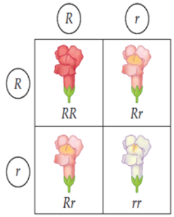 -The accompanying illustration shows the F2 phenotypes from a monohybrid cross in snapdragons. What type of inheritance produces such an outcome?
 (Multiple Choice)
4.9/5  (81)
(81) True-breeding yellow guinea pigs crossed with true-breeding white ones produce only cream-colored offspring. This pattern indicates incomplete dominance. Rough hair is found to be dominant to smooth hair. Give the F1 and F2 genotypic and phenotypic ratios of a cross of a smooth, white guinea pig with a homozygous, rough, yellow guinea pig.
(Essay)
4.8/5 (68)
(68) Genes at one locus that affect the expression of genes at a different locus are said to be
(Multiple Choice)
4.9/5 (83)
(83) In garden peas, one pair of alleles controls the height of the plant, and a second pair of alleles controls flower color. The allele for tall (D) is dominant to the allele for dwarf (d), and the allele for purple (P) is dominant to the allele for white (p). A tall plant with purple flowers crossed with a tall plant with purple flowers produces 3/4 tall purple and 1/4 tall white. What is the genotype of the parents?
(Short Answer)
4.9/5 (84)
(84) Consider the work Mendel did with his pea plants. Why is the study of human genetics much more difficult?
(Essay)
4.8/5 (72)
(72) 
Filters
- Essay(0)
- Multiple Choice(0)
- Short Answer(0)
- True False(0)
- Matching(0)