



 Chat with AI
Exam 6: Where It Starts - Photosynthesis

Exam 1: Invitation to Biology79 Questions
Exam 2: Lifes Chemical Basis67 Questions
Exam 3: Molecules of Life87 Questions
Exam 4: Cell Structure and Function106 Questions
Exam 5: Ground Rules of Metabolism69 Questions
Exam 6: Where It Starts - Photosynthesis69 Questions
Exam 7: How Cells Release Chemical Energy75 Questions
Exam 8: Dna Structure and Function61 Questions
Exam 9: From Dna to Protein64 Questions
Exam 10: Gene Control63 Questions
Exam 11: How Cells Reproduce77 Questions
Exam 12: Meiosis and Sexual Reproduction59 Questions
Exam 13: Observing Patterns in Inherited Traits85 Questions
Exam 14: Chromosomes and Human Inheritance76 Questions
Exam 15: Studying and Manipulating Genomes58 Questions
Exam 16: Evidence of Evolution55 Questions
Exam 17: Processes of Evolution74 Questions
Exam 18: Organizating Information About Species46 Questions
Exam 19: Lifes Origin and Early Evolution60 Questions
Exam 20: Viruses - Bacteria - and Archaea56 Questions
Exam 21: Protists - the Simplest Eukaryotes61 Questions
Exam 22: The Land Plants66 Questions
Exam 23: Fungi52 Questions
Exam 24: Animal Evolution - the Invertibrates74 Questions
Exam 25: Animal Evolution - the Chordates71 Questions
Exam 26: Human Evolution51 Questions
Exam 27: Plant Tissues96 Questions
Exam 28: Plant Nutrition and Transport69 Questions
Exam 29: Life Cycles of Flowering Plants89 Questions
Exam 30: Communication Strategies in Plants73 Questions
Exam 31: Animal Tissues78 Questions
Exam 32: Neural Control96 Questions
Exam 33: Sensory Perception72 Questions
Exam 34: Endocrine Control90 Questions
Exam 35: Structural Support and Movement72 Questions
Exam 36: Circulation58 Questions
Exam 37: Immunity73 Questions
Exam 38: Respiration78 Questions
Exam 39: Digestion and Nutrition98 Questions
Exam 40: Maintaining the Internal Environment73 Questions
Exam 41: Animal Reproductive Systems105 Questions
Exam 42: Animal Development72 Questions
Exam 43: Animal Behavior74 Questions
Select questions type


Use the figure below to match the pigments with their absorption spectra.
Figure 6.5C
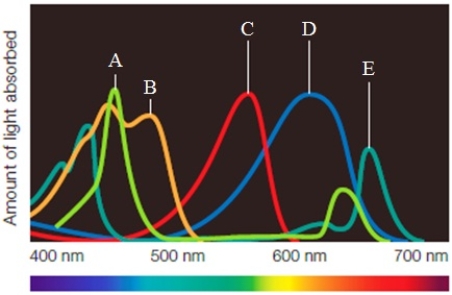 -chlorophyll a
 (Multiple Choice)
4.9/5  (80)
(80) Use the figure below to match the pigments with their absorption spectra.
Figure 6.5C
-beta-carotene
-beta-carotene (Multiple Choice)
5.0/5 (81)
(81) Match the pigment with its relationship to sunlight.
-causes some fruits and vegetables to appear orange or yellow
(Multiple Choice)
4.9/5 (82)
(82) Choose the one most appropriate description.
-the formation of glucose
(Multiple Choice)
4.8/5 (76)
(76) The processes listed below represent major chemical pathways in photosynthesis. Respond to the following statement with reference to these five processes.
-This carbon-fixing system uses CO₂ from inside the plant, and precedes the Calvin-Benson cycle.
(Multiple Choice)
4.7/5 (89)
(89) The first stable compound produced from CO₂ in the light-independent reaction is ____.
(Multiple Choice)
4.7/5 (93)
(93) Figure 6.5B
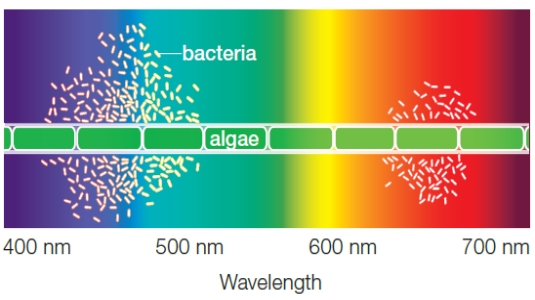 Following Questions refer to the figure above illustrating the results from Engelmann's investigation.
-According to the figure, the most effective wavelength for photosynthesis is revealed by algae exposed to ____ nanometers.
Following Questions refer to the figure above illustrating the results from Engelmann's investigation.
-According to the figure, the most effective wavelength for photosynthesis is revealed by algae exposed to ____ nanometers. (Multiple Choice)
4.7/5 (75)
(75) Match the pigment with its relationship to sunlight.
-absorbs only blue light
(Multiple Choice)
4.8/5 (85)
(85) The two photosystems of light-dependent reactions are designated ____.
(Multiple Choice)
4.9/5 (81)
(81) The processes listed below represent major chemical pathways in photosynthesis. Respond to the following statement with reference to these five processes.
-This is a carbon-fixing system that separates two carbon fixations into night and day activities.
(Multiple Choice)
4.7/5 (84)
(84) What is formed during the light dependent reactions of photosynthesis?
(Multiple Choice)
4.8/5 (82)
(82) Any light-driven reaction that attaches phosphate to a molecule is called ____________________.
(Short Answer)
4.8/5 (82)
(82) What is a required input for the light-independent reactions?
(Multiple Choice)
4.9/5 (83)
(83) The processes listed below represent major chemical pathways in photosynthesis. Respond to the following statement with reference to these five processes.
-This yields NADPH as well as ATP.
(Multiple Choice)
4.8/5 (81)
(81) A pigment absorbs a photon if the energy of the photon is ____.
(Multiple Choice)
4.9/5 (82)
(82) Choose the one most appropriate description.
-noncyclic pathway of ATP formation
(Multiple Choice)
5.0/5 (78)
(78) 
Filters
- Essay(0)
- Multiple Choice(0)
- Short Answer(0)
- True False(0)
- Matching(0)