



 Chat with AI
Exam 14: Risk Analysis

Exam 1: Introduction24 Questions
Exam 2: Demand Theory51 Questions
Exam 3: Consumer Behavior and Rational Choice52 Questions
Exam 4: Estimating Demand Functions48 Questions
Exam 5: Production Theory44 Questions
Exam 6: The Analysis of Costs54 Questions
Exam 7: Perfect Competition39 Questions
Exam 8: Monopoly and Monopolistic Competition47 Questions
Exam 9: Managerial Use of Price Discrimination27 Questions
Exam 10: Bundling and Intrafirm Pricing26 Questions
Exam 11: Oligopoly41 Questions
Exam 12: Game Theory28 Questions
Exam 13: Auctions30 Questions
Exam 14: Risk Analysis44 Questions
Exam 15: Principalagent Issues and Managerial Compensation24 Questions
Exam 16: Adverse Selection15 Questions
Exam 17: Government and Business35 Questions
Exam 18: Optimization Techniques55 Questions
Exam 19: Appendix Problems9 Questions
Select questions type


A game has two players.Player 1 chooses between two options,and then player 2,with the knowledge of what player 1 chose,chooses between two options.If this were depicted in a decision tree,how many forks would there be?
(Multiple Choice)
4.8/5  (86)
(86) Using the coefficient of variation instead of the standard deviation accounts for the:
(Multiple Choice)
4.9/5 (77)
(77) A person who has a utility function (with income on the horizontal axis and utility on the vertical axis)that curves up as income increases is:
(Multiple Choice)
4.7/5 (96)
(96) I.M.Hogg,who is risk-neutral over votes,is running for office with 500,000 sure voters.To add voters,he wants to choose n,the number of negative campaign ads to run,where 0  n
 4.The ads will backfire with probability n/5 and give him no extra votes.Otherwise,the ads will work and give him 100,000 + 40,000n extra votes.So n = 0 implies a total of 600,000 votes.He should choose n = :
n 4.The ads will backfire with probability n/5 and give him no extra votes.Otherwise,the ads will work and give him 100,000 + 40,000n extra votes.So n = 0 implies a total of 600,000 votes.He should choose n = : (Multiple Choice)
4.8/5 (72)
(72) If is the standard deviation of a project with expected returns R,the coefficient of variation is:
(Multiple Choice)
4.9/5 (77)
(77) Susan is indifferent between $500 for sure and a bet with a 60% chance of $400 and a 40% chance of $700.Susan is:
(Multiple Choice)
4.8/5 (86)
(86) If a payoff is equally likely to be $1,$2,$3,$4,or $5,the coefficient of variation is:
(Multiple Choice)
4.8/5 (78)
(78) If a coin were weighted so that heads had three times the chance [P(H)] of coming up as tails [P(T)],the probability distribution would be given by:
(Multiple Choice)
4.8/5 (92)
(92) An investor has utility function U = 10 + 5P - 0.02P2.What is the expected utility of the following investment option? 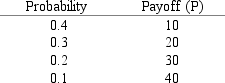
(Multiple Choice)
4.8/5 (71)
(71) For constants a and b,0 < b,b 1,and expected profit E( ),the utility function of a person who is risk-neutral can be written as U = :
(Multiple Choice)
4.8/5 (87)
(87) Joe is risk-neutral with utility U = bR,where b is a positive constant and R is profit from a venture.If a gamble has a 0.4 chance of R = 1 and a 0.6 chance of R = 2,Joe's expected utility E(U)is:
(Multiple Choice)
4.9/5 (85)
(85) A risk-averse person has a utility function that,with income on the horizontal axis and utility on the vertical axis,as income increases:
(Multiple Choice)
4.9/5 (81)
(81) Fred Kruger is indifferent between return rates satisfying R = 0.10 + (-0.01) ,where measures risk.Fred is:
(Multiple Choice)
4.8/5 (77)
(77) If a payoff is equally likely to be $1,$2,$3,$4,or $5,the square of the standard deviation is:
(Multiple Choice)
4.8/5 (80)
(80) If you get $10 for heads but lose $10 for tails on the flip of a fair coin,the coefficient of variation is:
(Multiple Choice)
4.9/5 (73)
(73) A decision fork with payoffs given for each branch is assigned a value based on:
(Multiple Choice)
4.8/5 (78)
(78) Fred has a utility function U = 10P 0.5 and also has an investment opportunity that will pay 25 with probability 0.4 and 100 with probability 0.6.What is the expected utility of this opportunity?
(Multiple Choice)
4.8/5 (80)
(80) 
Filters
- Essay(0)
- Multiple Choice(0)
- Short Answer(0)
- True False(0)
- Matching(0)