



 Chat with AI
Exam 11: Oligopoly

Exam 1: Introduction24 Questions
Exam 2: Demand Theory51 Questions
Exam 3: Consumer Behavior and Rational Choice52 Questions
Exam 4: Estimating Demand Functions48 Questions
Exam 5: Production Theory44 Questions
Exam 6: The Analysis of Costs54 Questions
Exam 7: Perfect Competition39 Questions
Exam 8: Monopoly and Monopolistic Competition47 Questions
Exam 9: Managerial Use of Price Discrimination27 Questions
Exam 10: Bundling and Intrafirm Pricing26 Questions
Exam 11: Oligopoly41 Questions
Exam 12: Game Theory28 Questions
Exam 13: Auctions30 Questions
Exam 14: Risk Analysis44 Questions
Exam 15: Principalagent Issues and Managerial Compensation24 Questions
Exam 16: Adverse Selection15 Questions
Exam 17: Government and Business35 Questions
Exam 18: Optimization Techniques55 Questions
Exam 19: Appendix Problems9 Questions
Select questions type


Duopolists A and B face the following demand curves: QA = 100 - 2PA + 5PB and QB = 120 - 3PB + 4PA.If both firms have zero marginal cost,what are the profit-maximizing prices and quantities?
(Multiple Choice)
4.9/5  (78)
(78) Duopolists A and B face the following demand curves: QA = 120 - 2PA + PB and QB = 120 - 2PB + PA.If both firms have zero marginal cost and they form a cartel,what is the profit-maximizing price and quantity?
(Multiple Choice)
4.7/5 (75)
(75) Two firms (A and B)have marginal costs MCA and MCB,marginal revenues MRA and MRB,and market marginal revenue MR.If both firms produce as a cartel,they should produce so that:
(Multiple Choice)
4.9/5 (93)
(93) Suppose duopolists in the market for spring water share a market demand curve given by P = 50 - 0.02Q,where P is the price per gallon and Q is thousands of gallons of water per day.The marginal cost of producing water is near zero for both firms.Optimal output for Cournot duopolists moving simultaneously is:
(Multiple Choice)
4.7/5 (87)
(87) Two local ready-mix cement manufacturers,Here and There,have combined demand given by Q = 105 - P.Their total costs are given by TCHere = 5QHere + 0.5Q2Here and TCThere = 5QThere + 0.5Q2There.If they successfully collude,their total output will be:
(Multiple Choice)
4.7/5 (66)
(66) Duopolists A and B face the following demand curves: QA = 150 - 5PA + 4PB and QB = 150 - 5PB + 4PA.If both firms have zero marginal cost and they form a cartel,what is the profit-maximizing price and quantity?
(Multiple Choice)
4.7/5 (83)
(83) An oligopolist that faces a kinked demand curve is charging price P = 6.Demand for an increase in price is Q = 280 - 40P and demand for a decrease in price is Q = 100 - 10P.Over what range of marginal cost would the optimal price remain unchanged?
(Multiple Choice)
4.8/5 (89)
(89) Glyde Air Fresheners is the dominant firm in the solid room aromatizer industry,which has a total market demand given by Q = 80 - 2P.Glyde has competition from a fringe of four small firms that produce where their individual marginal costs equal the market price.The fringe firms each have total costs given by TCi = 10Qi + 2Q2i.If Glyde's total costs are given by TCG = 100 + 6QG,what price should Glyde establish for air fresheners?
(Multiple Choice)
4.9/5 (65)
(65) If the cartel described by the accompanying diagram is broken up and forced into a perfectly competitive market situation,the optimal output and price will be: 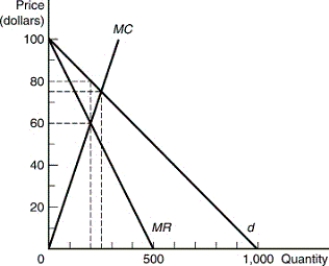
(Multiple Choice)
4.8/5 (89)
(89) The OPEC oil cartel lost its market power and world oil prices fell in the 1980s because:
(Multiple Choice)
4.9/5 (97)
(97) Two local ready-mix cement manufacturers,Here and There,have combined demand given by Q = 105 - P.Their total costs are given by TCHere = 5QHere + 0.5Q2Here and TCThere = 5QThere + 0.5Q2There.If they cannot successfully collude and instead produce where the market price equals marginal cost,their total output will be:
(Multiple Choice)
4.9/5 (83)
(83) When an economist says an oligopoly has a "small" number of firms,the economist means:
(Multiple Choice)
4.8/5 (77)
(77) 
Filters
- Essay(0)
- Multiple Choice(0)
- Short Answer(0)
- True False(0)
- Matching(0)