



 Chat with AI
Exam 3: Analysis of Financial Statements

Exam 1: An Overview of Financial Management and the Financial Environment46 Questions
Exam 2: Financial Statements, cash Flow, and Taxes77 Questions
Exam 3: Analysis of Financial Statements104 Questions
Exam 4: Time Value of Money168 Questions
Exam 5: Bonds, bond Valuation, and Interest Rates100 Questions
Exam 6: Risk and Return146 Questions
Exam 7: Valuation of Stocks and Corporations80 Questions
Exam 8: Financial Options and Applications in Corporate Finance28 Questions
Exam 9: The Cost of Capital92 Questions
Exam 10: The Basics of Capital Budgeting: Evaluating Cash Flows108 Questions
Exam 11: Cash Flow Estimation and Risk Analysis78 Questions
Exam 12: Corporate Valuation and Financial Planning41 Questions
Exam 13: Agency Conflicts and Corporate Governance6 Questions
Exam 14: Distributions to Shareholders: Dividends and Repurchases58 Questions
Exam 15: Capital Structure Decisions59 Questions
Exam 16: Supply Chains and Working Capital Management135 Questions
Exam 17: Multinational Financial Management49 Questions
Exam 18: Public and Private Financing: Initial Offerings, seasoned Offerings, and Investment Banks22 Questions
Exam 18: Extension 18 A: Rights Offerings4 Questions
Exam 19: Lease Financing23 Questions
Exam 20: Hybrid Financing: Preferred Stock, warrants, and Convertibles26 Questions
Exam 21: Dynamic Capital Structures22 Questions
Exam 22: Mergers and Corporate Control46 Questions
Exam 23: Enterprise Risk Management14 Questions
Exam 24: Bankruptcy, reorganization, and Liquidation12 Questions
Exam 25: Portfolio Theory and Asset Pricing Models35 Questions
Exam 26: Real Options11 Questions
Exam 27: Providing and Obtaining Credit29 Questions
Exam 28: Advanced Issues in Cash Management and Inventory Control17 Questions
Exam 29: Pension Plan Management10 Questions
Exam 30: Financial Management in Not For Profit Businesses10 Questions
Select questions type


Exhibit 3.1
The balance sheet and income statement shown below are for Pettijohn Inc. Note that the firm has no amortization charges, it does not lease any assets, none of its debt must be retired during the next 5 years, and the notes payable will be rolled over.
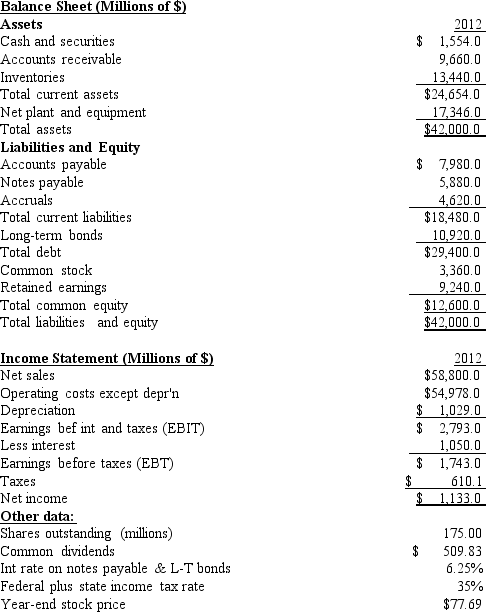 -Refer to Exhibit 3.1.What is the firm's EBITDA coverage?
 (Multiple Choice)
4.8/5  (88)
(88) Debt management ratios show the extent to which a firm's managers are attempting to magnify returns on owners' capital through the use of financial leverage.
(True/False)
4.8/5 (73)
(73) One problem with ratio analysis is that relationships can be manipulated.For example,if our current ratio is greater than 1.5,then borrowing on a short-term basis and using the funds to build up our cash account would cause the current ratio to increase.
(True/False)
4.8/5 (73)
(73) 
Filters
- Essay(0)
- Multiple Choice(0)
- Short Answer(0)
- True False(0)
- Matching(0)