



 Chat with AI
Exam 10: Multivariate Methods of Marketing Research I: Factor, cluster, and Discriminant Analyses

Exam 1: The Purpose and Process of Marketing Research75 Questions
Exam 2: Research Design and Data Sources75 Questions
Exam 3: Measurement in Marketing Research75 Questions
Exam 4: Causal Designs and Marketing Experiments75 Questions
Exam 5: Data Collection: Exploratory and Conclusive Research75 Questions
Exam 6: Designing Surveys and Data Collection Instruments75 Questions
Exam 7: Sampling75 Questions
Exam 8: Data Analysis and Statistical Methods: Univariate and Bivariate Analyses75 Questions
Exam 9: Multiple Regression: Modeling Multivariate Relationships74 Questions
Exam 10: Multivariate Methods of Marketing Research I: Factor, cluster, and Discriminant Analyses75 Questions
Exam 11: Multivariate Methods of Marketing Reseach Ii: Conjoint Analysis and Multidimensional Scaling75 Questions
Exam 12: Advanced Topics, research Frontiers, and Preparing the Final Report75 Questions
Select questions type


Use the following table from a cluster analysis to answer the following questions.
Agglomeration Schedule for Centroid Hierarchical Cluster Analysis
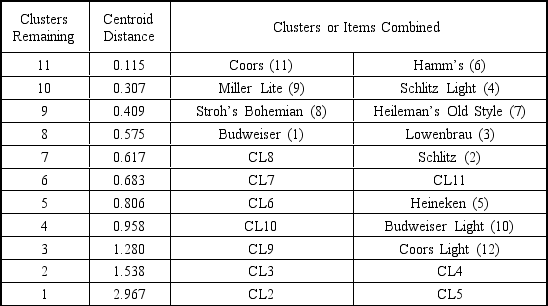 -When Budweiser Light joins with a cluster,identify all of the other brands already in the cluster it joins.
 (Essay)
4.8/5  (74)
(74) The best analysis technique for discovering segments within a market is
(Multiple Choice)
4.9/5 (85)
(85) In cluster analysis it is especially dangerous if the ranges of the variables are dramatically different.
(True/False)
4.9/5 (88)
(88) Factor analysis can help determine coefficients in multiple regression,because
(Multiple Choice)
5.0/5 (81)
(81) Hierarchical clustering works well if a researcher needs a fixed number of clusters,whereas nonhierarchical clustering is more useful when one needs to compare different clustering solutions.
(True/False)
5.0/5 (98)
(98) One of the primary problems with the principal components analysis of factor analysis is that it can take most of the variance to explain the first factor and leave little variance for other factors to explain.
(True/False)
4.8/5 (79)
(79) In dependence models,no variable or variables are designated as being predicted by others,because the researcher is interested in the interrelationships among all of the variables taken together.
(True/False)
4.8/5 (59)
(59) What is a latent class,and how does it apply to segmentation analysis?
(Essay)
4.7/5 (84)
(84) In simple terms,_______________ works on dividing up data points so that those in the same group are close to one another while those in different groups are far away.
(Multiple Choice)
4.8/5 (86)
(86) Discriminant analysis can only be used for a binary nominal dependent variable.
(True/False)
4.7/5 (90)
(90) A problem in developing a scale is in weighting the variables being combined in the scale._______________ can do this by using the _______________ as the weights.
(Multiple Choice)
4.9/5 (85)
(85) Knowing the value that someone scores on the principle factor after a varimax rotation tells you _______________ their score on other factors.
(Multiple Choice)
4.9/5 (72)
(72) All of the following of real-world uses of discriminant analysis except
(Multiple Choice)
4.8/5 (71)
(71) Factor analysis can be used for all of the following applications in marketing research except
(Multiple Choice)
4.8/5 (82)
(82) Factor analysis can be used for data transformations by identifying covariates that are exactly uncorrelated and make good inputs for dependence methods.
(True/False)
4.9/5 (80)
(80) In factor analysis,the object of the initial extraction is to
(Multiple Choice)
5.0/5 (73)
(73) Discuss the possible applications in marketing research for factor analysis.
(Essay)
4.7/5 (76)
(76) Both _______________ analyses are classified as data reduction methods because they take a great deal of data and summarize them with a much smaller set of quantities.
(Multiple Choice)
4.8/5 (92)
(92) 
Filters
- Essay(0)
- Multiple Choice(0)
- Short Answer(0)
- True False(0)
- Matching(0)