



 Chat with AI
Exam 5: Database Design

Exam 1: Getting Started76 Questions
Exam 2: The Relational Model87 Questions
Exam 3: Structured Query Language96 Questions
Exam 4: Data Modeling and the Entity-Relationship Model76 Questions
Exam 5: Database Design81 Questions
Exam 6: Database Administration76 Questions
Exam 7: Database Processing Applications82 Questions
Exam 8: Big Data, data Warehouses, and Business Intelligence Systems99 Questions
Exam 9: Getting Started With Microsoft Sql Server 201240 Questions
Exam 10: Getting Started With Oracle Database 11g Release 243 Questions
Exam 11: Getting Started With Mysql 56 Community Server71 Questions
Exam 12: James River Jewelry Project Questions70 Questions
Exam 13: Sql Views47 Questions
Exam 14: Getting Started in Systems Analysis and Design34 Questions
Exam 15: Getting Started With Microsoft Visio 201017 Questions
Exam 16: The Access Workbench-section Microsoft Access35 Questions
Exam 17: Getting Started With Web Servers, php, and the Netbeans IDE98 Questions
Exam 18: Business Intelligence Systems77 Questions
Select questions type


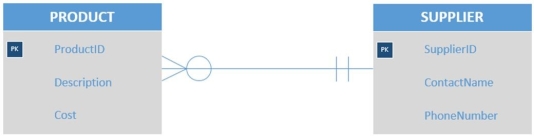
Given the tables PRODUCT (ProductID,Description,Cost)
SUPPLIER (SupplierID,ContactName,PhoneNumber)
As shown in the figure below,which of the following would represent the correct placement of foreign keys?

Free
(Multiple Choice)
4.8/5  (87)
(87) Correct Answer: Verified
E
An entity needs to be examined according to normalization criteria before creating a table from it in the relational database design.
Free
(True/False)
4.9/5 (83)
(83) Correct Answer:Verified
VerifiedFalse
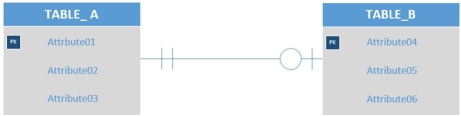
Given the tables TABLE_A (Attribute1,Attribute2,Attribute3)
TABLE_B (Attribute4,Attribute5,Attribute6)
As shown in the figure below,which of the following would display the correct placement of foreign keys in the relational model?
Free
(Multiple Choice)
4.8/5 (81)
(81) Correct Answer:Verified
VerifiedA
The first step of database design is to define a table for each ________.
(Short Answer)
4.8/5 (87)
(87) Which of the following is the correct technique for representing a M:N relationship using the relational model?
(Multiple Choice)
4.9/5 (84)
(84) By default,when Microsoft Access creates a relationship between two tables,it creates a(n):
(Multiple Choice)
4.9/5 (86)
(86) In certain circumstances,there may be a preference as to which table in a 1:1 relationship contains the foreign key.
(True/False)
4.9/5 (70)
(70) In relational database design,ID-dependent entities are used to ________.
(Multiple Choice)
4.9/5 (80)
(80) When transforming an ID-dependent E-R data model relationship into a relational database design and the child entity is designed to use a surrogate key,then ________.
(Multiple Choice)
4.8/5 (86)
(86) As far as Microsoft Access is concerned,there are no ________.
(Short Answer)
4.7/5 (89)
(89) Which of the following is the correct technique for representing a 1:N relationship in the relational model?
(Multiple Choice)
4.9/5 (83)
(83) Which of the following is true about representing a weak entity with the relational model?
(Multiple Choice)
4.8/5 (83)
(83) What is an association relationship,and how does it differ from an N:M relationship?
(Essay)
4.7/5 (74)
(74) As far as Microsoft Access is concerned,there are no N:M relationships.
(True/False)
4.8/5 (77)
(77) To create a 1:1 relationship in Microsoft Access,the Indexed property of the foreign key column must be set to Yes (No Duplicates).
(True/False)
4.7/5 (73)
(73) What relationship pattern is illustrated in the following schema? VEHICLE (VehicleID,Cost)
CAR (VehicleID,NumberOfSeats)
TRUCK (VehicleID,CargoCapacity)
VehicleID in CAR must exist in VehicleID in VEHICLE
VehicleID in TRUCK must exist in VehicleID in VEHICLE
(Multiple Choice)
4.8/5 (68)
(68) Once a table has been defined,it should be examined according to ________ criteria.
(Short Answer)
4.9/5 (86)
(86) 
Filters
- Essay(0)
- Multiple Choice(0)
- Short Answer(0)
- True False(0)
- Matching(0)