



 Chat with AI
Exam 10: Kinship, Family, and Marriage

Exam 1: Anthropology in a Global Age66 Questions
Exam 2: Culture70 Questions
Exam 3: Fieldwork and Ethnography63 Questions
Exam 4: Language62 Questions
Exam 5: Human Origins69 Questions
Exam 6: Race and Racism70 Questions
Exam 7: Ethnicity and Nationalism63 Questions
Exam 8: Gender67 Questions
Exam 9: Sexuality62 Questions
Exam 10: Kinship, Family, and Marriage72 Questions
Exam 11: Class and Inequality68 Questions
Exam 12: The Global Economy68 Questions
Exam 13: Migration62 Questions
Exam 14: Politics and Power70 Questions
Exam 15: Religion70 Questions
Exam 16: Health, Illness, and the Body69 Questions
Exam 17: Art and Media63 Questions
Select questions type


Which of the following types of marriage specifically involves the marital union of one man to two or more women?
(Multiple Choice)
4.7/5  (73)
(73) Many different kinship structures send a son away (or search outside their immediate kin groups) for a marriage partner. What rule does this reflect?
(Multiple Choice)
4.8/5 (84)
(84) In Melanie Medeiros's (2014) ethnographic study of the small town of Brogodo, the economy shrank drastically in the early twentieth century because of the decline of the mining industry, leaving residents to rely primarily on small-scale farming and remittances from relatives in urban areas. What impact did these political economic shifts have on gender and the family?
(Essay)
5.0/5 (88)
(88) One of the major shifts in marriage patterns, both in the United States and in many other countries, is the ability of same-sex partners to marry. Those who marry and also choose to have children will undoubtedly gain from what other recent change?
(Multiple Choice)
4.8/5 (91)
(91) Although some kinship relationships are established through biology or common descent, others are established through marriage. What do anthropologists call relationships established through marriage and/or alliance?
(Multiple Choice)
4.8/5 (68)
(68) Anthropologist E. E. Evans-Pritchard conducted ethnographic research with Nuer people of southern Sudan in the 1930s and argued that this group of people constituted a patrilineal descent group. What does it mean to be a patrilineal descent group and how does this differ from a matrilineal descent group? How were cattle used to reflect the patrilineal nature of Nuer descent? Provide at least two examples.
(Essay)
4.9/5 (92)
(92) Both matrilineal and patrilineal patterns of descent build kinship groups through either one genealogical line (the mother's side) or the other (the father's side). What anthropological concept does this reflect?
(Multiple Choice)
4.8/5 (82)
(82) Which type of assisted reproductive technology involves collecting mature eggs from a woman's ovaries and fertilizing them in a laboratory?
(Multiple Choice)
5.0/5 (80)
(80) How many different ways of organizing relatives did early anthropologists find by collecting kinship data from cultures worldwide?
(Multiple Choice)
4.9/5 (79)
(79) Nation-states draw heavily on ideas of ________ in order to create a sense of connection among very different people found within their national borders.
(Multiple Choice)
4.8/5 (69)
(69) Something similar to marriage exists in every known culture. However, many anthropologists observe that:
(Multiple Choice)
5.0/5 (76)
(76) How many different primary systems used to classify relatives in the parental generation, including the bifurcate merging system, were identified by early anthropologists?
(Multiple Choice)
4.9/5 (80)
(80) Where in the world are first-cousin marriages (between the children of two siblings) legally prohibited?
(Multiple Choice)
4.8/5 (88)
(88) Bridewealth is still prevalent in many African societies and frequently means that the groom's family gives cattle (and sometimes other goods) to the family of the bride-to-be. What is the goal of bridewealth?
(Multiple Choice)
4.8/5 (82)
(82) The text features a photograph of a prominent U.S. family, the Kennedys. We often refer to a family group as a clan ("Kennedy clan") and not a lineage ("Kennedy lineage"). How is this consistent with an anthropological definition of clan? 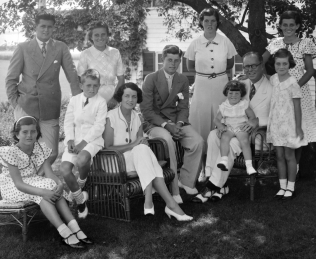
(Multiple Choice)
4.9/5 (87)
(87) Arranged marriages that are orchestrated by the families of the bride and groom are common in many cultural groups in Asia, the Pacific, the Middle East, and Africa. Although arranged marriage is not the primary form of marriage in the United States, it does exist. Anthropologists would argue that arranged marriages actually do occur more frequently when marriages that are arranged in subtle and implicit ways are considered. What are three examples of subtle, arranged marriages that occur in the United States that may not necessarily be overtly called "arranged marriages"? Why do you think these types of marriages occur? How do these types of marriage compare to companionate marriages?
(Essay)
4.7/5 (80)
(80) Sara Dorow documents the process by which Chinese infants are adopted by white American parents who bring the children to live in a new country. Why are children from China attractive for parents looking to adopt?
(Multiple Choice)
4.9/5 (81)
(81) Which of the following terms is defined as the system of meaning and power that cultures create to determine who is related to whom and to define their mutual expectations, rights, and responsibilities?
(Multiple Choice)
4.9/5 (78)
(78) Ambilineal descent groups such as Samoans, Maori, and Hawaiians are sometimes referred to as what kind of descent groups?
(Multiple Choice)
4.7/5 (68)
(68) What is distinctive about new kinship groups created through affinal relationships?
(Multiple Choice)
4.8/5 (71)
(71) 
Filters
- Essay(0)
- Multiple Choice(0)
- Short Answer(0)
- True False(0)
- Matching(0)