



 Chat with AI
Exam 6: Race and Racism

Exam 1: Anthropology in a Global Age66 Questions
Exam 2: Culture70 Questions
Exam 3: Fieldwork and Ethnography63 Questions
Exam 4: Language62 Questions
Exam 5: Human Origins69 Questions
Exam 6: Race and Racism70 Questions
Exam 7: Ethnicity and Nationalism63 Questions
Exam 8: Gender67 Questions
Exam 9: Sexuality62 Questions
Exam 10: Kinship, Family, and Marriage72 Questions
Exam 11: Class and Inequality68 Questions
Exam 12: The Global Economy68 Questions
Exam 13: Migration62 Questions
Exam 14: Politics and Power70 Questions
Exam 15: Religion70 Questions
Exam 16: Health, Illness, and the Body69 Questions
Exam 17: Art and Media63 Questions
Select questions type


What is the one term we might expect to see, but do not, in the variations of names given to different racial categories in the Dominican Republic?
(Multiple Choice)
4.8/5  (76)
(76) A set of ideas about a group of people, such as: "All Irishmen are drunks who beat their wives," or "All Arabs are terrorists," can make it seem natural and normal to discriminate against these groups. What is the term for sets of ideas like these?
(Multiple Choice)
5.0/5 (85)
(85) In the period between 1933 and 1936, the Nazi regime implemented laws that defined who was and was not Jewish according to ancestry. Any person with three or four Jewish grandparents was considered a "full-blooded" Jew; those with fewer (but more than zero) were considered "half-breeds" or "mongrels." This approach to dividing and categorizing people relies on the assumption that:
(Multiple Choice)
4.9/5 (84)
(84) Explain how the idea of "white" or "whiteness" changed over time in the United States.
(Essay)
4.8/5 (80)
(80) In Living with Racism: The Black Middle-Class Experience (1994), sociologist Joe Feagin and psychologist Melvin Sikes write about middle-class African Americans who, despite their class status, continue to face racial discrimination. This study is an example of ________.
(Multiple Choice)
4.9/5 (86)
(86) Explain the concept of racialization and how it applies to Middle Eastern people in the United States. Why is this process reflected in the New York school system as studied by Maria Kromidas?
(Essay)
4.8/5 (88)
(88) Three hundred years of forced transport of millions of Africans to North and South America resulted in ________.
(Multiple Choice)
4.8/5 (76)
(76) Gregor Mendel, a monk in the mid-nineteenth century, discovered that crossing white- and purple-flowered pea plants yielded purple flowers and not a blend of the two colors. What important discovery did Mendel's work reveal?
(Multiple Choice)
4.8/5 (80)
(80) Chinese immigrants to the United States were quickly separated according to an arbitrary set of characteristics, including slight differences in skin color. The Irish immigrants were similarly segregated, despite having white skin. What was one of the bases on which the Irish were segregated and racialized? 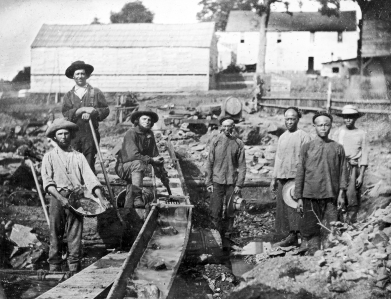
(Multiple Choice)
4.9/5 (74)
(74) How does the U.S. census, taken every ten years since 1790, provide a window into the changing conception of "race"?
(Essay)
4.9/5 (90)
(90) In November 2014, what did a local Ferguson, Missouri, grand jury decide in the case of the death of Michael Brown?
(Multiple Choice)
4.7/5 (84)
(84) The story of Shellcracker Haven and how the local white residents were gradually disenfranchised from their lives and work because of their class status is a strong reflection of the tendency to do what?
(Multiple Choice)
4.9/5 (88)
(88) The Department of Justice's investigation of the Ferguson City Police Department found that:
(Multiple Choice)
4.7/5 (71)
(71) What is the name for the system of classification, with no biological basis, that uses certain physical characteristics to divide the human population into supposedly discrete groups?
(Multiple Choice)
4.9/5 (65)
(65) The U.S. involvement in Vietnam and the subsequent war was the result of a long legacy of French and U.S. involvement in Vietnamese economic, military, and political life. Today, this can be understood as ________.
(Multiple Choice)
4.8/5 (94)
(94) What do we call laws in the United States that allowed such things as "white only" swimming pools, restaurants, schools, beaches, and the like, similar to apartheid in South Africa?
(Multiple Choice)
4.8/5 (78)
(78) Explain how and why the "one drop of blood rule" was traditionally used to determine race in American culture.
(Essay)
5.0/5 (75)
(75) Compare and contrast the concepts of individual racism with institutional racism. Provide examples from class to support your points.
(Essay)
4.9/5 (92)
(92) What do anthropologists call common, everyday slights that communicate hostile, derogatory, and negative messages about someone's race, gender, sexual orientation, or religion?
(Multiple Choice)
4.8/5 (78)
(78) 
Filters
- Essay(0)
- Multiple Choice(0)
- Short Answer(0)
- True False(0)
- Matching(0)