



 Chat with AI
Exam 15: Temperature Sensors

Exam 1: The Diagnostic Process28 Questions
Exam 2: Gasoline, Alternative Fuels, and Diesel Fuels26 Questions
Exam 3: Circuit Testers and Digital Meters24 Questions
Exam 4: Oscilloscopes and Dsos15 Questions
Exam 5: Engine Systems26 Questions
Exam 6: In-Vehicle Engine Service24 Questions
Exam 7: Valve Train and Variable Valve Timing Diagnosis25 Questions
Exam 8: Engine and Misfire Diagnosis37 Questions
Exam 9: Can and Network Communications14 Questions
Exam 10: Onboard Diagnosis17 Questions
Exam 11: Global Obd Ii and Mode 0623 Questions
Exam 12: Immobilizer Systems23 Questions
Exam 13: Starting and Charging System Diagnosis16 Questions
Exam 14: Ignition System Operation and Diagnosis20 Questions
Exam 15: Temperature Sensors13 Questions
Exam 16: Throttle Position Tp Sensors11 Questions
Exam 17: Map and Maf Sensors19 Questions
Exam 18: Electronic Throttle Control Systems14 Questions
Exam 19: Oxygen Sensors20 Questions
Exam 20: Fuel Trim Diagnosis22 Questions
Exam 21: Fuel Pumps, Lines, and Filters12 Questions
Exam 22: Fuel-Injection Components and Operation24 Questions
Exam 23: Gasoline Direct-Injection Systems22 Questions
Exam 24: Fuel-Injection System Diagnosis and Service18 Questions
Exam 25: Electronic Transmission Controls27 Questions
Exam 26: Vehicle Emissions Standards and Testing13 Questions
Exam 27: Emission Control Devices Operation and Diagnosis36 Questions
Exam 28: Module Reprogramming19 Questions
Exam 29: Symptom-Based Diagnosis21 Questions
Select questions type


An IAT is being tested. After the vehicle has been allowed to cool for several hours, a scan tool is used to observe the IAT sensor reading. When compared to the engine coolant temperature (ECT), the two temperatures should be within how many degrees F of each other?

Free
(Multiple Choice)
4.9/5  (78)
(78) Correct Answer: Verified
C
Technician A says that the ECT and IAT sensors can be tested visually, as well as by using a digital multimeter or a scan tool. Technician B says that the ECT sensor is a high-authority sensor at engine startup and is used for open-loop control, as well as idle speed. Which technician is correct?
Free
(Multiple Choice)
4.8/5 (68)
(68) Correct Answer:Verified
VerifiedC
An exhaust gas recirculation (EGR) temperature sensor is used on ________.
Free
(Multiple Choice)
4.8/5 (85)
(85) Correct Answer:Verified
VerifiedD
The wiring to the IAT sensor has high resistance (cut wire). What could this cause?
(Multiple Choice)
4.9/5 (83)
(83) Technician A says that the purpose of the intake air temperature (IAT) sensor is to provide the engine computer (PCM) with the temperature of the air entering the engine. Technician B says that the IAT sensor information is used for fuel control (adding or subtracting fuel) and spark timing, depending on the temperature of incoming air. Which technician is correct?
(Multiple Choice)
4.7/5 (72)
(72) The sensor that measures the temperature of the air being drawn into the engine is called which of these?
(Multiple Choice)
4.8/5 (75)
(75) Which of the following components provides the engine control computer with coolant temperature information?
(Multiple Choice)
4.7/5 (80)
(80) All of the following are approved methods for diagnosing a ECT (engine coolant temperature) sensor EXCEPT ________.
(Multiple Choice)
4.7/5 (83)
(83) 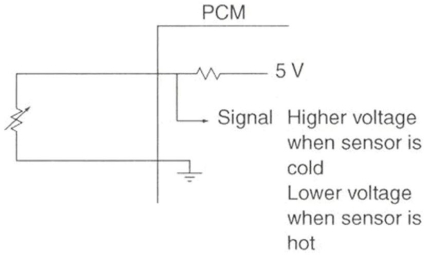
Technician A says that other temperature sensors that operate like the ECT include the transmission fluid temperature (TFT), and cylinder head temperature sensor. Technician B says that all temperature sensors increase in resistance as the temperature decreases. Which technician is correct?
(Multiple Choice)
4.9/5 (77)
(77) Why does the PCM monitor engine oil temperature on some vehicles?
(Multiple Choice)
4.9/5 (83)
(83) Technician A says that all temperature sensors are PTC devices that decrease in resistance as the temperature increases. Technician B says that some vehicle manufacturers use a stepped ECT circuit inside the PCM to broaden the accuracy of the sensor. Which technician is correct?
(Multiple Choice)
4.9/5 (92)
(92) 
Filters
- Essay(0)
- Multiple Choice(0)
- Short Answer(0)
- True False(0)
- Matching(0)