



 Chat with AI
Exam 13: Emotions, Stress, and Health

Exam 1: Introduction: Principles of Psychology100 Questions
Exam 2: Psychology As a Science165 Questions
Exam 3: The Neuroscience of Behavior163 Questions
Exam 4: Genes, Environment, and Behavior163 Questions
Exam 5: Developmental Psychology162 Questions
Exam 6: Sensation and Perception157 Questions
Exam 7: Consciousness164 Questions
Exam 8: Learning147 Questions
Exam 9: Memory163 Questions
Exam 10: Language and Cognition149 Questions
Exam 11: Intelligence151 Questions
Exam 12: Motivation and the Regulation of Behavior160 Questions
Exam 13: Emotions, Stress, and Health163 Questions
Exam 14: Personality166 Questions
Exam 15: Social Psychology164 Questions
Exam 16: Clinical Psychology162 Questions
Select questions type


According to the James-Lange theory, your psychological experience of fear, in reaction to the body sensation of a bear attacking you, is
(Multiple Choice)
4.9/5  (78)
(78) According to the _______, to feel less anxious before or during a test, you should smile.
(Short Answer)
4.9/5 (85)
(85) Devise a long-term, stressful scenario and then describe two positive and two negative ways to cope with it (i.e., to reduce stress).
(Essay)
4.9/5 (79)
(79) Though there is evidence from studies of animals to support the idea that early exposure to mild stress will make an individual better able to handle stress later in life, research on adverse childhood experiences in humans showed that
(Multiple Choice)
4.8/5 (80)
(80) Rather than rely purely on studies of words for emotional states to determine how many emotions humans experience, scientists have turned to studying
(Multiple Choice)
4.9/5 (91)
(91) Which of the following scenarios is supported by Bushman's research on aggressive behavior?
(Multiple Choice)
4.7/5 (87)
(87) The autonomic nervous system consists of two divisions, the _______ nervous system, which activates the body for action, and the _______ nervous system, which prepares the body for relax and recuperate.
(Short Answer)
4.9/5 (72)
(72) The sympathetic nervous system revs up the body, increasing heart rate, respiration, and blood pressure. How is this beneficial in the presence of danger?
(Essay)
4.7/5 (80)
(80) According to the Mayo clinic's recommendations for stress relief, which of the following is most likely to alleviate stress during final exam periods?
(Multiple Choice)
4.9/5 (80)
(80) Compare and contrast the "high road" and "low road" of affective processing in the brain.
(Essay)
4.8/5 (72)
(72) According to research described in the text, _______ is more likely to increase happiness than _______.
(Multiple Choice)
4.8/5 (86)
(86) A person who has grown increasingly unhappy and unable to perform well at work, maintain close friendships, and stay healthy is most likely suffering from
(Multiple Choice)
4.9/5 (76)
(76) According to Hans Selye, what is the order of stages in the general adaptation syndrome?
(Multiple Choice)
4.9/5 (92)
(92) Which of the following best supports the two-factor theory of emotion?
(Multiple Choice)
4.9/5 (79)
(79) In a frequently used classification scheme, eight basic human emotions are identified, consisting of opposing pairs of emotions. According to the information in the textbook, this model is based on
(Multiple Choice)
4.7/5 (74)
(74) During final exam period, a friend who is worried about her grades insists on staying up late to study night after night. What can you tell her about how doing so might affect her health?
(Essay)
4.7/5 (67)
(67) Refer to the figure below.
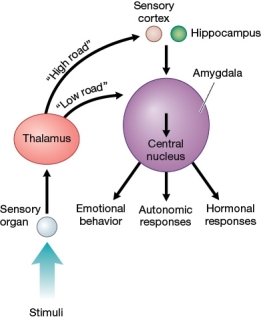 Which scenario would most likely result in stimuli taking the "low road" pathway to the amygdala?
 (Multiple Choice)
4.9/5 (76)
(76) When you feel content and relaxed, your _______ nervous system is likely active.
(Multiple Choice)
4.7/5 (79)
(79) Which dimension of stress refers to the actual events and stimuli that threaten us?
(Multiple Choice)
5.0/5 (87)
(87) Which discipline examines the psychological, social, and biological factors that influence physical and mental health?
(Multiple Choice)
4.9/5 (93)
(93) 
Filters
- Essay(0)
- Multiple Choice(0)
- Short Answer(0)
- True False(0)
- Matching(0)