



 Chat with AI
Exam 5: Determinants

Exam 1: Systems of Linear Equations57 Questions
Exam 2: Euclidean Space48 Questions
Exam 3: Matrices76 Questions
Exam 4: Subspaces60 Questions
Exam 5: Determinants48 Questions
Exam 6: Eigenvalues and Eigenvectors75 Questions
Exam 7: Vector Spaces45 Questions
Exam 8: Orthogonality75 Questions
Exam 9: Linear Transformations60 Questions
Exam 10: Inner Product Spaces45 Questions
Exam 11: Additional Topics and Applications75 Questions
Select questions type


A square matrix
 is called nilpotent if
 for some positive integer k. Prove that if
 is nilpotent, then
 .
is called nilpotent if
for some positive integer k. Prove that if
is nilpotent, then
. (Essay)
4.9/5  (65)
(65) Use determinants to find the area of the parallelogram with vertices (0, 0), (3, 2), (2, 3), and (-1, 1).
(Short Answer)
4.7/5 (73)
(73) Without solving for
 , use Cramer's Rule to find the value of
 in the linear system.
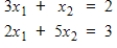
, use Cramer's Rule to find the value of
in the linear system.
(Essay)
4.8/5 (80)
(80)  and
 for the matrix
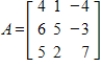
 is invertible, and
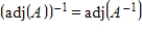 .
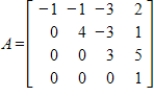
Compute the determinant of the given matrix A by using row operations to reduce to echelon form.
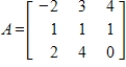
(Essay)
4.9/5 (82)
(82)  matrix. Then
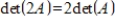 .
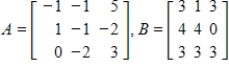
 and
 for the matrix
 ,
 ,
 , and
 where
 matrices A,
 .
 .
 , then at least one entry of A has value
 .
Find the area of T (D) where
 , D is the parallelogram with vertices (4, 2), (5, 3), (4, 6), and (3, 5), and

, D is the parallelogram with vertices (4, 2), (5, 3), (4, 6), and (3, 5), and
(Short Answer)
4.8/5 (78)
(78) Use determinants to decide if a unique solution exists for the linear system
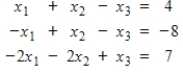
(Short Answer)
4.8/5 (84)
(84) Suppose the matrix
 results from a matrix A using the row operations
 and
 . Find
 .
results from a matrix A using the row operations
and
. Find
. (Essay)
4.7/5 (74)
(74) Compute the determinant of the given matrix A by using row operations to reduce to echelon form.
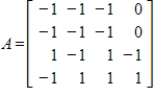
(Essay)
5.0/5 (74)
(74) Without solving for
 , use Cramer's Rule to find the value of
 in the linear system.
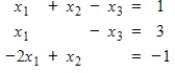
, use Cramer's Rule to find the value of
in the linear system.
(Essay)
4.8/5 (83)
(83) 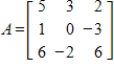
If applicable, use Cramer's Rule to find the unique solution of the given linear system. If Cramer's Rule is not applicable, explain why.
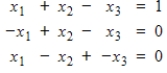
(Essay)
4.9/5 (74)
(74)  , then
 .

Filters
- Essay(0)
- Multiple Choice(0)
- Short Answer(0)
- True False(0)
- Matching(0)