



 Chat with AI
Exam 14: Intrapartum Fetal Surveillance

Exam 1: Maternity and Women's Health Care Today26 Questions
Exam 2: The Nurse's Role in Maternity and Women's Health Care24 Questions
Exam 3: Ethical, Social, and Legal Issues27 Questions
Exam 4: Reproductive Anatomy and Physiology24 Questions
Exam 5: Hereditary and Environmental Influences on Childbearing25 Questions
Exam 6: Conception and Prenatal Development24 Questions
Exam 7: Physiologic Adaptations to Pregnancy56 Questions
Exam 8: Psychosocial Adaptations to Pregnancy24 Questions
Exam 9: Nutrition for Childbearing53 Questions
Exam 10: Antepartum Fetal Assessment38 Questions
Exam 11: Perinatal Education27 Questions
Exam 12: Processes of Birth40 Questions
Exam 13: Nursing Care During Labor and Birth43 Questions
Exam 14: Intrapartum Fetal Surveillance45 Questions
Exam 15: Pain Management During Childbirth47 Questions
Exam 16: Nursing Care During Obstetric Procedures52 Questions
Exam 17: Postpartum Physiologic Adaptations36 Questions
Exam 18: Postpartum Psychosocial Adaptations29 Questions
Exam 19: Normal Newborn: Processes of Adaptation29 Questions
Exam 20: Assessment of the Normal Newborn26 Questions
Exam 21: Care of the Normal Newborn24 Questions
Exam 22: Infant Feeding35 Questions
Exam 23: Home Care of the Infant24 Questions
Exam 24: The Childbearing Family with Special Needs29 Questions
Exam 25: Complications of Pregnancy70 Questions
Exam 26: Concurrent Disorders During Pregnancy25 Questions
Exam 27: Intrapartum Complications37 Questions
Exam 28: Postpartum Maternal Complications44 Questions
Exam 29: High-Risk Newborn: Complications Associated with Gestational Age and Development23 Questions
Exam 30: High-Risk Newborn: Acquired and Congenital Conditions24 Questions
Exam 31: Family Planning25 Questions
Exam 32: Infertility12 Questions
Exam 33: Preventive Care for Women7 Questions
Exam 34: Women's Health Problems19 Questions
Exam 32: Infertility12 Questions
Exam 33: Preventive Care for Women7 Questions
Exam 34: Women's Health Problems19 Questions
Select questions type


Client is at 38 weeks' gestation, gravida 1, para 0, vaginal exam-4 cm, 100% effaced, +1 station vertex. What is the most likely intervention for this fetal heart rate pattern? 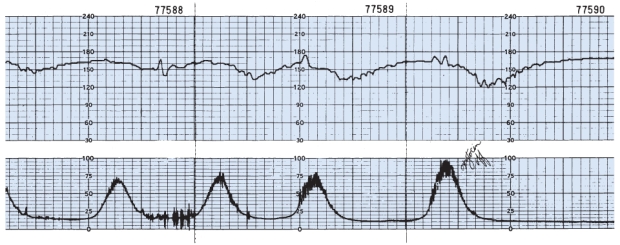
(Multiple Choice)
4.8/5  (71)
(71) Match each term with the correct definition.
-Late decelerations
(Multiple Choice)
4.9/5 (71)
(71) What is the most likely cause for this fetal heart rate pattern? 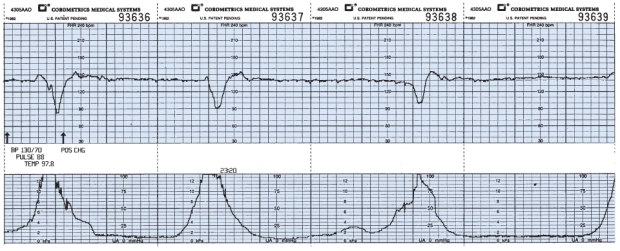
(Multiple Choice)
4.8/5 (82)
(82) Match each term with the correct definition.
-Early decelerations
(Multiple Choice)
5.0/5 (83)
(83) Which is the most appropriate method of intrapartum fetal monitoring when a woman has a history of hypertension during pregnancy?
(Multiple Choice)
4.8/5 (71)
(71) Which of the following therapeutic applications provides the most accurate information related to uterine contraction strength?
(Multiple Choice)
4.9/5 (85)
(85) The nurse recognizes that fetal scalp stimulation may be prescribed to evaluate the response of the fetus to tactile stimulation. Which conditions contraindicate the use of fetal scalp stimulation? (Select all that apply.)
(Multiple Choice)
4.7/5 (80)
(80) In which situation would it be appropriate to obtain a fetal scalp blood sample to establish fetal well-being?
(Multiple Choice)
5.0/5 (88)
(88) To clarify the fetal condition when baseline variability is absent, the nurse should first:
(Multiple Choice)
4.9/5 (95)
(95) Increasing the infusion rate of nonadditive intravenous fluids can increase fetal oxygenation primarily by:
(Multiple Choice)
4.7/5 (83)
(83) A nurse documents that the fetal heart rate variability is marked. This indicates that the range is greater than how many beats per minute? Record your answer as a whole number.
_____ bpm
(Short Answer)
4.7/5 (75)
(75) Proper placement of the tocotransducer for electronic fetal monitoring is:
(Multiple Choice)
4.9/5 (77)
(77) Why is continuous electronic fetal monitoring generally used when oxytocin is administered?
(Multiple Choice)
4.9/5 (74)
(74) Which can be determined only by electronic fetal monitoring?
(Multiple Choice)
5.0/5 (79)
(79) Which maternal condition should be considered a contraindication for the application of internal monitoring devices?
(Multiple Choice)
4.9/5 (81)
(81) The nurse is reviewing an electronic fetal monitor tracing from a patient in active labor and notes the fetal heart rate gradually drops to 20 beats per minute (bpm) below the baseline and returns to the baseline well after the completion of the patient's contractions. How will the nurse document these findings?
(Multiple Choice)
4.9/5 (76)
(76) In which situation would a baseline fetal heart rate of 160 to 170 bpm be considered a normal finding?
(Multiple Choice)
4.8/5 (85)
(85) When the deceleration pattern of the fetal heart rate mirrors the uterine contraction, which nursing action is indicated?
(Multiple Choice)
4.7/5 (78)
(78) Which nursing action is correct when initiating electronic fetal monitoring?
(Multiple Choice)
4.9/5 (84)
(84) 
Filters
- Essay(0)
- Multiple Choice(0)
- Short Answer(0)
- True False(0)
- Matching(0)