



 Chat with AI
Exam 10: Policy issues: resource taxes and climate change

Exam 1: Thinking like an economist89 Questions
Exam 2: Production possibilities and opportunity cost123 Questions
Exam 3: Market demand and supply123 Questions
Exam 4: Markets in action123 Questions
Exam 5: Elasticity of demand and supply124 Questions
Exam 6: Production costs123 Questions
Exam 7: Perfect competition125 Questions
Exam 8: Monopoly123 Questions
Exam 9: Monopolistic competition and oligopoly124 Questions
Exam 10: Policy issues: resource taxes and climate change124 Questions
Exam 11: Measuring the size of the economy124 Questions
Exam 12: Business cycles and economic growth124 Questions
Exam 13: Inflation and unemployment121 Questions
Exam 14: A simple model of the macro economy134 Questions
Exam 15: The monetary and financial system124 Questions
Exam 16: Macroeconomic policy I: monetary policy124 Questions
Exam 17: Macroeconomic policy II: fiscal policy123 Questions
Exam 18: International trade and finance133 Questions
Exam 19: Applying graphs to economics37 Questions
Select questions type


Under the emissions trading scheme,if lots of firms introduce emissions curbing technologies,the demand for permits:
(Multiple Choice)
4.9/5  (80)
(80) Emissions trading schemes require government to set the appropriate level of carbon tax
(True/False)
4.7/5 (76)
(76) Exhibit 10-3 Price and demand for permits data
 -In Exhibit 10-3,if the 'cap' is set at 80 permits,the resulting market price of permits is:
 (Multiple Choice)
4.7/5 (86)
(86) A New South Wales government subsidized the installation of household solar rooftop generators at the cost of:
(Multiple Choice)
4.7/5 (72)
(72) Exhibit 10-3 Price and demand for permits data
-In Exhibit 10-3,if the 'cap' is set at 80 permits,and the demand for the permits decreased by 20 units at each price level,the resulting price of permits is equal to:
-In Exhibit 10-3,if the 'cap' is set at 80 permits,and the demand for the permits decreased by 20 units at each price level,the resulting price of permits is equal to: (Multiple Choice)
4.9/5 (70)
(70) Exhibit 10-3 Price and demand for permits data
-In Exhibit 10-3,if the 'cap' is set at 100 permits,the resulting market price of permits is:
-In Exhibit 10-3,if the 'cap' is set at 100 permits,the resulting market price of permits is: (Multiple Choice)
4.9/5 (60)
(60) Which of the following is not a policy solution to reduce emissions?
(Multiple Choice)
4.8/5 (74)
(74) Which of the following statements is most likely to be true?
(Multiple Choice)
4.9/5 (75)
(75) Exhibit 10-2 Carbon emissions as an externality
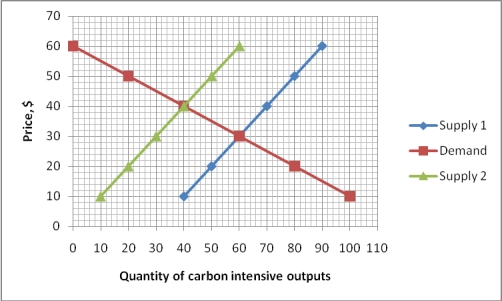 -In Exhibit 10-2,what is the quantity of carbon intensive outputs if the supply is 'Supply 1'?
 (Multiple Choice)
4.7/5 (71)
(71) Suppose a new emissions reducing production technology is installed.The price of emissions permits will:
(Multiple Choice)
4.9/5 (79)
(79) An example of a policy that is not designed to reduce the output of the activity creating the negative externality is a:
(Multiple Choice)
4.7/5 (82)
(82) Exhibit 10-2 Carbon emissions as an externality
-In Exhibit 10-2,what is the price of carbon intensive outputs if the supply is 'Supply 1'?
-In Exhibit 10-2,what is the price of carbon intensive outputs if the supply is 'Supply 1'? (Multiple Choice)
4.8/5 (82)
(82) Exhibit 10-4 The market for permits
 -In Exhibit 10-4,if the demand for permits is 'Demand 2',the price of permits is equal to:
 (Multiple Choice)
4.9/5 (70)
(70) 
Filters
- Essay(0)
- Multiple Choice(0)
- Short Answer(0)
- True False(0)
- Matching(0)