



 Chat with AI
Exam 7: Perfect competition

Exam 1: Thinking like an economist89 Questions
Exam 2: Production possibilities and opportunity cost123 Questions
Exam 3: Market demand and supply123 Questions
Exam 4: Markets in action123 Questions
Exam 5: Elasticity of demand and supply124 Questions
Exam 6: Production costs123 Questions
Exam 7: Perfect competition125 Questions
Exam 8: Monopoly123 Questions
Exam 9: Monopolistic competition and oligopoly124 Questions
Exam 10: Policy issues: resource taxes and climate change124 Questions
Exam 11: Measuring the size of the economy124 Questions
Exam 12: Business cycles and economic growth124 Questions
Exam 13: Inflation and unemployment121 Questions
Exam 14: A simple model of the macro economy134 Questions
Exam 15: The monetary and financial system124 Questions
Exam 16: Macroeconomic policy I: monetary policy124 Questions
Exam 17: Macroeconomic policy II: fiscal policy123 Questions
Exam 18: International trade and finance133 Questions
Exam 19: Applying graphs to economics37 Questions
Select questions type


Assume that the market equilibrium is 100 units at the price of $70.What is the price each firm can charge if each produces 10 units of output?
(Multiple Choice)
4.8/5  (80)
(80) If ATC = $20,AVC = $15,AFC = $5,MC = $15 and MR = $15,then a perfectly competitive firm should:
(Multiple Choice)
4.8/5 (80)
(80) Suppose that,in the long run,the price of feature films rises as the movie production industry expands.We can conclude that movie production is a/an:
(Multiple Choice)
4.8/5 (85)
(85) A constant-cost industry is an industry in which expansion of total output results in higher prices to consumers
(True/False)
4.8/5 (76)
(76) The long-run supply curve in a perfectly competitive increasing-cost industry is upward-sloping.
(True/False)
4.9/5 (67)
(67) Exhibit 7-6
 -Refer to Exhibit 7-6.If market price is $22,the firm should:
 (Multiple Choice)
4.8/5 (85)
(85) If a competitive firm cannot cover all of its costs,then it should shut down in the short run.
(True/False)
4.9/5 (78)
(78) Under perfect competition,which of the following are the same (equal)at all levels of output?
(Multiple Choice)
4.9/5 (73)
(73) Exhibit 7-7
 -According to Exhibit 7-7,given the short-run equilibrium of this firm,we would expect in the long run:
 (Multiple Choice)
4.8/5 (85)
(85) Exhibit 7-10 Long-run perfectly competitive industry
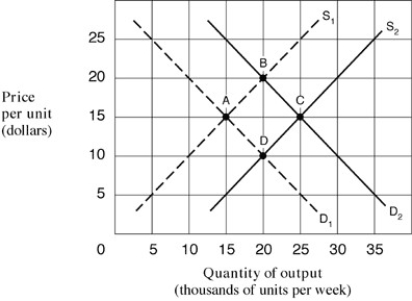 -Refer to Exhibit 7-10 and assume that a perfectly competitive industry is in long-run equilibrium at point A,and the demand curve shifts from D₁ to D₂.Which of the following is a part of the industry-adjustment process?
 (Multiple Choice)
4.8/5 (73)
(73) Assume the short-run average total cost for a perfectly competitive industry remains constant as the output of the industry expands.In the long run,the industry supply curve will:
(Multiple Choice)
4.9/5 (93)
(93) How long will the state of short-run equilibrium remain unchanged?
(Multiple Choice)
4.9/5 (92)
(92) In the short run,if a perfectly competitive firm is producing at a price above average total cost,its economic profit must be:
(Multiple Choice)
4.9/5 (72)
(72) If a firm's MR currently equals MC and product price = $24,AVC = $22 and ATC = $26,then in the long run this firm:
(Multiple Choice)
4.9/5 (90)
(90) In a constant-cost industry,input prices remain constant as:
(Multiple Choice)
4.9/5 (75)
(75) A firm operating in a perfectly competitive market is a price taker because:
(Multiple Choice)
4.8/5 (72)
(72) Exhibit 7-2 Cost per unit curves
 -As shown in Exhibit 7-2,the price at which the firm earns zero economic profit in the short run is:
 (Multiple Choice)
4.9/5 (82)
(82) 
Filters
- Essay(0)
- Multiple Choice(0)
- Short Answer(0)
- True False(0)
- Matching(0)