



 Chat with AI
Exam 14: Object-Oriented Data Modeling

Exam 1: The Database Environment and Development Process116 Questions
Exam 2: Modeling Data in the Organization103 Questions
Exam 3: The Enhanced E-R Model103 Questions
Exam 4: Logical Database Design and the Relational Model102 Questions
Exam 5: Physical Database Design and Performance103 Questions
Exam 6: Introduction to SQL105 Questions
Exam 7: Advanced SQL107 Questions
Exam 8: Database Application Development105 Questions
Exam 9: Data Warehousing103 Questions
Exam 10: Data Quality and Integration105 Questions
Exam 11: Big Data and Analytics102 Questions
Exam 12: Data and Database Administration110 Questions
Exam 13: Distributed Databases100 Questions
Exam 14: Object-Oriented Data Modeling105 Questions
Select questions type


A composition is an instance of class that is made up of more than one class.
(True/False)
4.9/5  (95)
(95) An association ________ is an association that has attributes or operations of its own.
(Multiple Choice)
4.7/5 (85)
(85) A graph of instances that are compatible within a class diagram is called an object diagram.
(True/False)
4.8/5 (82)
(82) A class that has no direct instances but whose descendants may have direct instances is called an abstract class.
(True/False)
4.8/5 (80)
(80) An association that has its own attributes or operations or that participates in relationships with other classes is called an association class.
(True/False)
4.7/5 (73)
(73) When an object is an instance of more than one class, this is known as multiple classification.
(True/False)
4.8/5 (79)
(79) A model of a real world application and associated properties are created in the:
(Multiple Choice)
4.9/5 (76)
(76) A class that has direct instances is called a(n) ________ class.
(Multiple Choice)
4.9/5 (83)
(83) ________ means that the same operation can apply to two or more classes in different ways.
(Multiple Choice)
4.9/5 (86)
(86) A class-scope attribute is an attribute of a class that specifies a value common to an entire class, rather than a specific value for an instance.
(True/False)
4.9/5 (70)
(70) According to the UML Notation Guide, the term disjoint means that a descendent may not be descended from more than one of the subclasses.
(True/False)
4.8/5 (81)
(81) An association role is the end of an association where it connects to a class.
(True/False)
4.9/5 (80)
(80) 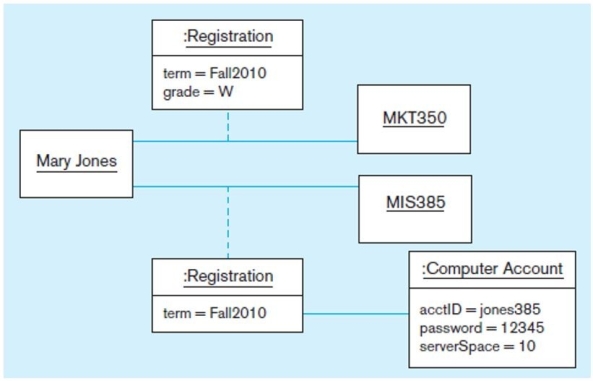
Object-oriented model objects differ from E-R models because:
(Multiple Choice)
4.8/5 (78)
(78) 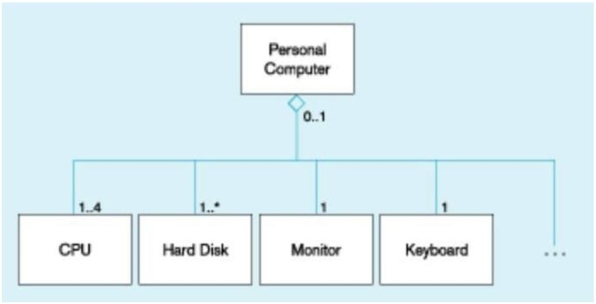
The end of an association where it connects to a class is called a(n):
(Multiple Choice)
4.8/5 (76)
(76) 
Filters
- Essay(0)
- Multiple Choice(0)
- Short Answer(0)
- True False(0)
- Matching(0)