



 Chat with AI
Exam 20: Stellar Evolution: The Life and Death of a Star

Exam 1: Charting the Heavens: The Foundations of Astronomy94 Questions
Exam 2: The Copernican Revolution: The Birth of Modern Science100 Questions
Exam 3: Radiation: Information from the Cosmos102 Questions
Exam 4: Spectroscopy: The Inner Workings of Atoms94 Questions
Exam 5: Telescopes: The Tools of Astronomy102 Questions
Exam 6: The Solar System: Comparative Planetology and Formation Models151 Questions
Exam 7: Earth: Our Home in Space102 Questions
Exam 8: The Moon and Mercury: Scorched and Battered Worlds112 Questions
Exam 9: Venus: Earth's Sister Planet98 Questions
Exam 10: Mars: A Near Miss for Life?102 Questions
Exam 11: Jupiter: Giant of the Solar System101 Questions
Exam 12: Saturn: Spectacular Rings and Mysterious Moons104 Questions
Exam 13: Uranus and Neptune: The Outer Worlds of the Solar System108 Questions
Exam 14: Solar System Debris: Keys to Our Origin114 Questions
Exam 15: Exoplanets: Planetary Systems Beyond Our Own74 Questions
Exam 16: The Sun: Our Parent Star113 Questions
Exam 17: The Stars: Giants,Dwarfs,and the Main Sequence107 Questions
Exam 18: The Interstellar Medium: Gas and Dust among the Stars100 Questions
Exam 19: Star Formation: A Traumatic Birth108 Questions
Exam 20: Stellar Evolution: The Life and Death of a Star107 Questions
Exam 21: Stellar Explosions: Novae,Supernovae,and the Formation of the Elements104 Questions
Exam 22: Neutron Stars and Black Holes: Strange States of Matter113 Questions
Exam 23: The Milky Way Galaxy: A Spiral in Space105 Questions
Exam 24: Galaxies: Building Blocks of the Universe106 Questions
Exam 25: Galaxies and Dark Matter: The Large-Scale Structure of the Cosmos104 Questions
Exam 26: Cosmology: The Big Bang and the Fate of the Universe101 Questions
Exam 27: The Early Universe: Toward the Beginning of Time110 Questions
Exam 28: Life in the Universe: Are We Alone?105 Questions
Select questions type


That brighter Sirius A weighs 3 solar masses,but the white dwarf Sirius B is only about one solar mass implies:

Free
(Multiple Choice)
4.9/5  (80)
(80) Correct Answer: Verified
B
In globular clusters,the brightest stars will be:
Free
(Multiple Choice)
4.8/5 (84)
(84) Correct Answer:Verified
VerifiedB
Describe the helium flash and why it occurs.
Free
(Essay)
4.9/5 (90)
(90) Correct Answer:Verified
VerifiedWhen the core of a red giant has reached a temperature of 100 million K,helium fusion can occur.With helium fusion the temperature rises but the pressure does not because it is the electron degenerate pressure which is holding up the core and it is independent of the temperature.Increased pressure would expand the core and cool it but this does not happen.The increase in temperature makes the fusion occur faster,which raises the temperature more and produces a runaway explosion of fusion known as the helium flash.
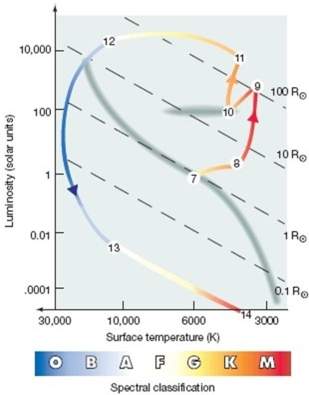 -Refer to the figure above.What is the name of the path between the points labeled 11 and 12?
 (Multiple Choice)
4.8/5 (89)
(89) The age of a star cluster can be determined by the luminosity of the main sequence turnoff into the giant stage.
(True/False)
5.0/5 (83)
(83) Relate hydrostatic equilibrium to the star's mass,composition,and evolution off the main sequence.
(Essay)
4.7/5 (90)
(90) How have Hubble images revised our view of the structure of planetary nebulae,and even the potential for the Sun to become one?
(Essay)
4.7/5 (78)
(78) When a low-mass star runs out of hydrogen in its core,it gets brighter.Why?
(Essay)
4.9/5 (82)
(82) Which stars in globular clusters are believed to be examples of mergers?
(Multiple Choice)
4.8/5 (85)
(85) Which of the following best describes the evolutionary track followed on the H-R diagram for the most massive stars?
(Multiple Choice)
4.7/5 (89)
(89) The most famous case of a more massive hot star orbiting with a more evolved but presently less massive red giant is the eclipsing binary:
(Multiple Choice)
4.8/5 (75)
(75) The "helium flash" occurs at what stage in stellar evolution?
(Multiple Choice)
4.8/5 (79)
(79) Give evidence that magnetism plays a role in planetary nebula formation.
(Essay)
4.8/5 (83)
(83) Describe what the internal structure of the Sun looks like,indicating what physical phenomena are occurring there.In what respects (internal structure,energy generation,etc.)does the internal structure of a high mass Main Sequence star differ from that of the Sun?
(Essay)
4.9/5 (83)
(83) When a star's inward gravity and outward pressure are balanced,the star is said to be:
(Multiple Choice)
4.7/5 (87)
(87)
-Refer to the figure above.What is the name of the path between the points labeled 13 and 14?
-Refer to the figure above.What is the name of the path between the points labeled 13 and 14? (Multiple Choice)
5.0/5 (79)
(79) The Main Sequence is the first stellar stage in which energy produced by ________ balances the energy lost by radiation from the surface of the star.
(Essay)
4.8/5 (86)
(86) 
Filters
- Essay(0)
- Multiple Choice(0)
- Short Answer(0)
- True False(0)
- Matching(0)