



 Chat with AI
Exam 20: Exchange Rates and the Macroeconomy

Exam 1: What Is Economics?227 Questions
Exam 2: The Economy: Myth and Reality150 Questions
Exam 3: The Fundamental Economic Problem: Scarcity and Choice250 Questions
Exam 4: Supply and Demand: An Initial Look308 Questions
Exam 5: An Introduction to Macroeconomics211 Questions
Exam 6: The Goals of Macroeconomic Policy207 Questions
Exam 7: Economic Growth: Theory and Policy223 Questions
Exam 8: Aggregate Demand and the Powerful Consumer214 Questions
Exam 9: Demand-Side Equilibrium: Unemployment or Inflation?211 Questions
Exam 10: Bringing in the Supply Side: Unemployment and Inflation?223 Questions
Exam 11: Managing Aggregate Demand: Fiscal Policy205 Questions
Exam 12: Money and the Banking System219 Questions
Exam 13: Monetary Policy: Conventional and Unconventional205 Questions
Exam 14: The Financial Crisis and the Great Recession61 Questions
Exam 15: The Debate over Monetary and Fiscal Policy214 Questions
Exam 16: Budget Deficits in the Short and Long Run210 Questions
Exam 17: The Trade Off between Inflation and Unemployment214 Questions
Exam 18: International Trade and Comparative Advantage226 Questions
Exam 19: The International Monetary System: Order or Disorder?213 Questions
Exam 20: Exchange Rates and the Macroeconomy214 Questions
Select questions type


If the dollar depreciates,both the aggregate demand curve and the aggregate supply curve shift inward.
(True/False)
4.9/5  (77)
(77) What effect did the decrease in the value of the dollar have on the U.S.trade deficit in the period from 2006 to 2009?
(Multiple Choice)
5.0/5 (87)
(87) A currency appreciation reduces aggregate demand and increases aggregate supply.
(True/False)
5.0/5 (64)
(64) Table 20-1
Suppose the economy of Macroland is described by the following:
C = 200 + .8DI (DI = disposable income)
I = 300 + .2Y − 50r (Y = GDP)
(r, the interest rate, is measured in percentage points. For example, a 9 percent interest rate is r = 9).
For this economy, assume that the Federal Reserve uses its monetary policy to peg the interest rate at
r = 5
G = 750
T = .25Y
X = 200
M = 150 + .2Y
Hint: DI = Y − T
-From Table 20-1,compute equilibrium GDP for Macroland.
(Multiple Choice)
4.7/5 (71)
(71) A rise in interest rates tends to contract the economy by appreciating the currency and reducing net exports.Provide the reasoning behind this conclusion.
(Essay)
4.9/5 (71)
(71) The U.S.trade deficits of the late 1990s were due primarily to low saving rates.
(True/False)
4.9/5 (90)
(90) Figure 20-6
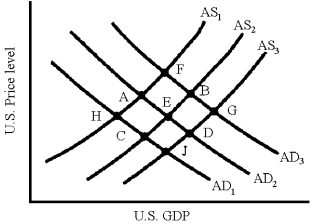 -In Figure 20-6,which of the following will cause a movement from equilibrium at point D to equilibrium at point B?
 (Multiple Choice)
4.8/5 (74)
(74) The combined effects of a fiscal contraction and a monetary expansion are
(Multiple Choice)
4.7/5 (86)
(86) Despite the monetary expansion of the 1992-2000 period,the inflation rate
(Multiple Choice)
4.8/5 (80)
(80) Define the following terms and explain their importance to the study of macroeconomics:
a.open economy
b.closed economy
c.budget deficits and trade deficits
d.international capital flows
(Essay)
4.9/5 (81)
(81) What important lesson did American economists learn in the 1980s and again in 2001-2003?
(Multiple Choice)
5.0/5 (83)
(83) A decrease in the price level in Japan will shift the U.S.aggregate demand curve outward.
(True/False)
4.7/5 (90)
(90) An economic boom in the United States would cause the aggregate demand curve in other countries to shift outward.
(True/False)
4.9/5 (83)
(83) An appreciation of the Japanese yen would shift the Japanese aggregate demand curve inward.
(True/False)
4.8/5 (85)
(85) 
Filters
- Essay(0)
- Multiple Choice(0)
- Short Answer(0)
- True False(0)
- Matching(0)